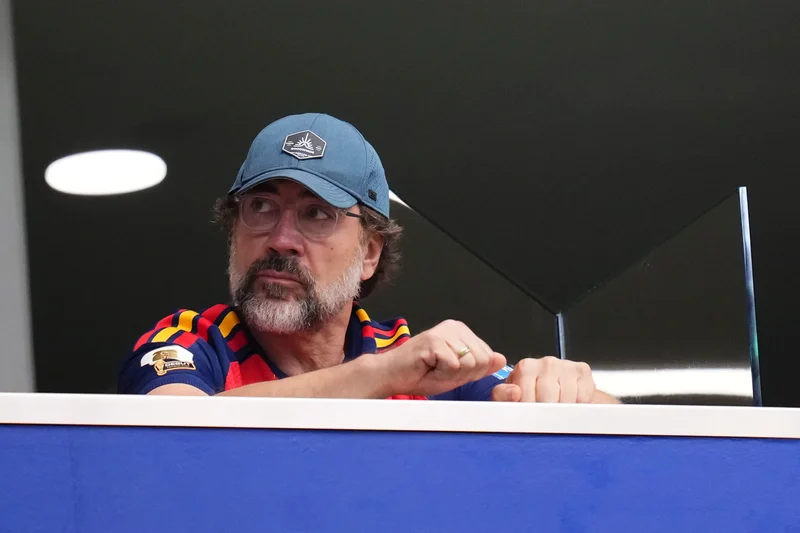
Controversy over the World Cup final between Spain and Argentina shows no sign of stopping. On Wednesday it was the Spanish singer Rosalía who apologized for a social media post that upset some people in Argentina, where she is scheduled to perform as part of a tour. On Thursday, it was Spanish actor Javier Bardem who felt the need to speak out after another controversy sparked by an interview in which he discussed the Sunday match.
It all began with a conversation between the actor and the journalist Mehdi Hasan for the outlet Zeteo, recorded a few hours after the New Jersey final. During the talk, Bardem discussed the political climate surrounding the game and whether the match could be seen as a symbolic reflection of the Israel–Palestine conflict: the actor criticized Argentine president Javier Milei’s support for Israeli prime minister Benjamin Netanyahu, whom Bardem described as a “war criminal.” Bardem said that this political attitude had influenced the atmosphere around the World Cup final, and argued that when a leader backs someone they consider responsible for a genocide, it is understandable that part of the public might be inclined to support the rival, in this case Spain.
Although Bardem himself emphasized during the interview that “political leaders do not represent their people” and expressly stated that “Milei is not all of the Argentine population,” versions circulated on social media and in several Argentine outlets claiming that the actor had accused the Argentine national team players of being “accomplices in a genocide in Palestine.”
The actor, who after the final celebrated Spain’s victory on his social networks, has now sought to reflect on the controversy generated by his remarks. “Because of what’s happening, I want to share this video about my words and about what I did not say and would never say,” the actor begins. “I said that I thought it was unfair to judge the Argentine national team for the attitudes of their president.”
“What I have never said is that Argentina is a xenophobic or racist country; that would never come out of my mouth,” he explains, before recalling that he has nothing but “a lot of affection, respect and admiration” for Argentina and listing how the country has influenced him “cinematically, as an actor, socially, politically and personally,” and noting that several of his closest people are Argentine. Bardem also stresses how a decontextualized interpretation can end up overshadowing the real words but, judging by the heated climate surrounding everything linked to that final, his is unlikely to be the last statement to leave controversy in its wake.