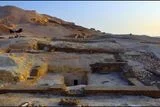
Among the mummies crowded into an ancient Egyptian tomb, a dog rested directly above a man and a woman. To archaeologist Jared Carballo-Pérez, the arrangement offered a possible trace of a bond people still share with animals today.
The burial was among nine burial groupings documented in chamber three of tomb TT 209 in the Theban Necropolis, an ancient cemetery across the Nile from Luxor.
According to a new study in Frontiers in Environmental Archaeology, people continued bringing their dead into the chamber from the Twenty-fifth Dynasty, between 754 B.C.E and 656 B.C.E., through the Ptolemaic period, when a line of Macedonian Greek rulers controlled Egypt from 305 B.C.E. to 30 B.C.E. As the chamber filled, later burials had to accommodate the bodies already there.
What initially resembled a crowded collection of mummies began to reveal a deliberate sequence once the team examined how the bodies touched, overlapped, and occupied the remaining space.
“The first clue came from the second layer of mummies, where the bodies placed above were already partly in contact with those below and occupied a relatively delimited area. It was not until we [analyzed] the stratigraphy and body relationships in detail, however, that the sequence became clearly structured rather than simply crowded,” Carballo-Pérez, first author of the study, told Discover.
An Ancient Egyptian Tomb Filled Over Centuries
In all, the researchers recorded 16 human mummies and one dog. A disturbed area elsewhere in the chamber held remains from at least four other people.
The earliest bodies lay apart in coffins with nets, amulets, and valuable goods stored in Phoenician amphorae, large ceramic transport jars. These objects point to wealth and high status.
By the end of the Twenty-fifth Dynasty and under Persian rule, new bodies filled gaps between earlier burials. Some had an arm folded inward, whereas earlier bodies generally had both arms at their sides.
Separate burials gave way to stacked bodies in two-thirds of the chamber’s burials. The layers still followed a recognizable order, preserving earlier occupants as each body was added.
A Mummified Dog Rested Above Two People
One burial from the Ptolemaic period in the chamber’s southeastern section stacked four human mummies with the dog. The group had no coffins, but the bodies were still carefully mummified. Upright jars, absent from earlier burials, may signal another change in ritual.
“Anthropologically, placing an animal so close to human burials can suggest some kind of meaningful relationship, although we cannot say exactly what that relationship was here,” Carballo-Pérez shared with Discover. “Personally, I find it moving because these human-animal connections are something we can still recognize today, but I try to keep that personal reaction separate from the scientific interpretation, which has to remain cautious.”
If the dog was not a companion, it may have represented a psychopomp, a spiritual guide believed to help the dead reach the afterlife.
Some later people were also buried with both arms crossed over the chest, a pose Egyptologists call the Osirian position because of its connection to Osiris, the Egyptian god associated with the dead and the afterlife. These details indicate that burial customs shifted over time rather than disappearing.
Finding Order Among the Crowded Dead
Photographs, sketches, and written notes recorded where each mummy lay in relation to the others and to the chamber around it. The team compared those records with the chamber’s stratigraphy, or the layers of material that had accumulated over time. Past flooding, fires, and repeated visits had shifted debris, making parts of the burial sequence difficult to reconstruct.
Carballo-Pérez hopes the same approach will help researchers reconsider other crowded burial spaces.
“If excavation and analysis pay close attention to microstratigraphy, body position and the relationships between individuals, deposits that initially look disordered may reveal a much clearer sequence of use and change,” Carballo-Pérez concluded.
Reconstructed in sequence, the chamber shows how people responded to the dead who were already there.
Read More: Newly Discovered Saqqara Tombs Preserve a 3,000-Year-Old Family Record
Article Sources
Our writers at Discovermagazine.com use peer-reviewed studies and high-quality sources for our articles, and our editors review for scientific accuracy and editorial standards. Review the sources used below for this article:
- This article references information from a study published in Frontiers in Environmental Archaeology:From individualized mummies to collective accumulations: an archaeothanatological analysis of funerary reuse in Theban Tomb 209 (Twenty-Fifth Dynasty–Ptolemaic Egypt)