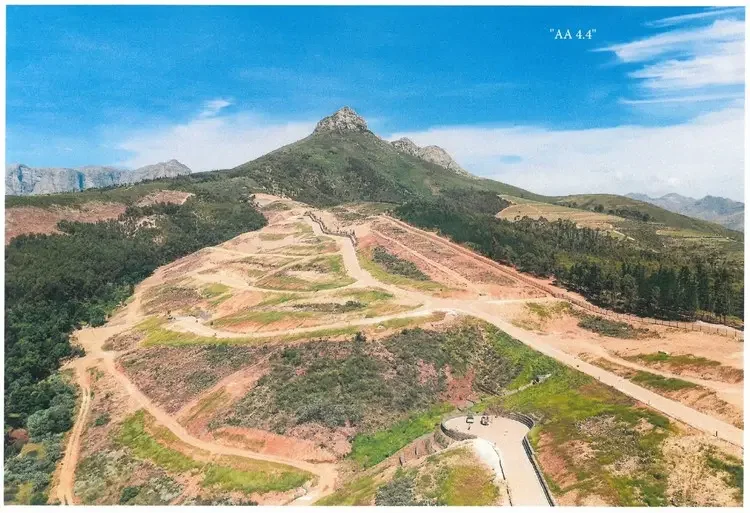
The Botmaskop dispute in Stellenbosch is often described as a technical matter of authorisations and commencement. But its deeper lesson lies in the widening gap between what authorities intend, what they write and what the public can reasonably understand. The familiar warning on the London Underground, Mind the Gap, captures the problem precisely. In South African land‑use governance, the gap is not between train and platform; it is between legal procedure and democratic comprehension. And into that gap, communities keep falling.
In 2003, the province approved a small boutique hotel on less than one hectare of mountainside. Years later, that modest authorisation was treated as the legal foundation for a seventy‑unit residential estate. No public document explained how a tourism facility became continuous with a gated development. Interested and Affected Parties were left to reconstruct a paper trail that should have been made legible from the outset. Participation was perceived as formally complete but communicatively hollow. In truth, it was never complete at all.
Legislation, if it is to be the enabling tool it is supposed to be, requires accessibility. The Spatial Planning and Land Use Management Act demands meaningful public participation and intelligible documentation. The Municipal Systems Act requires municipalities to provide information in a manner that promotes democratic involvement. The National Heritage Resources Act requires heritage impacts to be communicated clearly enough for communities to understand what is at stake. The Promotion of Administrative Justice Act requires administrative action to be procedurally fair, which includes comprehensibility. The Constitution itself requires public administration to be transparent and accountable. On paper, the system is rich with obligations to communicate clearly.
But legislation cannot function if the language through which it operates obscures rather than reveals meaning. Botmaskop is a textbook case of meaning falling through the cracks. The shift from hotel to estate was processed through inherited wording, allowing consequential changes to disappear inside administrative language. A second round of public participation, which should have been triggered by the substantive change in land use, simply never happened. Because it did not happen, the public was denied the very tools that would have made the development intelligible. The system needs adjustment in the interests of democracy and the required intervention is linguistic as much as legal.
This is where Systemic Functional Linguistics (SFL), associated with M. A. K. Halliday and later developed by scholars such as Martin and Rose, becomes useful. Halliday’s central insight is that language does not merely transmit information; it performs social work. Institutional texts make meaning through three interlocking dimensions: field, tenor and mode. Field refers to what is happening and what activity is being represented. Tenor refers to who is involved, what roles they occupy and how authority is distributed between them. Mode refers to how the message is delivered, including whether it explains, records, instructs, justifies or merely files away a decision. Together these dimensions constitute register: the patterned way a text sounds, functions and becomes recognisable within a particular social setting.
When field, tenor and mode are aligned, public communication can do its democratic work. When they are misaligned, participation becomes hollow. Botmaskop illustrates this drift with unusual clarity. The field changed dramatically, from a small tourism facility to a substantial residential estate, yet the official texts held the field steady by treating the later development as continuous with the earlier authorisation. The tenor fragmented across heritage authorities, planners, environmental consultants, municipal officials and developers, each speaking from a different institutional position and with different degrees of accountability. The mode remained stubbornly administrative, even when the situation demanded explanation, narrative and justification. The public did not receive a continuity statement explaining the changed field, a decision map clarifying the tenor, or plain‑language documents adjusting the mode. Without alignment across these dimensions, I&APs could not see what was happening, let alone respond to it. As things turned out, in the latter phase of the development they were not invited to.
This failure is not confined to Stellenbosch. It reverberates across the Boland, where unsuitable development is increasingly pushed through linguistic gaps that legislation leaves open. Heritage authorities speak in the language of significance and cumulative impact. Planning officials speak in the clipped vocabulary of zoning and permissible use. Environmental consultants speak in the register of impacts and mitigation. Developers speak in the register of continuity and entitlement. Courts speak in the register of procedural certainty. These registers rarely meet and almost never translate into one another. The result is predictable: those who wish to defend the Boland’s cultural landscapes are not merely disadvantaged; they are pushed toward the edge of the platform as the train accelerates.
The consequence is cultural as much as procedural. The Boland’s mountains, vineyards, heritage sites and rural character have been shaped over generations by communities who built its culture, its economy and its sense of place. Yet these communities increasingly find themselves displaced by what can only be described as a zero‑culture: developments that arrive without history, rootedness or any relationship to the landscapes they occupy. Developers exploit linguistic gaps in legislation to present discontinuity as continuity, impact as mitigation, and transformation as permissible use. They use administrative language to smooth over cultural rupture. They rely on the fact that the public cannot intervene meaningfully when the field is obscured, the tenor fragmented and the mode reduced to procedural minimums. In this way, those who contributed to the Boland’s cultural richness are being pushed out by developments that contribute nothing comparable in return.
SFL offers a way to repair what legislation alone cannot. An SFL‑informed public‑participation system would reset the field whenever a development changes in substance, map the tenor so that institutional roles and accountability become visible, and adjust the mode so that public‑facing documents are intelligible before consultation begins. It would require continuity statements that explain change, decision maps that show institutional relationships, and plain‑language reviews that ensure comprehension. Such reforms would not eliminate conflict, but they would make it harder for consequential changes to be absorbed into inherited wording. They would make it harder for developments to slip through linguistic cracks. They would make it harder for communities to discover too late that the decisive meanings were settled elsewhere.
Botmaskop shows that governance failures can be linguistic before they are cultural or political. If authorities are serious about public participation, they must mind the language as carefully as they mind the law. Without continuity statements, decision maps and linguistic review, the democratic promise of participation will remain formal rather than real. And the Boland will continue to be reshaped by meanings settled out of sight, out of reach and out of the public’s hands. Those who built its culture will not fall into the gap; they will continue to be pushed under the train.
When communities repeatedly encounter misalignment between what authorities intend, what they write and what the public can reasonably understand, they will inevitably ask who allowed such gaps to persist. They will point to the political actors who tolerated a system in which their own voters were never given the linguistic tools to participate meaningfully. Once the victims of this communicative catastrophe recognise it as a blight on democracy, their response may be forceful. But by then, the damage will likely be entrenched. Democratic reaction tends to arrive only after democratic erosion has already taken root — when the gaps have widened, the register has collapsed and the public realises too late that the decisive meanings were settled out of sight and out of reach.
Janine Maske is a language practitioner, lecturer and author with a PhD in Afrikaans and Dutch. She lives on a small farm in Wellington and has defended the integrity of the Blouvlei for more than twenty-five years. Her work focuses on the linguistic dimensions of governance, where institutional language shapes — and often distorts — public participation and accountability.