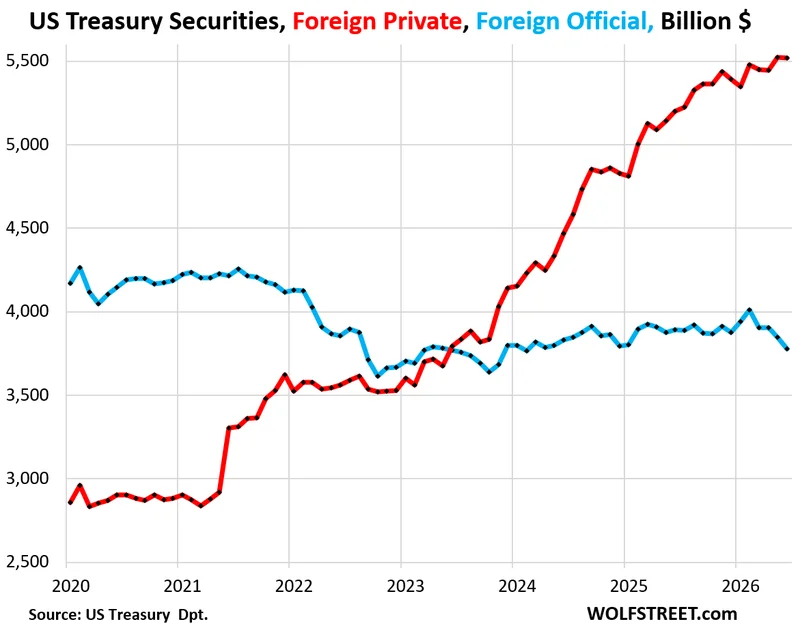
But private-sector holdings remained at huge record, with the big seven financial centers leading the charge.
By Wolf Richter for WOLF STREET.
Foreign holders shed $72 billion of Treasury securities in June, bringing their holdings down to $9.30 trillion, according to Treasury data released this afternoon.
The entities that shed Treasuries were “foreign official” holders, such as central banks and government entities, see Japan: Combined, they shed $70 billion in June. Since February, they have shed $233 billion, bringing their holdings down to $3.78 trillion, the lowest since February 2024 (blue line in the chart).
But “foreign” private-sector entities kept their Treasury holdings essentially unchanged at the record $5.52 trillion (red line in the chart). They include US companies with offshore accounts, such as Apple in Ireland, and US hedge funds domiciled in the Cayman Islands that engage in the basis trade and hold the Treasuries that form the base for the basis trade in the Cayman Islands.
Japan reduced its Treasury holdings by $26 billion in June. Since February, it reduced its holdings by $123 billion.
Japan has attempted to prop up the yen multiple times in recent years, including twice this year, most recently the big kahuna joint US-Japan intervention at the beginning of August. Each time, Japan sold dollars and bought yen in the foreign exchange markets.
To get these dollars, Japan’s authorities can do several things, including:
- Let Treasury securities mature without rolling them over, or selling some outright, and set aside the USD cash while preparing for the next yen intervention.
- Unwind their overnight reverse repos at the Fed as needed.
The Fed has $358 billion in “foreign official” reverse repos on its balance sheet. This is essentially USD cash that the foreign central banks have put on deposit at the Fed, and the Fed owes them this USD cash. The foreign central banks can unwind the reverse repos to cash out the USD in the morning if needed (foreign official reverse repos, like the other reverse repos, are a liability on the Fed’s balance sheet, not an asset).
The big drops in Japan’s holdings in 2022, in 2024, and in 2026 in the chart above roughly line up in advance to Japan’s big yen interventions as Japan was shedding Treasuries – likely by not rolling over maturing securities – to prepare for the interventions ahead of time. Then later, it added back some Treasuries.
The interventions (blue) require sudden selling of dollars and buying of yen in large enough a quantity to at least temporarily move the market. To get this large quantity of USD cash, Japan needs to prepare for it, such as by not rolling over maturing Treasury securities in the weeks and months ahead of the intervention:
Mainland China and Hong Kong combined shed $42 billion in June and $84 billion over the 12-month period, continuing a long methodical process:
Seven of the largest holders are financial centers. Combined, their Treasury holdings dipped by $11 billion in June, from the record in May, to $3.23 trillion. They account for about 35% of all foreign holdings!
They include in order of magnitude of their holdings: The United Kingdom, or more precisely the City of London, the largest financial center in the world; the Cayman Islands where US hedge funds are domiciled; Belgium, home of Euroclear; Luxembourg; Ireland; Switzerland; and Singapore.
Some of them added to their holdings, other shed holdings. But they don’t necessarily signify foreign attitudes and concerns about US Treasuries. And there is certainly no lack of interest in Treasuries at these financial centers:
Japan, Mainland China & Hong Kong, and the seven financial centers combined account for 57% of total foreign holdings of US Treasuries.
Other major holders, and changes in June:
- Canada: $460 billion, +$24 billion.
- France: $390 billion, -$3 billion.
- Norway: $203 billion, -$4 billion.
- India: 186 billion, + $5 billion.
- Brazil: $168 billion, unchanged.
- Saudi Arabia: $142 billion, +$2 billion.
- South Korea: $135 billion, +$3 billion.
- UAE: $115 billion, -$4 billion
- Israel: $111 billion, -$7 billion.
**What was not a factor in June: **
Market value of Treasury securities. These Treasury holdings are valued at market value. So in months when long-term Treasury yields rise, the market value of Treasuries falls, and this will cause those holdings to fall, even without foreign holders changing anything.
In other months, when long-term yields fall, market value of Treasuries rise, and those foreign holdings rise even if holders don’t change anything.
But in June, long-term Treasury yields ended the month about where they’d started it, with the 10-year Treasury yield at 4.45% at the end of May and at the end of June. So the market value of long-term Treasuries changed very little from the end of May to the end of June. And market value was not a factor.
Enjoy reading WOLF STREET and want to support it? You can donate. I appreciate it immensely. Click on the mug to find out how: