A bill returning more than 3000 hectares to Māori in Te Tauihu has unanimously passed its third and final reading.
The Te Here ā Nuku (Nelson Tenths) Bill aims to settle a land dispute that has gone on for close to two centuries and will see 3068 hectares, including the Kaiteriteri Recreation Reserve and part of the Abel Tasman Great Walk, returned to its original owners, with a $420 million compensation payment.
In the 1830s, Māori in Te Tauihu were promised that, if they sold 151,100 acres (61,148ha) of land to the New Zealand Company, they could keep one-tenth, but instead received fewer than 3000 acres (1214ha), and the agreement to reserve the land was in part-payment for the company's purchase of the land.
Then, in 1845, a Crown grant stated a tenth of all land used for the Nelson settlement - plus pā, wāhi tapu, urupā and cultivations owned by the whānau and hapū - would be reserved in a trust for the customary owners, but this did not happen. This is known as the Nelson Tenths.
The descendants of those Māori have fought for the return of their land ever since, notably Rore Stafford, who has been in and out of court over the issue for decades.
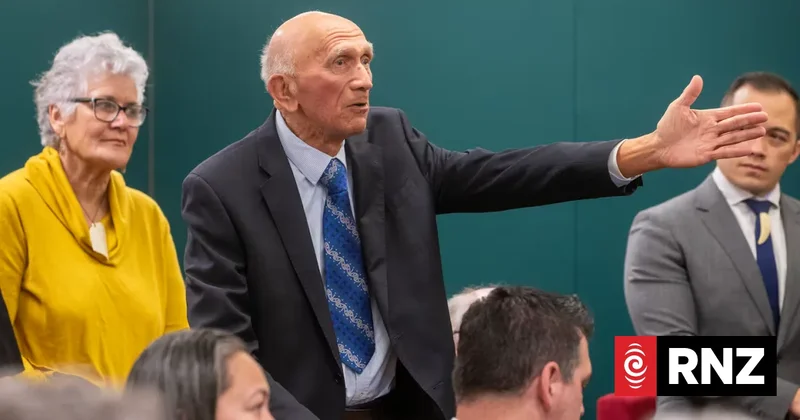
Stafford joined his whānau, descendants and members of the Te Here-ā-Nuku Trust in the public gallery to witness the bill pass its final reading on Tuesday.
Giving his speech in the house, Attorney-General Chris Bishop said New Zealand's "colonial government" failed to keep the promises it made to the land's customary owners.
"This was contrary to the rule of law, respect for property rights, and the law of trust and equity." he said.
"While the agreement and this bill are about realising the original promise of the Nelson Tenths, today, the Crown can look beyond the ideas of our colonial predecessors.
"The historic arrangement of the Crown holding land for the benefit of customary owners reflects a dated paternalism from the 19th century. In 2026, we are pleased for the trustees to take the title and responsibility for their own land."
Bishop said seeing the bill pass its final reading represented Parliament at its "best" and the government was proud to resolve it on behalf of the Crown.
"It's Parliament acting at its best and I think we could all do with a bit more of that.
"The fact that the Crown can now enjoy a moment of pride at this stage of a long and sometimes bitter history of the Nelson Tenths is a great credit to two things - the dignity, humility and persistence of Mr Stafford and the customary owners, and secondly, the capacity of New Zealand, with our systems of law and our government, to genuinely look to the wrongs of the past and vindicate rights in the present, and forge a just and durable future."
Nelson MP Rachel Boyack began her speech with a waiata, before saying that the passing of the bill was a reminder that "justice can take far too long".
"The fact that this issue has persisted across generations speaks to the importance of governments being willing to confront historical wrongs and work alongside communities to resolve them," she said. "The story of the Nelson Tenths is ultimately a story of endurance.
"It is a story of people who never gave up on what was promised to their tūpuna. It is a story of communities holding fast to their history, their identity and their rights."
Te Tai Tonga MP Tākuta Ferris said the passing of the bill was not only important for the people of Te Tauihu, but all Māori.
"The public won't quite understand that this settlement isn't just another settlement and that this settlement actually doesn't have anything to do with Te Tiriti o Waitangi," he said. "This settlement is about this house upholding the depth and breadth of its own law, which it has managed to ignore in this case for 180-plus years.
"Our young people, you remember what happened here... remember that you were here, that you were here with your kuia, that you were here with your koroua and that this example that has been achieved today is an example, not only for us, but for every iwi, hapu, whānau [and] marae across the country."
The bill will now be sent to the governor-general to receive royal ascent.
The whānau gathered in the public gallery concluded the bill reading with a waiata - Ka Pioioi.