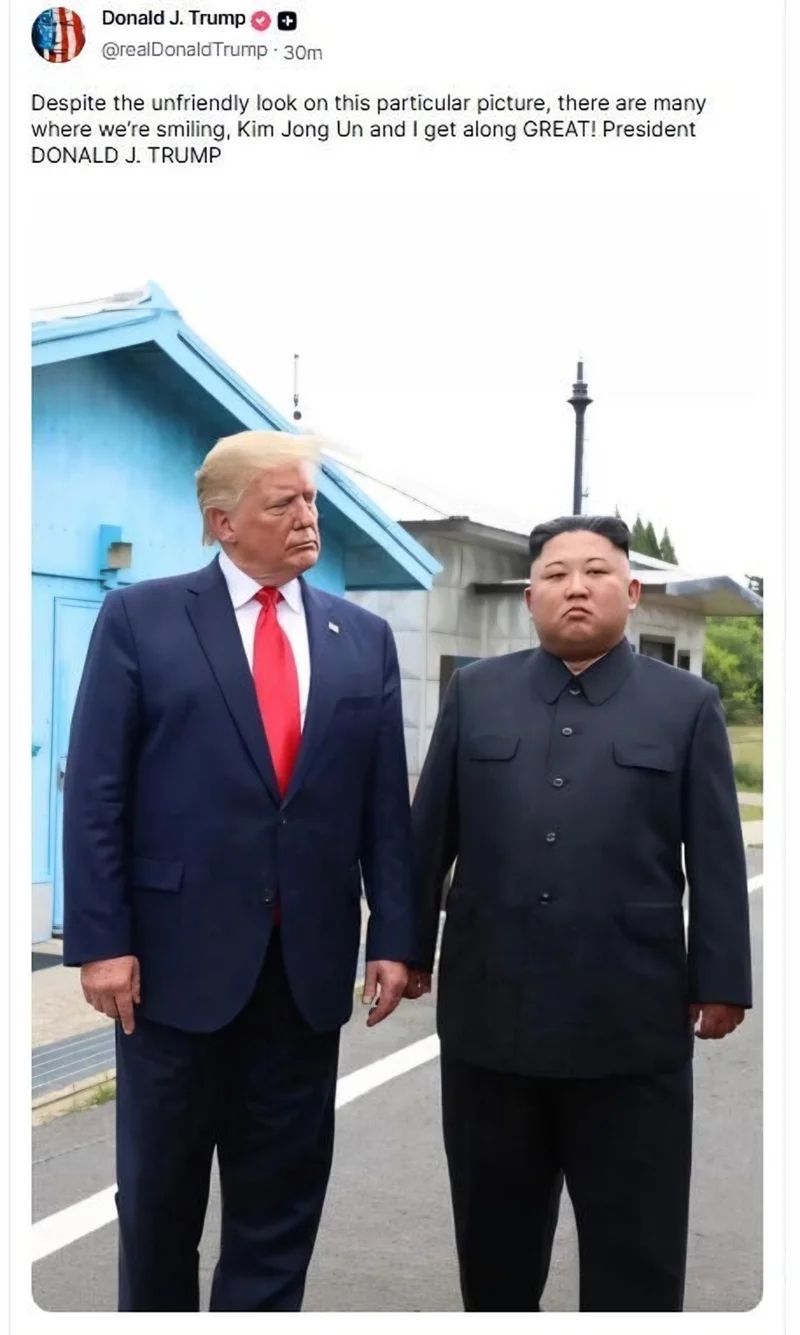
U.S. President Donald Trump's social media post Sunday announcing that he ordered the Pentagon to "substantially reduce" joint South Korea-U.S. military drills, came on the morning of the first day of the Ulchi Freedom Shield joint exercises.
"These exercises are not only costly ... but send a signal that is totally inappropriate and hostile, to a Country that, as long as Donald J. Trump has been President, has been unthreatening and respectful," Trump wrote on his Truth Social site.
The comments were widely interpreted as a signal that Trump was seeking a meeting with the recalcitrant North Korean leader Kim Jong-un, whom he has met three times during visits in Singapore, Hanoi and at Panmunjeom.
On Tuesday, when asked by White House journalists why Kim had not responded to his efforts to reengage, Trump responded, "He has." But because Trump did not provide additional details, it is hard to determine what and when the response from the North came and in what fashion.
Trump's position toward Seoul has made trade negotiations between the two countries a delicate dance. But Trump's latest comments on what is a sensitive and critical aspect of the South Korea-U.S. alliance point to a challenge Seoul will need to aggressively tackle.
Faced with the quagmire of the Iran war and looming midterm elections, the U.S. president seems to be seeking a political win through another meeting with the North Korean leader. Trump is likely also wary of the growing military ties between North Korea and Russia, which could be slowed through friendly relations with Kim.
Nevertheless, the U.S. threatening to scale back the joint drills invariably puts pressure on South Korea and injects a sense of urgency about the state of the alliance. While the annual exercises had previously been reduced after the Trump-Kim summit in Singapore in 2018, the timing of Trump's comments makes navigating the relationship between South Korea and the U.S. all the more sensitive.
Cheong Wa Dae on Monday reiterated that the two countries continue to coordinate on joint military posture and military drills. The presidential office also expressed hope that friendly ties between North Korea and the U.S. would lead to dialogue and open discussions to further peace and stability on the Korean Peninsula. It added that Seoul was considering contributing to U.S. efforts in Iran. In the same social media post about reducing the number of drills, Trump wrote that South Korea has refused the U.S. request to join its efforts to denuclearize Iran, likely prompting Cheong Wa Dae's response.
Trump has frequently voice his dissatisfaction with allies and other partner nations for not joining the U.S. war in Iran. But for him to link the South Korea-U.S. alliance and its joint military drills in statements about cost-effectiveness and the war in Iran comes across as transactional and disrespectful. The alliance between Seoul and Washington, even as a new geopolitical landscape is being formed, has long been the linchpin of U.S. strategy in Asia.** **
A U.S. president willing to engage with North Korea for peace on the peninsula should be welcomed. President Lee Jae Myung in his Liberation Day speech expressed a more forward-looking vision of Korean peace, inviting the related nations — without specifically naming them — to meet for talks to bring end to the hostilities between the two Koreas. Such efforts would necessarily involve China and U.S., making Trump's efforts at securing a meeting with the North Korean leader in line with South Korea's goals.
The haphazard style of Trump's comments, which likely came without any prior discussion or notice to Seoul, highlights that gaps in communication between Seoul and Washington indeed exist. Coincidentally, Industry Minister Kim Jung-kwan is on yet another U.S. visit — his second in just three weeks — as pressure from the U.S. on trade grows. Speaking in the U.S., the industry minister noted that the two countries need to work details of a $200 billion investment plan, which is part of the $350 billion investment agreed on last year in return for a 15 percent U.S. tariff on South Korean imports.
As past experiences have shown, Trump's often sudden and unpredictable changes in position on security and trade — even with allies — have led to deals. At the same time, his actions are gradually raising concerns about the strength of the alliance, which has endured for more than seven decades. While it primarily serves to deter North Korean provocations, it is also increasingly adapting to broader U.S. interests, including maintaining peace and stability around Taiwan. Undermining trust in such a long-standing alliance or alienating a key ally would serve neither Seoul nor Washington’s interests.