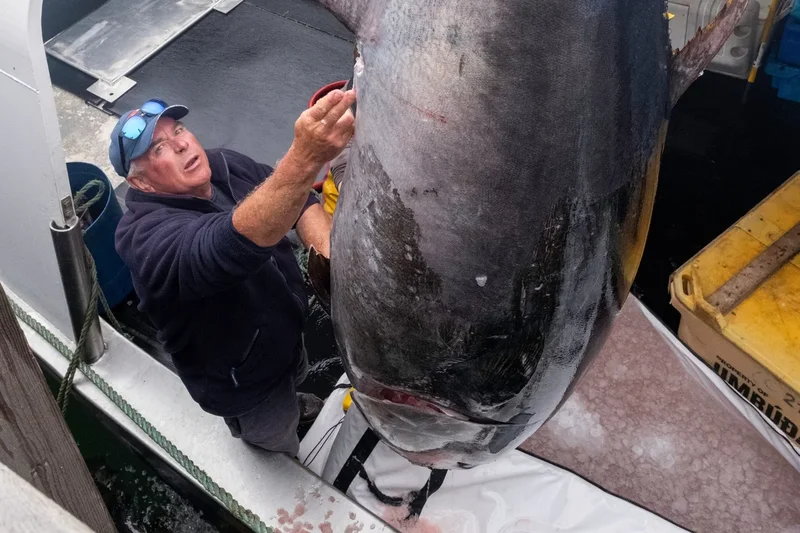
Anglers and conservationists are heralding the first bluefin tuna fish to be caught and landed in the North Sea for almost 90 years.
The huge fish, that weighed 746lbs (53sts) was landed at Whitby, North Yorks, the famous fishing port that was once a mecca for big game fishing in the 1950s,
Whitby still holds the long-standing British record for a bluefin tuna on rod and line; a 851lbs monster caught in 1933.
Hollywood stars like Clark Gable and David Niven were drawn to the area for the chance to catch the enormous 'Tunny' fish.
But due to overfishing of herring stocks the big game species disappeared from the North Sea in the 1960s.
Over the last 10 years they have returned in huge numbers to the waters of the south west coast where there is now a thriving and sustainable fishery for them.
Under strict Defra rules, a handful of fishing vessels are granted an annual licence to catch and land a small quota of bluefin tuna which they can sell to fish markets for thousands of pounds.
The waters off Devon and Cornwall are teeming with Tunny, and now they appear to have returned in great number to the North Sea.
The crew of the Whitby fishing vessel Dominator caught the whopping specimen which is thought to be the first bluefin tuna landed in the area since 1939.
Whitby photographer Glenn Kilpatrick was there to witness its arrival.
He said: "A truly enormous Atlantic Bluefin Tuna, or Tunny as these fish were always traditionally known here, was landed at Whitby.
"I watched Dominator return, sitting noticeably heavy to one side with the weight of the catch aboard.
"The live weight was calculated at 746.54lbs. That is one seriously big fish.
"The crew were understandably pleased with their fish. I'm told the fish will now be sold to restaurants here in the UK.
"More importantly from a local history point of view, I believe this may be the first Tunny landed at Whitby since 1939.
"These giant fish were present in the North Sea from at least the 1800s and became particularly famous here during the great Tunny fishing era of the 1930s.
"By the 1950s they had largely disappeared as the North Sea ecosystem changed dramatically and herring stocks collapsed through overfishing.
"Herring stocks suffered catastrophic declines during the twentieth century, but after decades of management they have recovered substantially.
"That has not gone unnoticed by the wildlife around the Yorkshire coast.
"We now regularly see Minke Whales, Humpback Whales and several species of Dolphin.
"Basically, if you protect the bottom of the food chain and allow the food to be there, everything further up gets an opportunity to flourish."
The University of Exeter has been monitoring the return of bluefin tuna stocks to the North Sea which has included tagging them.
Dr Lucy Hawkes, of the University of Exeter, is leading the research and said: "Bluefin tuna are supposed to be in our waters and used to be incredibly important to this region.
"The fact they’re back has been thanks to some careful and judicious management of fisheries.
"Bluefin tuna are also top predators who can only be in these waters if the ecosystems underneath them are healthy.
"Essentially their presence is a good way of signalling your waters are doing well, but we have no idea where they’ve come from – which is why tagging is so important."
Since 2018, researchers have tagged 165 bluefin tuna from the south west coast, Wales and Jersey.
But they say the fish found off the north east coast are considerably larger and may be genetically distinct from those already tagged.
The tagging data has revealed migration routes into the Mediterranean for spawning before returning north for the British summertime.