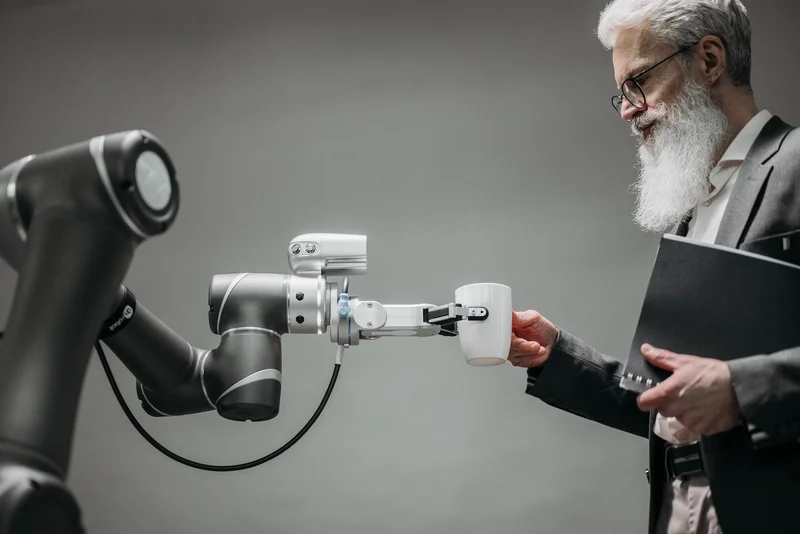
Machine learning and AI are helping businesses with both a national and international distribution of offices to collaborate effectively with one another, eliminating age-old inefficiencies and supporting stronger large-scale project management.
Although machine learning (ML) is a subset of artificial intelligence, it’s set to be a driving force in transforming the way teams communicate and delegate tasks to one another in the years ahead, and fresh use cases are emerging every day.
The ML industry is set to expand at a significant pace. Although the global machine learning market size was valued at $47.99 billion in 2025, it’s expected to grow at a CAGR of 26.7% to reach a
The technology helps businesses connect separate offices frictionlessly by enabling new innovations like real-time language translation, automated meeting summaries, and intelligent cross-office knowledge sharing, as well as bridging more complex geographical communication gaps to improve the performance of distributed teams.
With this in mind, let’s take a deeper look into some of the key emerging use cases that underline the revolutionary potential that ML holds in enhancing collaboration at scale:
Closing Communication Gaps
If you’re a business that has offices spanning the globe, language barriers could be a hurdle to overcome when it comes to fast collaboration.
Machine learning can assist real-time translation techniques to empower more offices to conduct meetings despite these communication barriers. With the help of language processing models, it’s possible to instantly translate speech and text throughout different regional offices.
Google has already incorporated AI into its Translate tool to deliver live conversational translations that can help to change the way we collaborate in the future.
The use of ML means that Google can lean on the advanced reasoning and
Machine learning can also close communication gaps through smart scheduling, where algorithms can analyze multiple time zones and staff availability to schedule meetings at the best possible time for all participants, no matter where they are in the world.
Intelligent Knowledge Sharing
Other intelligent tools like Microsoft Copilot and Zoom AI Companion can support collaboration throughout businesses in a way that provides invaluable insights as soon as a meeting, call, or conversation has been completed.
They can transcribe calls, extract action items, and generate instant summaries for staff across different offices.
Because ML works seamlessly with natural language processing (NLP), it’s easy for the technology to scan and
This allows all users to easily gain access to summaries of either conversations or chat messages into brief and actionable points. For staff in different time zones logging onto the software at a later time, sifting through information won’t be nearly as time-consuming.
Machine learning tools can also automatically update shared project boards and track deadlines without manual handoffs.
Holistic Project Overviews
Machine learning can also work wonders when it comes to task delegation, with smart algorithms capable of studying the project histories of employees in an unbiased manner to autonomously highlight the individuals who are best positioned to solve specific problems.
This allows intelligent tools to become a functional assistant when managing complex projects, not only supporting task delegation in a transparent way but also by providing all team members access to critical information as and when it’s expected to be required.
This form of
The Future of ML in Collaboration
The beauty of machine learning is that it’s still an emerging technology and there’s plenty to come for its capabilities in uniting teams throughout different offices and geographies.
With real-time translations, intelligent data sharing, and its ability to build skilled teams for various projects, ML is not only going to become an integral technology for distributed businesses, but it will also be pivotal in ensuring that colleagues can work frictionlessly with one another long into the future.
We’re likely to see more use cases emerge to further break down long-standing barriers in team environments, opening the door to long-term success while typical bottlenecks are overcome in a comprehensive way.