War was supposed to crush Iran’s ‘Axis of Resistance.’ Instead, it’s bloodied but unbroken
- Click here to listen to this article
- One goal of the war on Iran was to weaken, if not eliminate, its proxies in the Middle East, such as Hezbollah in Lebanon and Hamas in Gaza.
- Iran’s proxies have definitely been weakened in nearly six months of war, but they also have proved to be surprisingly resilient.
- Analysts say the axis’ locally based fighters and shared battlefield know-how create a durable, multifront challenge that Washington and its allies struggle to confront.
AMMAN, Jordan — When the U.S. launched the Iran war nearly six months ago, it was to be the coup de grace in dismantling the “Axis of Resistance,” an Iran-led alliance of armed groups and governments arrayed against the United States and Israel.
The axis included not just the militant groups Hamas and Hezbollah, but Yemen’s Houthi rebels, militias in Syria and Iraq and the government of Syria’s then-dictator Bashar Assad.
The thinking was that with the axis’ “tentacles” weakened, if not vanquished, all that would remain, as Israeli and U.S. officials often said, would be the “head of the octopus” — Iran.
But it now appears reports of the axis’ unraveling are exaggerated.
The Islamic Republic, far from capitulating under the U.S. and Israel’s withering assault, has compounded its leverage by closing the Strait of Hormuz.
Hamas and Hezbollah remain stubbornly in place, with the latter maintaining its lethality, even as Iraqi militias — defying Baghdad’s attempts at defanging them — have launched attacks on America’s Persian Gulf allies.
And though Assad has been ousted from Syria, the Houthis in Yemen now threaten to restart their long-running feud with Saudi Arabia and seal another crucial choke point — the Bab al Mandab strait linking the Red Sea and Gulf of Aden. Such a move would further roil already skittish energy markets.
A day after Trump hailed the two-week ceasefire, reversing course on his threat to escalate, the only country spared from attack appeared to be Iran itself.
“Never has the Resistance Axis been as strong as it is today,” wrote Ali Khezrian, a hard-liner who is a member of the Iranian parliament’s National Security and Foreign Policy Committee, in a post on X on Saturday.
Though Syria was a big loss “that must be compensated,” he said, the rest of the axis’ members were “in the strongest condition they have ever been in the history of their resistance.”
Analysts say statements such as Khezrian’s overstate the case, but they nevertheless acknowledge the axis has proved more resilient than expected.
Although there is little doubt the axis is diminished compared with what it was a few years ago, “there’s now a period of a slow dawning realization that the way it’s built has made it able to match the moment,” said Peter Salisbury, a professor at Columbia University’s School of International and Public Affairs who recently published a report on the axis’ evolution for the Century Foundation think tank.
In June, the U.S. and Iran signed a memorandum of understanding that called for a 60-day end of hostilities to allow time to negotiate an end to the conflict. The memorandum expired Monday and efforts to end the war appear to be at a standstill.
But when the U.S. and Israel attacked Iran on Feb. 28, it appeared to be an opportune moment to strike.
For decades, Tehran had poured billions of dollars funding, training and arming militias across the Middle East that shared its enmity toward the U.S. and Israel, establishing what analysts called a “ring of fire” around Israel, along with a forward line of defense that would help defend Iran in case of American or Israeli attack.
But after the Hamas-led attack on Oct. 7, 2023, Israel went on the offensive. Even as it annihilated Hamas in Gaza, it pummeled Hezbollah in Lebanon, decimating the group’s much-vaunted arsenal and killing the upper echelons of its leadership.
Since an October ceasefire, Israel has shifted the Yellow Line west, boosting its control from 53% to about 64% of the Gaza Strip.
When the Houthis began hitting Israel and Red Sea shipping, the U.S. deployed its navy to fight back, leading the rebel group to accept a truce, and Israeli strikes forced the group’s senior leaders underground. In Iraq, militias did little more than the occasional halfhearted attack on U.S. bases in the country.
Assad’s Syria, meanwhile, collapsed in 2024 under the weight of a rebel offensive, denying Tehran an essential land corridor to Hezbollah and the only state partner in the axis aside from Iran.
“Our actions are taking apart the axis brick by brick,” said a triumphant-sounding Israeli Prime Minister Benjamin Netanyahu near the end of 2024.
By June 2025, Netanyahu and President Trump had launched the 12-day war against Iran, and with only a feeble response from the axis’ other members, the decades of blood and treasure Iran invested in the axis seemed a waste.
Then in February, Netanyahu attacked once more, Trump in tow.
All of which is why the axis’ resurgence has come as a surprise.
Since the start of Epic Fury, as the war on Iran was called, the various axis members have swung into action: Iraqi militias have lobbed drones and rockets on U.S. bases in the country and have been blamed for attacks on Saudi Arabia, a claim they deny.
The Houthis, though they mostly stayed out of the fight in the beginning, started their own blockade on Saudi shipping in July.
Iran says it is working to finalize a joint statement with Oman on a plan to manage shipping through the Strait of Hormuz.
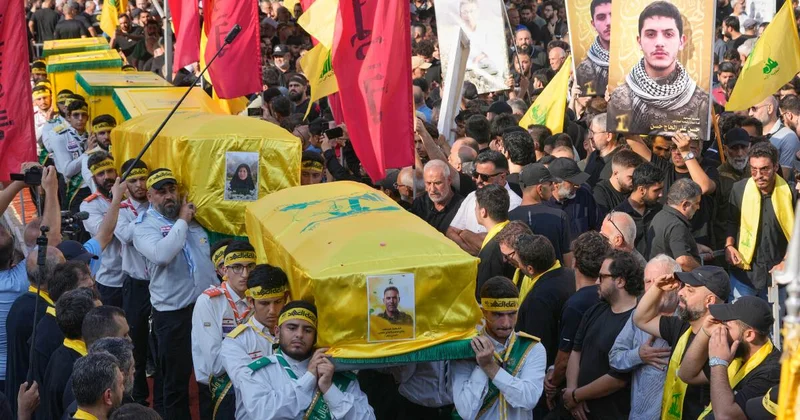
But the most unexpected turn has come from Hezbollah. Thought to be an all but spent force only a few months ago, it has put up a vigorous defense against Israel’s ground invasion in Lebanon, incorporated new tactics and weapons — including drones — in its combat doctrine. It also appears to have largely sidestepped the Israeli intelligence infiltration that killed its senior leadership in recent years.
That regeneration power, said Ramzy Mardini, the founder of Geopol Labs, a Middle East-based geopolitical risk advisory firm, is the central and most important characteristic of the axis. Although many dismiss the members as mere proxies of Iran, they are instead “deeply rooted groups embedded within social bases, political movements and state institutions.”
“What looks like a resurgence is better understood as resilience. These organizations have the capacity to absorb enormous losses, adapt, and revive their capabilities and membership, even when it appears they have been permanently degraded or destroyed,” Mardini said.
“We tend to assume their resilience and capabilities are externally procured when, in fact, much of that power is locally produced,” he said.
Salisbury agreed, adding that axis members are also able to call on the pool of knowledge shared among them; experience fielding weapons in one theater can inform fighting in another.
The collective result has been a multifront conundrum that the U.S. and Israel cannot easily solve without incurring costs their allies are unwilling to bear.
“Iran has a hybrid strategy in the current war,” wrote Mahdi Mohammadi, a senior advisor to Iran’s chief negotiator, in a post on X.
“We are not fighting on one front and we are not using one tool. The fronts and tools are integrated into one operational platform,” he wrote.
Recent successes have also flipped the narrative on Tehran’s investment in the axis and its effectiveness.
“I genuinely see Iran’s relationship with the axis as one of interdependence. It derives some of its strength, information and access to global markets through these different groups,” Salisbury said. “After a variety of shocks in the last three years, you can argue that the investment has proven more worthwhile than people thought.”