For years now Tim Holme has watched the same drama repeat itself roughly once a week. A headline arrives: some laboratory somewhere has cracked the problem, invented the battery of the future, solved in a paper what industry has chased for decades. “And approximately zero of those have come true,” says Holme, co-founder and chief technology officer of QuantumScape, a San Jose, Calif., company that has spent 15 years chasing the most promised and least delivered idea in energy storage and run up an accumulated deficit of more than $3.9 billion: the solid-state battery.
The most recent cautionary tale was Donut Lab, a Finnish start-up that drew breathless coverage after unveiling what it said was a high-performance solid-state cell with about double the energy density of typical lithium-ion batteries and without rare-earth minerals or fire risk. It didn’t release data backing its boldest claims. In June, battery researcher and YouTuber Ryan Hughes and outside experts presented evidence that Donut’s cell was high-performance lithium ion—with liquid inside. “People who’ve spent a long time in the battery industry have a healthy dose of skepticism,” Holme says.
But amid the noise, the race is speeding up. Announcements are tumbling out of China, Japan, South Korea and the U.S. as battery makers move from lab to factory. Toyota, which holds the most corporate patents, says solid-state cells will finally start appearing in its cars within two years. Chinese companies, which already make more than 80 percent of the world’s lithium-ion batteries, have begun shipping semisolid-state cells.
On supporting science journalism
If you're enjoying this article, consider supporting our award-winning journalism by subscribing. By purchasing a subscription you are helping to ensure the future of impactful stories about the discoveries and ideas shaping our world today.
In the U.S., two front-runners are taking alternative paths to the same goal: Volkswagen-backed QuantumScape, which now produces its ceramic-based cells on a pilot line in Silicon Valley, and Factorial Energy, a Billerica, Mass., company led by founder and CEO Siyu Huang, whose polymer cells are being tested in vehicles by Mercedes-Benz and Stellantis. The companies claim energy densities well beyond today’s typical electric vehicle, or EV, cells, up to 301 watt-hours per kilogram (Wh/kg) for QuantumScape’s cell and 391 Wh/kg for Factorial’s—gains that could quiet range anxiety. By volume, QuantumScape’s cell packs the slightly bigger punch: 844 watt-hours per liter (Wh/L) versus 748.
QuantumScape is building a new battery chemistry that demands a new manufacturing process; Factorial is designing a cell that can run on much of the industry’s existing equipment. Their bet is similar: rather than compete with China at its lithium-ion game, skip past it. The biggest test is still electric cars. But amid cooling EV sales and supply-chain concerns, both companies are already looking beyond them.
Who’s winning the race can be hard to know, partly because the definition of “solid state” isn’t itself so solid.
The underlying technology was largely pioneered in the U.S. M. Stanley Whittingham developed the first functional rechargeable lithium battery in the 1970s while doing research at Exxon; John Goodenough, whose foundational work on lithium-ion cells won him a share of the 2019 Nobel Prize in Chemistry, spent much of his career at the University of Texas at Austin. The technology was commercialized by Sony in Japan for its Handycam, then mass-produced in Korea and, increasingly, China. The battery that now powers most of our EVs and electric devices, notes Ilias Belharouak, section head for electrification at Oak Ridge National Laboratory, “was invented in the United States—and unfortunately we lost sight of manufacturability for quite a bit.”
Who’s winning the race can be hard to know, partly because the definition of “solid state” isn’t itself so solid. The term describes an architecture, not a set of chemistries—one that replaces most or all of the liquid electrolyte with a solid. In a conventional lithium-ion battery, the liquid electrolyte shuttles lithium ions back and forth—to the anode as you charge your phone and back to the cathode as you use it. That liquid is highly conductive but flammable, and the fires it feeds burn hot and toxic.
Solid electrolytes replace most if not all of that flammable liquid while also opening up the next frontier: swapping out the graphite anode with pure lithium metal. Because graphite stores only one lithium ion for every six carbon atoms, typical rechargeable batteries top out at an energy density of around 250 Wh/kg. Lithium metal needs no host at all, boosting the anode’s storage capacity around 10-fold.
The challenge with pure lithium is that it’s highly reactive. Hence the solid electrolyte. As it allows ions to pass through, the solid helps physically block dendrites, the branchlike lithium deposits that caused early lithium-metal batteries to short-circuit and catch fire. Ditching graphite saves space and weight, too, and removes a key ingredient whose supply chain China dominates. “The best lithium cell chemistry can be is using pure metallic lithium,” says Jeff Sakamoto, a materials scientist at the University of California, Santa Barbara, who worked on batteries for NASA’s 2003 Mars rovers and now directs MUSIC, a U.S. Department of Energy research center focused on ion transport. The solid electrolyte, he says, is what physically—and ideally thermodynamically—stabilizes a lithium-metal electrode. A battery “can go forever if it’s thermodynamically stable.”
But “solid state” is also, to some degree, a marketing term. “There are people introducing terms like ‘quasi-solid state,’ ‘hybrid solid state,’ ‘condensed state,’” Holme says, “all kinds of terms that are never defined.” In practice, most solid-state batteries contain some liquid—usually in the cathode region—to help with conductivity, making them semisolid at best. All-solid-state batteries are the goal, but in the meantime, the real question, Holme argues, is what the architecture unlocks: higher energy density, faster charge, longer range, better safety and, ultimately, lower cost.
Central to battery design is the choice of electrolyte—typically a ceramic, a sulfide, a polymer or some combination. A polymer can be easier to manufacture but comes with conductivity challenges; a sulfide is more conductive but requires careful dry-room manufacturing; a ceramic oxide is the hardest to process at thin dimensions and high volumes but, Holme wagers, the most rewarding. “The bet we made was to pick the material that has the best material properties,” he says. “But it’s brittle and very, very challenging to make.”
QuantumScape has dispensed with two of the four components of a typical battery. Its ceramic electrolyte supports an “anode-free” architecture in which the lithium-metal anode forms on the first charge rather than being preloaded. Factorial has gone with the grain of existing manufacturing. Its FEST (Factorial Electrolyte System Technology) electrolyte—a polymer with an ultrathin lithium-metal layer at the anode—is designed for about 80 percent of existing lithium-ion equipment.
Both companies insist they have moved from science to engineering. But some in the research community remain skeptical. “There is now a significant deviation between what’s possible and where the technology really is,” Sakamoto says. He and his MUSIC colleagues use operando microscopy to observe batteries working, mapping the tiny defects that accumulate in the electrolyte as it charges and recharges. The gap between public expectations and the technology’s true maturity, he and others worry, risks draining public confidence if commercial milestones slip once more.
The most fundamental challenge is the interface—the boundary between the solid electrolyte and the electrodes, where dendrites and voids take root. Moving ions through a solid is inherently harder than through a liquid. “It’s like humans,” Belharouak says. Imagine migrating across a vast landscape. If there’s a river, “you can swim.” But if there’s a mountain, “you have to climb it somehow.”
Tiny voids, left behind as lithium strips from and redeposits onto the electrodes, become roadblocks and bottlenecks. As ions take detours, lithium piles up. It is as soft as taffy, but as it forms at the interface, the metal can “frack” through even hard ceramic like tree roots through concrete.
Expanding and contracting with each cycle, the electrodes also tend to lose contact with the electrolyte, creating gaps. Maintaining contact often requires external mechanical force. But too much can crack the brittle electrolyte or force lithium metal through it, causing a short circuit. Both companies have had to design battery packs with mechanisms that “breathe” with the cells, adding weight and complexity.
Holme is mostly mum about how QuantumScape tamed its interface problem. He says the company used density functional theory—quantum-chemical simulations—to develop a ceramic that is compatible with lithium at the interface, without requiring an extra lithium foil that is costly and hard to process. “That was a real breakthrough that, to my knowledge, hasn’t been solved elsewhere,” he says. Then comes the bigger challenge: “You have to figure out how to actually make—at high scale, at high quality—the material that you’ve simulated in silico.”
Manufacturing at automotive scale—a leap from 1,000 cells a day on a pilot line to 100,000 or more in a gigafactory—amplifies every challenge. Quality and yield requirements are exacting; a ceramic defect invisible at a small scale becomes a failure mode at volume. Since January 2025, at least 14 Western battery start-ups have gone under trying to make that leap.
QuantumScape is trying to avoid that fate with its Eagle Line, an automated pilot facility it unveiled in February, and Cobra, a proprietary heat-treatment process for “baking” the ceramic electrolyte that cuts what had taken hours to minutes. “We got lucky,” Holme says. “It wasn’t guaranteed that nature provides us a rapid processing window where we can still achieve the best materials properties.” Like Factorial, the company has integrated artificial intelligence for quality control, and it has enlisted Corning and Murata as manufacturing partners.
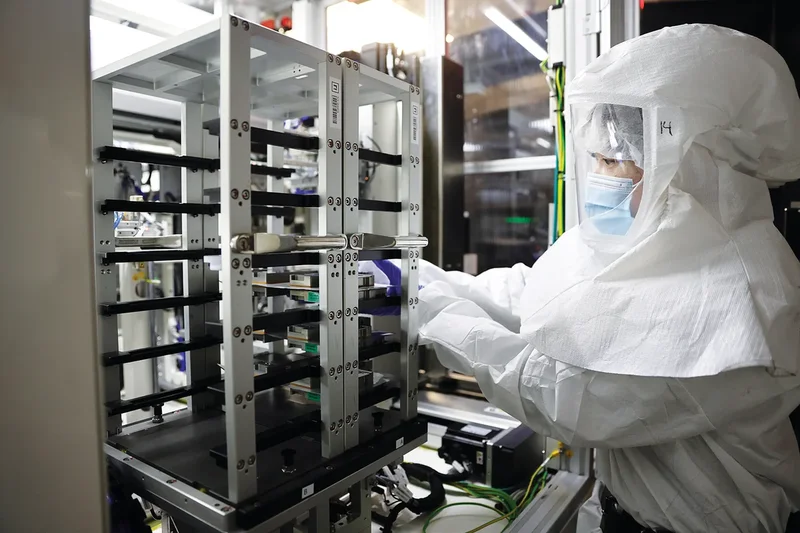
Just don’t call it a battery maker. After reworking its business model in 2024, QuantumScape is now a technology licensor with a vision of doing for batteries something akin to what Nvidia did for chips: develop the architecture, let partners manufacture at scale. Alongside a partnership with Honda, its primary path to gigawatt-hour production runs through PowerCo, Volkswagen’s battery subsidiary, with up to $131 million in milestone-gated funding over the next two years.
“We may have lost the battle for EV batteries, but the race to electrify the skies is just beginning.” —Halle Cheeseman, battery scientist
Factorial’s deals—with Mercedes, Stellantis, Hyundai, Kia—are further down the road. Last year a Mercedes EQS running its cells drove about 1,205 kilometers, from Stuttgart, Germany, to Malmö, Sweden, without stopping. This past June, Stellantis began road-testing them in a Dodge Charger Daytona, the technology’s North American debut.
But the road to EV adoption is long and twisty. A June report from the International Energy Agency found that close to 30 percent of all new cars sold globally last year were EVs. In the U.S., though, the market’s lost its juice. Since the Trump administration cut carbon mandates and EV incentives in 2025, EV sales have slowed dramatically, leading several of QuantumScape’s and Factorial’s partners to cancel models and factory plans.
The cooling EV market has given Holme and Huang reason to look toward AI data centers, robotics and aviation—electric vertical take-off and landing aircraft and military drones included. QuantumScape has added a veteran of defense giant Raytheon to its board and hired the former chief scientist of the U.S. Air Force as an adviser. Factorial is expanding a fabrication line for aerospace applications and recently announced another investor: In-Q-Tel, the U.S. Central Intelligence Agency’s venture arm. “Everyone wants drones, drones, drones,” says Halle Cheeseman, a former program director at ARPA-E. He takes the longer view: “We may have lost the battle for EV batteries, but the race to electrify the skies is just beginning.”
Drones require what solid-state batteries promise: high energy density, low weight, reliable performance across temperature extremes. They’re also more forgiving than cars. EV drivers demand fast charging; drone operators typically swap batteries or use them once, which makes dendrites easier to manage. Smaller sizes and lower volumes also ease the strain on supply chains and manufacturing, and certification standards make it easier to integrate a battery into a drone than into an aircraft. Defense buyers also tend to be less price-sensitive.
The drone demand has “fundamentally changed the arc of this industry,” says Venkat Viswanathan, a University of Michigan engineering professor who studies next-generation batteries for aerospace. With continued battery advances, he thinks the electrification of most shorter-duration flights in the next decades is “completely within reach.”
The battlefield, remade by robots in Ukraine and elsewhere, is already there. The Pentagon is now aiming to produce thousands of U.S.-made drones per month, but, Huang notes, as of last year more than 80 percent of drone batteries were imported from China. Beijing has since restricted exports of high-energy-density drone batteries, and the U.S. has moved to ban Chinese-made components from American defense equipment, placing BYD, the world’s second-largest battery maker, on a blacklist in June. Huang sees particular value in powering fast interceptors. If your car goes twice as far as the next guy’s, cool. “If your drone is running [with] twice the range of your enemies’, it’s a complete game changer.” Advanced battery manufacturing, she says, “is an asset we cannot afford to lose.”
The bigger prize remains the EV market, and reaching it will require partnerships as global as the battery supply chain itself. Huang, who grew up in China, studied in Sweden, earned her Ph.D. at Cornell and built her company in Massachusetts, has assembled global tie-ups accordingly. Battery innovation, she says, “cannot be achieved by a single company.”
Steadier policy would help, too. “My advice to any policymaker is to remove barriers—end tariffs, offer tax credits, support immigration for talent,” says Shirley Meng, a materials scientist who recently left the doe research hub she oversaw at the University of Chicago for a senior post at Nanyang Technological University in Singapore, after saying U.S. policy shifts had helped push her overseas. For a country trying to rebuild its battery industry, her move carries its own warning. “If the U.S. remains open to fair global partnerships, either in R&D or in trade,” she says, “then it is possible that the battery field will come out stronger in a few years.”
Despite the supply-chain fears, the American industry may depend, at least for now, on Chinese expertise. Cheeseman calls it the “cuckoo” approach: enticing manufacturers—including BYD—to build U.S. factories and nurture domestic manufacturing science so we can learn how to make these things. Chinese battery behemoth CATL typically runs more than 3,000 sensors on a production line. “I’m not sure if we would know where to place 300,” Cheeseman says.
As new factories ramp up, prototypes will need to keep proving themselves. The safety benefits are still fuzzy; engineers need more rigorous abuse testing on large-format cells. Cost is unproven, too: Cheeseman estimates that early solid-state batteries cost two to three times as much as liquid-electrolyte cells.
And the target keeps moving. EV makers are now prioritizing cost and materials over performance, prompting an industry-wide shift from nickel manganese cobalt cells to lower-energy but cheaper lithium iron phosphate. And for demanding applications such as drones, silicon-anode lithium-ion batteries can already reach 400 Wh/kg. “If everybody is like bees around a honeypot at 400,” Cheeseman says, “you have to be shooting for 600 or 800 or 1,000.”
But after decades of promises, solid state is no longer a question of if. “I believe it’s inevitable,” Cheeseman says, citing simplicity and safety gains. His best guess is that solid-state cells will eventually reach mainstream EVs by the early 2030s. Just don’t ask him to bet on it.