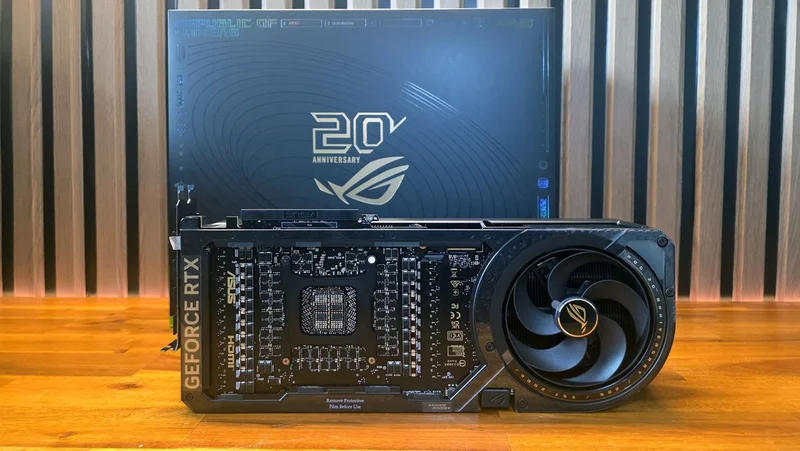
Computer enthusiast 1usmus has developed a new update for their Hydra overclocking application that introduces VRAM overclocking and power limit control for some of the best graphics cards on the market, Nvidia's RTX 50-series. The new update, 2.3B, adds support for a maximum memory offset of +3000MHz for memory overclocking and a static power limit adjustment that peaks at 125% regardless of which RTX 50-series model is used.
The new update allows RTX 50-series graphics card owners to overclock their GPU’s GDDR7 memory up to 36 Gbps. 1usmus showed off their personal Asus ROG Astral LC RTX 5090 OC overclocked to 36 Gbps on the memory to confirm that the application works as advertised. Hydra’s aforementioned limits are reportedly aimed at this first release specifically to keep users safe. But 1usmus hinted that future iterations of the app could have higher limits, noting that the RTX Pro 6000 has experimental support for the “complete feature set” of the program.
Beyond VRAM and power limit adjustments, Hydra version 2.3B also features direct XBAR offset control and support for second-generation “Rail Offsets.” The voltage frequency curve has also been changed and is now unrestricted compared to prior versions.
Compared to mainstream overclocking tools, Hydra supports more in-depth overclocking features that are geared for extreme overclocking. This is particularly true of the XBAR offset control, which is a method of overclocking an Nvidia GPU’s interconnect, helping improve performance beyond just GPU core and memory overclocking, similar to overclocking the Infinity Fabric on AMD CPUs. For pure core and memory overclocking, Hydra’s latest update matches what existing overclocking tools can achieve, such as MSI Afterburner, for now.
For the uninitiated, Hydra is a tool 1usmus released several years ago to better tune Ryzen CPUs. Since then, the app has evolved from just being an advanced AMD overclocking utility to also featuring overclocking support for Nvidia GPUs, overclocking support for Radeon GPUs, DRAM overclocking, and memory stability testing.
Get Tom's Hardware's best news and in-depth reviews, straight to your inbox.