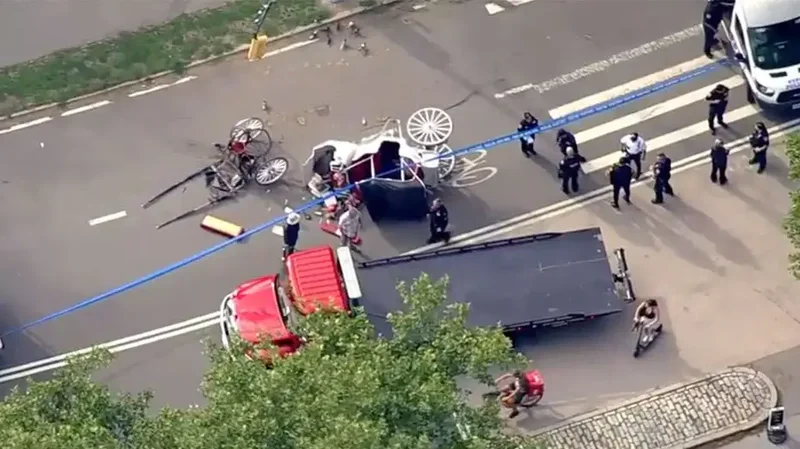
The family of an 18-year-old tourist who died after a horse bolted during a carriage ride in Central Park is seeking $105 million from New York City, alleging that stray electrical voltage may have caused the animal to panic.
Romanch Mahajan, who was visiting New York from India with his family, spending the day snapping photos around Manhattan, suffered fatal head injuries during the June 17 incident near Cherry Hill in Central Park. His family says the unsecured carriage horse, Sampson, suddenly took off while the driver stopped to take their picture.
"This was an avoidable accident," Sagar Chadha of Liakas Law, counsel for the Mahajan family, wrote in a statement. "The allegations set forth in the Notice of Claim describe a preventable tragedy that followed years of warnings, prior incidents and failures to implement basic safeguards."
"An 18-year-old young man came to New York City with his family and never made it back home,:" the statement continued. "His family deserves answers, accountability and meaningful change so that no other family experiences what they have endured."
The tragedy came just over two weeks after New York City horse-drawn carriages would have disappeared under an earlier proposed ban that failed last year. That bill, introduced in 2024, would have prohibited horse-drawn cab operations beginning June 1, 2026, but it was defeated by the City Council’s Health Committee in November 2025.
"If the city had passed the law last year, our son would still be alive today," Deepak Mahajan said in a recorded video statement that played at a July 17 New York City Council hearing, as he and Romanch's mother wept. "The only measure that can prevent another death is a full and complete act.
"Let his death not be in vain."
The effort was revived this year just days before Mahajan’s death: Council Member Christopher Marte introduced a new version of the ban June 11 — six days before the June 17 accident — that would phase out horse-drawn cabs by June 1, 2028. That bill is now being renamed "Romanch’s Law," and has the backing of New York City Council Speaker Julie Menin.
"His death was heartbreaking, and it was preventable," Menin wrote in a statement to support and rename the bill. "That tragedy is why I have decided to support Romanch’s Law, legislation that would begin the transition away from horse-drawn carriages as a tourist attraction in Central Park — for the safety of New Yorkers, visitors from around the world, and the horses themselves."
The family alleges in four notices of claim – documents that are generally required before someone can sue New York City – that "stray voltage and/or contact voltage" in the area "caused, precipitated, contributed to and/or was a substantial factor" in causing the horse to be "shocked, stimulated, startled, agitated, frightened and/or spooked, and to bolt and run away."
The filings filed Friday name the city, Con Edison and several municipal agencies, including the departments of Parks and Recreation, Transportation, Health and Mental Hygiene, and Consumer and Worker Protection.
Mahajan’s father, Deepak Mahajan, has said the family was inside the carriage, posing for a photo with the driver, when the horse abruptly bolted. As the carriage sped through the park, Romanch’s mother, Priya, fell out.
Romanch then jumped from the moving carriage in an attempt to help her, according to his father. The teenager struck his head on the pavement and was later pronounced dead at NewYork-Presbyterian/Weill Cornell Medical Center.
Other members of the family suffered minor injuries, with the four notices of claim totaling $105 million.
The family’s claims add a new dimension to the investigation by focusing on the possibility that electrical voltage in the park contributed to the horse’s behavior.
Con Edison acknowledged that low levels of stray voltage were detected in the area on July 16 and July 23, weeks after the fatal incident, according to the filings.
"These allegations demand a complete and transparent investigation," Chadha said. "The family intends to determine not only why an occupied carriage was allegedly left unsecured, but whether dangerous electrical conditions existed in the very area where this horse suddenly became spooked and whether anyone knew or should have known about those conditions before Romanch was killed."