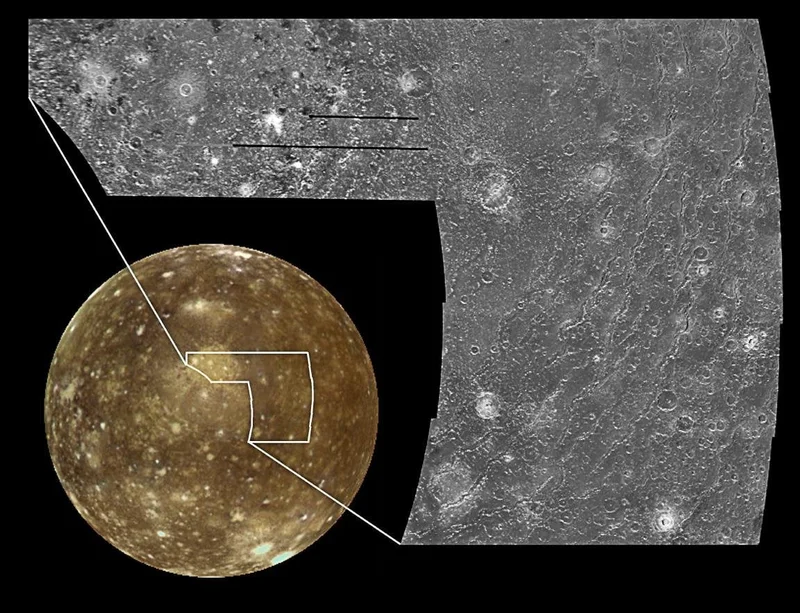
Of Jupiterâs four Galilean moons, Callisto is the one that gets the least attention. Io is constantly being resurfaced by volcanoes. Europa has a giant liquid water ocean. And Ganymede has its own magnetic field that interacts with its parent planet in weird ways. Callisto, by comparison, seems sedate, with its ancient, crater-saturated surface seemingly frozen in time. But new data from the James Webb Space Telescope (JWST) shows that even this most benign of the Big Four moons is more active than previously realized.
The data, which was recently published in the Planetary Science Journal by an international team of astronomers led by Maria Camarca of Caltech, was based on JWSTâs Near-Infrared Spectrograph (NIRSpec) instrument. It covered three major perspectives of Callisto itself â its trailing hemisphere, the giant Asgard impact basin, and a view centered squarely on Valhalla, the largest multi-ring impact structure in the solar system.
One notable feature in the data was water ice. NIRSpec picked up the 3.1 µm âFresnel peakâ indicative of ice crystals, and mapped it onto the moonâs surface in unprecedented detail. When complete, there was a notable divide between the leading and trailing hemispheres. On the leading hemisphere, the water ice directly tracks with geography. Bright impact basins like Valhalla and Asgard, along with younger craters like Lofn and Heimdall, show sharp spikes in water ice where ancient impacts excavated fresh, brighter material that contrasts sharply with the dark albedo of the rest of Callisto.
On the trailing hemisphere, on the other hand, the ice forms a distinct âbullseyeâ pattern. Its signature is weakest near the equatorial center and strengthens towards higher latitudes. Most likely, that pattern is shaped by plasma blasting the moonâs surface from Jupiterâs magnetosphere. The charged particles that plasma is made up of sweep along behind Callisto, altering the structure of its ice in the process.
Another clear spectral feature was the 4.25 µm spectral band â representative of dry ice (i.e. frozen CO2). The authors note that CO2 shouldnât naturally remain stable on Callistoâs surface without some sort of entrapment or replenishment mechanism. But the signal is there clear as day to anyone looking.
On the trailing hemisphere, solid CO2 is concentrated at the center of the disk, forming the opposite pattern to that of the water ice. In fact, according to the paper, they were anti-correlated, supporting the idea that particle radiation actively converts water ice and carbon-rich grains into CO2. On the leading hemisphere, the strongest CO2 signal was found around the Lofn and Heimdall craters. Since these are relatively young, that deposit is most likely from the impact itself, making it the largest known reservoir of CO2 not created by radiation.
CO2 doesn't just exist on Callistoâs surface, either. JWST detected a very faint atmosphere, primarily made up of CO2, though it was extremely patchy. The highest concentration appeared around the Valhalla basin, but it doesnât line up with the highest concentration of solid CO2, nor does it align with the areas with the hottest temperatures. This illogical pattern mimics that seen on other icy moons such as Ganymede, highlighting the complex process volatiles like water and CO2 undergo, and which we are still struggling to pin down in our models.
There was yet another signature of interest in the JWST data â a clear absorption feature at 4.57 µm. The current theory is that this is caused by carbon-nitrogen (CN) bearing compounds, though its signal is notably stronger on Callisto than on other Galilean moons. How specifically those get to Callisto is also a matter for debate, though the going theory there is that the other irregular satellites in the system regularly rain down dust on Callistoâs leading hemisphere, where the nitrogen-rich minerals react with the native carbonaceous material to create organic compounds.
Obviously even with data from the most powerful space-based telescope, we are still lacking in our understanding of some fundamental processes happening on this quietest of Galilean moons. But soon, we might get some better insight, as the Jupiter Icy Moons Explorer (JUICE) mission is on its way to the system. During planned flybys in the 2030s, JUICE will use its high resolution camera and spectrometer to capture more detailed images of the surface of Callisto than has ever been possible before. As we continue to shine even more of a light on this moon, it could offer up even more insight into the differences in four of the most interesting moons in the solar system.
Learn more:
M. Camarca et al - Callisto from JWST: CO2-rich terrain on the leading hemisphere and global patterns of H2O ice