Topline
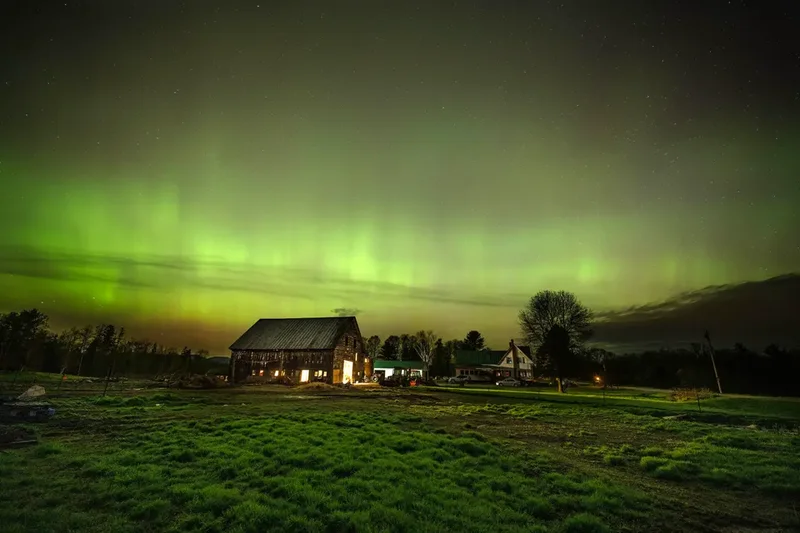
The northern lights could be visible from some northern states along the U.S.-Canadian border on Tuesday night, according to a forecast from the National Oceanic and Atmospheric Administration, as forecasters expect a coronal mass ejection to cause minor geomagnetic storms after reaching Earth.
Key Facts
NOAA is predicting a Kp index of four out of nine for Tuesday night, meaning the northern lights could be visible from certain states and appear brighter with more “motion and formations.”
Forecasters are also warning of minor geomagnetic storms on Tuesday and early Wednesday morning, according to NOAA’s three-day forecast, likely caused by a coronal mass ejection or solar winds.
What Are Coronal Mass Ejections?
Coronal mass ejections are expulsions of solar material with embedded magnetic fields that erupt from the Sun’s corona, or outer layer of atmosphere. This material often has a stronger magnetic field than background solar winds, according to NOAA, which can cause geomagnetic storms when it interacts with the Earth’s own magnetosphere. Forecasters at NOAA also said Tuesday’s geomagnetic storms could be caused by a co-rotating interaction region—a compression region created by high speed solar winds interacting with slower, background solar winds. The storms expected on Tuesday and Wednesday are only expected to be minor—rated a G1 out of on NOAA’s scale. However, even minor storms can cause the northern lights to appear visible further south.
Where Could the Northern Lights Be Visible?
States along the U.S.-Canada border have a “low” likelihood for visibility on Tuesday night, according to NOAA’s prediction map. These include northern Washington, Idaho, Montana, North Dakota, South Dakota, Minnesota, Wisconsin and Michigan’s Upper Peninsula. Most of Alaska could also see the aurora, according to NOAA’s predictions. However, the sun sets extremely late in Alaska during the summer months, meaning it likely won’t get dark enough in most of the state for the aurora to be visible.
What’s the Best Way to View the Northern Lights?
Experts at NOAA recommend prospective viewers travel as far north as possible, towards Earth’s magnetic north pole located in northern Canada. They should position themselves on a vantage point, like a hill with a clear view of the sky and far enough away from cities or other light sources. The lights are most active in the hours just around midnight, according to NOAA, meaning viewers should try to catch the aurora between 10 p.m. and 2 a.m.
What’s the Best Way to Photograph the Northern Lights?
An expert who spoke to National Geographic said that viewers can use smartphone cameras to capture quality photos of the aurora, provided they use the correct settings and equipment. Photographers should remember to bring a tripod and remote timer for their devices, allowing them to remain stabilized without movement long enough to capture an image of the aurora. They should also remember to turn on night mode and turn flash off, and shoot in RAW image format.