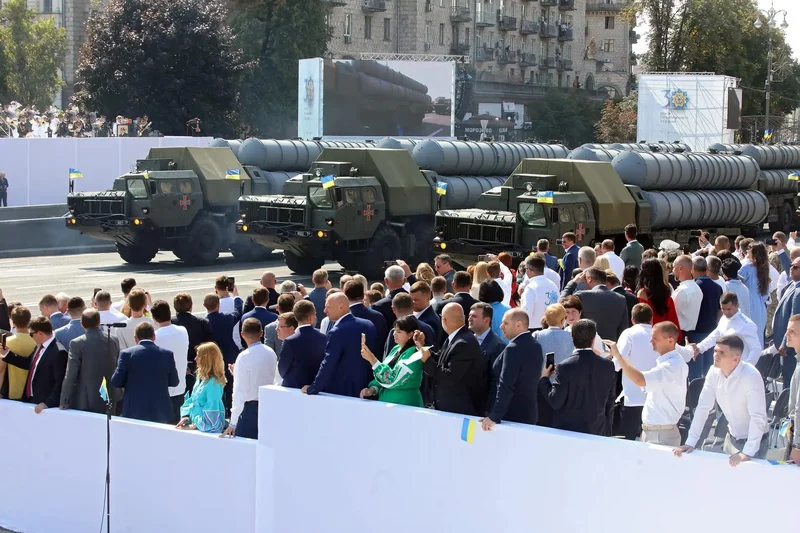
Four years and six months into its grinding war with Russia, Ukraine finds itself critically short of essential American-made MIM-104 Patriot missile defense systems to shield its cities and critical infrastructure from Russian ballistic missiles. With the war on Iran having rapidly expended large quantities of Patriot interceptors that could take years to replenish, Kyiv is working on upgrading its older Soviet-era S-300 strategic missiles by building new interceptors as part of a project with the United States. NATO member Greece still possesses a relatively modern S-300 variant, the PMU-1, and stockpiles of interceptor missiles acquired in the late 1990s that could help Ukraine. However, Athens is unlikely to transfer these systems or missiles for various reasons.
CNN reported Monday on a Patriot sitting idle in a Ukrainian cornfield that hadn’t been fired for the past ten weeks as Ukrainian stockpiles of these missiles reach alarmingly low levels. Almost five years of war with Russia has seen Ukraine become a world leader in developing and building cost-effective defense systems and strategies against drones, such as the Iranian-designed Shaheds Russia has used in large numbers since 2022. However, Kyiv’s ability to develop defenses against ballistic missiles is much more limited, a weakness that Moscow is only too happy to exploit. CNN’s report noted that July has become the deadliest month for Ukrainian civilians since May 2022.
One solution Ukraine is working on to plug this critical capability gap is modernizing its arsenal of older S-300 systems inherited from the Soviet Union and building new missiles for them.
“There’s a joint U.S.-Ukrainian effort going on to essentially retrofit or upgrade the old S-300 missiles or a newer variant of the S-300 and give it better capabilities,” retired U.S. Army Col. Robert Hamilton told PBS in an August 5 interview. “And so that should come online near the end of this year. But, again, we’re talking 100 or a couple of hundred a year that could be produced.”
Before Ukraine received its first Patriot systems provided by the U.S., Germany, and the Netherlands, beginning in April 2023, it relied heavily on its strategic S-300s to fend off Russia’s larger and more modern air force. However, these interceptors were also finite.
“S-300, they work very well,” said Ukraine’s then-Defense Minister Oleksii Reznikov in late 2022. “The fact is that they were not made in Ukraine, that is, we do not have S-300 missiles, so we use stocks.”
Reznikov went on to add that Kyiv was negotiating to acquire extra interceptor missiles from the arsenals of other S-300 operators to replenish its reserve and keep Russia’s air force at bay. Earlier that year, Slovakia gave Ukraine its sole S-300PMU system along with an estimated 45 5V55U interceptor missiles, which have a maximum range of approximately 93 miles. Ukraine entered the war with older Soviet-era S-300PT and S-300PS variants originally introduced in the late 1970s and mid-1980s, respectively.
In early April 2023, a report in The New York Times indicated that Ukraine’s S-300s and Buk systems, which then made up 89 percent of Ukraine’s air defense against Russian warplanes and bombers, were within a month of depletion. Luckily for Kyiv, the more advanced Patriots started arriving then, and it quickly put them to effective use. More than three years later, these Patriots are also facing depletion, and it isn’t clear when Kyiv can acquire adequate replacements or potentially license-produce interceptors locally.
Ukraine would no doubt welcome replacement S-300 interceptors or even complete batteries from allied countries that possess them. In late 2025, Norway generously agreed to pay for S-300 interceptors for Ukraine. Timely delivery of extra interceptors could buy Kyiv time until the upgraded interceptors it’s developing start rolling off the assembly line, reloading launchers, and reentering the fight.
In a bizarre episode in the late 1990s, Greece acquired two S-300PMU-1 systems and 175 5V55U missiles originally ordered by Cyprus but never delivered because the purchase sparked a crisis with Turkey. Athens later test-fired these Russian systems on Crete in 2013 and reportedly allowed the Israeli Air Force to train against them. Israel destroyed Iran’s S-300PMU-2 systems in the recent wars without losing any crewed aircraft.
Greece likely still has a considerable number of operational 5V55U missiles available. Ukraine would certainly welcome the opportunity to acquire them, and Norway would almost certainly be willing to foot the bill. While Athens has provided military aid since the 2022 invasion, it has proven hesitant to transfer the S-300s, at least not without timely replacements of Patriots, which seems much less likely these days. Furthermore, Moscow warned it against doing so, noting that Athens requires its authorization to transfer those missile systems to any third party. And Russia has no desire to authorize Ukraine acquiring such strategic systems for glaringly obvious reasons.
In July, Greece approved up to $4 billion for primarily Israeli-made systems for its Achilles’ Shield multilayered air defense project, which aims to protect the country from various threats ranging from drones to ballistic missiles. And while Cyprus never got its S-300s all those years ago, it did recently acquire capable Barak MX systems from Israel in 2025, which have anti-ballistic capabilities.
George Tzogopoulos, a senior fellow at the Center International de Formation Européenne, outlined several reasons why these systems, originally ordered by Cyprus and possessed by Greece, are unlikely to end up in Ukraine anytime soon.
Politically, he noted that Greece-Ukraine relations are “rather strained” after a recent incident in Greek waters. In May, he recalled, Greek authorities discovered a Ukrainian maritime drone near the island of Lefkada, possibly dispatched by Kyiv to target tankers exporting Russian oil.
“The Ukrainian foreign ministry had to publicly apologize to Greece in the immediate aftermath,” Tzogopoulos told me. “Further to this naval incident, the Greek government is concerned about the extent to which cordial Turkish-Ukrainian relations are affecting the prospects of Greek-Ukrainian collaboration on the co-production of maritime drones.”
“Conditions set by Kyiv do not generate enthusiasm in Athens.”
And while Greece’s stance against Russia’s invasion of Ukraine hasn’t changed, Athens has concluded that providing unequivocal support hasn’t led Kyiv to, in turn, “prioritize Greek national interests” in foreign policy and military strategy.
“Against this backdrop, Greece appears skeptical of sending its S-300PMU-1s to Ukraine and causing Russia’s wrath,” Tzogopoulos said. “While the EU is currently looking for ways to re-engage with Russia, Athens has no reason to experience another low point in its relations with Moscow.”
And while the Greek analyst noted that technical ways to send the Greek S-300s to Ukraine via the U.S. or Norway do exist, the political result will “hardly be different” for Greece.
“More importantly, the modernization the Achilles Shield will bring to the Greek defense sector does not automatically render the Russian system useless,” Tzogopoulos said. “Time is required, and Greece is not prepared to decommission them in the short-term or medium term. Greece’s priority remains to safeguard its national security, which is anchored to Turkey’s deterrence.”
“This is the main reason why it had not sent its S-300 PMU-1s to Ukraine before.”
He concluded that Greece could replace the S-300s with other systems in the future.
“The silver lining in this case is that Greece will not have to handle Russia’s response,” Tzogopoulos said. “It is not currently on the agenda, however.”
“In the interim, I would not exclude limited Greek-Ukrainian collaboration on the issue, but this largely depends on the general attitude of Ukraine, which is currently scrutinized in Greece.”