Colombia Earthquake Toll Rises to 304 as 400,000 Students Move to Online Classes
Colombia · Earthquake
A national disaster decree now runs to August 2027. And the Education Ministry is wiring satellite internet into shelters so lessons can carry on.
The Colombia earthquake of 10 August has now killed 304 people, according to the national disaster agency’s latest balance. Another 4,548 were injured and 426 remain missing, while damage reports reach 472 municipalities.
Alongside the casualty count, the government says more than 400,000 students have lost normal access to school.
What the Latest Count Shows
Colombia’s disaster agency, UNGRD, updated its national balance on 18 August. It now lists 304 dead, 4,548 injured and 426 people still missing.
Rescue teams have pulled 356 people out alive since the ground moved. However, the missing figure has barely shifted in recent days.
The climb has been steady rather than sudden. UNGRD reported 239 deaths on 12 August, then 288 by 14 August, before reaching 304.
The United States embassy in Bogotá has kept a natural disaster alert running for travellers. For now, officials treat every figure as provisional.
The Colombia Earthquake in Numbers
The Colombia earthquake measured magnitude 7.4 and struck just after 7:30 on the morning of 10 August. Its epicentre sat near San José del Palmar, in Chocó.
Because the rupture was deep, roughly 107 kilometres down, the shaking travelled unusually far. As a result, 472 municipalities across 15 departments now report damage.
Pereira, Cali, Quibdó, Manizales and Armenia were all placed on red alert, the top disaster level. Aftershocks followed quickly, with 106 logged by the evening of 11 August.
How Wide the Damage Runs
UNGRD counts 123,789 affected families and 292,043 affected people. That is a much wider circle than the casualty list alone suggests.
Earlier bulletins recorded 9,215 homes destroyed and 45,457 more damaged. Since then, assessment teams have kept adding to both totals.
Beyond housing, an earlier bulletin listed 188 health centres and 530 community centres affected, plus 140 collapsed buildings. Because engineers are still working through the list, these counts keep moving.
Why 400,000 Students Are the Next Problem
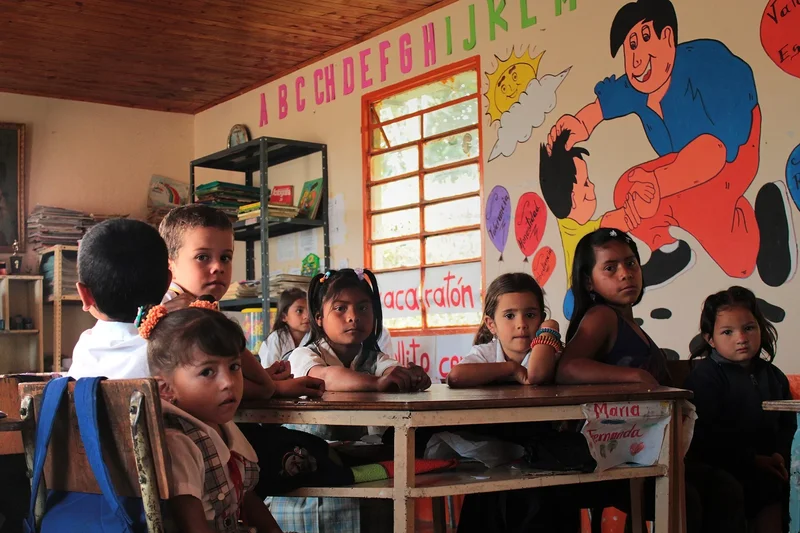
The Education Ministry says more than 400,000 students have had their schooling interrupted. In short, a rescue emergency has turned into an education emergency.
Its first balance, on 15 August, counted 1,631 damaged school sites across 19 departments. Officials there put the preliminary number of affected students near 500,000.
A separate UNGRD cut, taken on 14 August, put 2,595 education centres in some state of damage. On that reading, 447,715 enrolled students could not reach their classrooms.
What Directiva 009 Actually Orders
Education Minister Viviane Morales issued Directiva 009 in mid-August. It tells regions to keep teaching, instead of simply pausing the school year.
Where families have a connection, schools switch to virtual lessons using ministry materials. Moreover, the plan promises subsidised data plans and tablets.
The directive sorts schools into three damage levels, from critical to preventive alert. After that grading, each site gets a route back: tents, mobile classrooms, or borrowed space in churches, libraries and community halls.
Classrooms With a Satellite Dish
For towns with no signal, the directive sets up education shelters fitted with satellite links. Students gather in one room and take their lessons online together.
It is a blunt fix, yet it keeps children somewhere safe and supervised. In addition, it gives teachers a working base while their buildings are checked.
The plan also runs in four phases, from immediate response to longer-term recovery and strengthening. Psychosocial support sits alongside the timetable changes, since many children watched their schools crack.
Where the Pressure Is Heaviest
Risaralda, Valle del Cauca, Chocó and Caldas carry the worst of the damage. Pereira alone reported dozens of damaged schools in mid-August.
Cali has told parents that classes restart gradually from 24 August. Sites will reopen in person, hybrid or online, depending on what inspectors find.
Cali is using the week of 18 to 21 August for staff preparation before pupils return. Meanwhile, several Cundinamarca towns suspended classes outright on the day of the quake.
The Legal Machinery Behind the Money
President Abelardo De La Espriella signed Decree 1171 on 11 August. It declared a national disaster situation running until 11 August 2027, with room to extend.
The decree unlocks direct contracting and creates a ring-fenced Sismo 2026 account. Therefore, recovery spending can be tracked apart from the ordinary budget.
The declaration covers Antioquia, Caldas, Cauca, Chocó, Quindío, Cundinamarca, Risaralda, Huila, Valle del Cauca, Tolima, Putumayo and Norte de Santander. It also allows credit relief for registered victims.
What Officials Have Not Published
The government has not released a national count of people living in shelters. Nor has it given restoration percentages for electricity and water.
Early loss estimates near 30 trillion pesos, about US$7.5 billion, have circulated in Bogotá. Still, that number is preliminary and has not been formally confirmed.
The gap matters for planning. Without shelter and utility numbers, it is harder to judge how fast the coffee-region towns can absorb returning families.
What Families Should Watch Next
Aftershocks continue. The geological service logged 106 of them within two days of the main quake, and smaller tremors keep rattling Chocó.
For parents, the practical question is which school site reopens, and when. Because inspections run building by building, the answers will arrive unevenly.
Higher education is caught in the same squeeze. Ministry figures show 117 universities and colleges filing 243 damage reports, with academic activity suspended at dozens of campuses.
Frequently Asked Questions
How many people died in the Colombia earthquake?
UNGRD’s 18 August balance lists 304 dead, 4,548 injured and 426 missing. The figures are provisional and have risen almost daily since 10 August.
Why are more than 400,000 students learning online?
The Education Ministry says the quake damaged or closed enough school buildings to disrupt over 400,000 students. Directiva 009 keeps them learning remotely while sites are inspected.
When do classes go back to normal?
There is no single national date. Cali plans a gradual return from 24 August, while other regions reopen site by site once engineers clear the buildings.
Is the emergency declaration still in force?
Yes. Decree 1171 declared a national disaster situation on 11 August 2026.
This article was produced by The Rio Times’ automated newsroom system. How we use AI · Report an error