You can’t completely prevent your dog from encountering ticks — populations are growing, causing the blood-suckers to show up in backyards and parks, not just deeply wooded areas. However, you can take steps to protect your pet and reduce the likelihood that they’ll get a potentially dangerous illness like Lyme disease, which is more common than you might think. In fact, about one out of every 30 dogs has tested positive this year, according to the Companion Animal Parasite Council. Read on to learn about the best tick preventatives for dogs according to veterinarians, and other steps you can take to stop the parasites from hitching a ride on your pet.
The best tick preventatives for dogs
There’s a handful of ways to protect your dog from ticks, but routinely checking them for the parasites and putting them on a year-round preventative are the most important. It’s also crucial to get them vaccinated against Lyme disease, which is the most common tick-borne disease and the only one that there’s a vaccine for, says Dr. Lindsay Kendrick, the medical director at VEG ER for Pets in Boston.
Before answering all your tick-related questions below, I curated a list of products that you’ll need to check for and prevent the parasites. A note about the tick preventatives on this list: I added options that meet expert guidance; are highly-rated; repel and/or kill multiple types of parasites; and are EPA- or FDA-approved. Some tick preventatives are sold over-the-counter, but many are only available via a prescription, which you’ll need to get from your vet.
Best tick comb
The easiest way to check for ticks is running your hand over your dog’s body and feeling for bumps, but to be even more precise, use a fine-toothed comb. As you drag it through your pet’s coat, it surfaces ticks, which tend to be quite small, so you can easily see them. Young ticks in particular are tiny, so you may not feel them on your dog’s body but find them with a comb, says Kendrick. She added that the comb is a must for dogs with thick coats — all that padding makes ticks easy to miss.
Tweezerman’s comb is technically made for finding fleas, but it works for ticks, too. It has stainless steel bristles with rounded tips that are gentle on skin, and a handle that’s big enough to get your hand around for a comfortable grip.
Best tick mitt
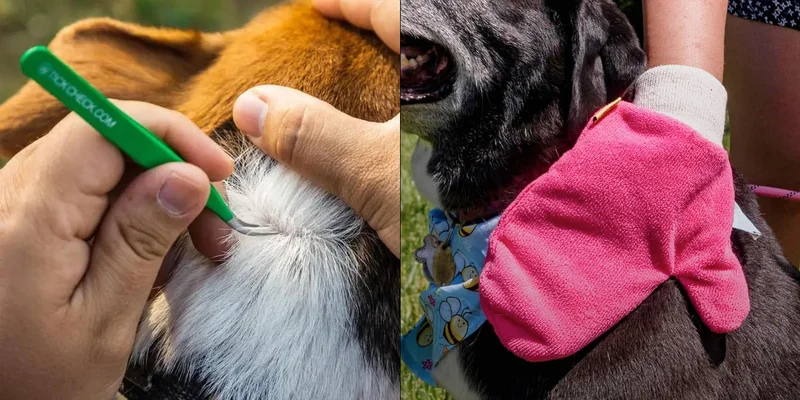
My dog has a very thin, short coat, so I can’t use a comb when I check her for ticks. Instead, I rely on the Tick Mitt, which is a glove made from a special type of textured fabric — the brand says it works like Velcro for parasites sitting on people and pets’ skin, as well as those clinging onto clothes, shoes and other items. You put the mitt on your hand and slowly sweep it across your dog’s body, inspecting it between passes to remove any ticks you caught.
The Tick Mitt works best for dogs with short coats, according to the brand, but if your dog has a thick and/or long coat, brush them first, then use the mitt to grab any ticks that surfaced. It can’t remove ticks embedded into the skin’s surface — for that, use tweezers.
Best tick removal kit
You can use any tweezers to remove ticks from your dog’s skin, but you might want to keep a dedicated tool in your bag while you’re on the go, or put one by your door so you can get rid of parasites before entering your home. TickCheck’s Tick Removal Kit comes with two stainless steel tools in a little case: a fine-tip tweezer for removing small ticks and a grabber tool for removing larger ticks that are deeply embedded in the skin. The set also comes with a card that helps you identify what type of tick you likely found.
Best chewable tick preventative
All the dog parents at NBC Selected, myself included, give our pets NexGard’s Chewable Flea and Tick Protection every month and have been doing so for years. They’re FDA-approved to kill multiple types of ticks, as well as fleas. The chewables are beef-flavored, so my dog thinks they’re standard treats and eats them immediately.
NexGard requires a prescription from your veterinarian, which the online retailer you purchase from will collect at checkout.
Best topical tick preventative
Frontline Plus’ Flea and Tick Topical Treatment, which comes in pre-measured applicators, are FDA-approved to kill ticks as well as fleas and chewing lice. To use it, you part the hair at your dog’s shoulder blades and squeeze out what’s inside one applicator. You have to keep your dog dry for 24 hours post-application — after that, the topical treatment is waterproof for a month, according to the brand. It comes in packs of three, six and eight.
Best tick collar
Think of over-the-counter tick collars as an additional layer of protection against the parasites, not your dog’s primary preventative, says Kendrick. She recommends giving your dog a prescription preventative year-round, like the chewable and topical ones I recommend above, and putting a tick collar, like Seresto’s, on them if you’re bringing them into wooded or grassy areas. That’s exactly what I do — knowing that my dog has two lines of defense against ticks when we’re outside gives me peace of mind, especially during the peak season.
Seresto’s tick collar, which also protects dogs against fleas, is adjustable and unclasps as needed. It comes in two sizes: one for dogs under 18 pounds and one for dogs over 18 pounds. I only use the collar when I take my dog to grassy, woodsy outdoor areas, so when I’m not using it, I keep it in the sealed container it comes in because it lasts for up to eight months, according to the brand.
Checking your dog for ticks: when, how and what requires a vet visit
When to check your dog for ticks
During tick season, which is usually from April to September, check your dog for the parasites daily, says Dr. Susanne Heartsill, the U.S. director of companion animal veterinary services at Ceva Animal Health. Be extra thorough after outdoor activities like walks, trips to the park and hikes, especially if you’re visiting grassy, wooded areas.
While ticks are more prevalent during the warmer months, they can stay active for longer, and in some parts of the country, they’re a year-round concern. Overall, the more you check your dog, the better. Heartsill also recommends using resources like the Companion Animal Parasite Council’s Parasite Prevalence Maps to monitor the prevalence of tick-borne diseases among dogs in your area to evaluate their risk level.
How to check your dog for ticks
Checking your dog for ticks is simple: Slowly run your hand over their body and feel for bumps. If you feel one, part the fur and look closely at it. Ticks are typically the size of a pencil eraser (although they can be smaller or bigger), and they look similar to black, brown, gray or red spiders, says Kendrick. You can also use a fine-toothed comb (like the one I recommend above) to check your pet for ticks, which is especially helpful if they have a thick coat — the comb surfaces ticks that might be deeply buried in hair or fur, making them more visible, says Kendrick.
Ticks are often easier to spot after they feed on your dog’s blood because they get bigger, says Heartsill. She also recommends looking for unusual skin bumps, red or irritated areas, scabs and bites — that’s all evidence that the parasite may have been feeding on them.
Check every part of your dog’s body for ticks, but the parasites like warm, moist areas, so pay extra attention to the following spots:
- Around the ears
- Under and around the collar and/or harness
- Between the toes
- Around and under the tail
- Around the neck
- The armpit area
- The groin area
- Around the eyes and lips
What to do if you see a tick on your dog
If you see a tick on your dog, remove it immediately. Pluck it off their skin with tweezers or a specialized tick removal tool like those I recommend above: Use the pointed end to grip the tick as close to the skin as possible and pull directly up with steady, even pressure, says Heartsill. Your goal is to remove the tick in one piece, so don’t twist, crush or squeeze its body. Find more tick removal tips here from the Centers for Disease Control and Prevention.
Once the tick is off your dog, put it in a tightly-sealed plastic bag and bring it to your vet. They can run tests on the tick to see what types of diseases it carries, if any, says Kedrick. If you can’t bring it to your vet, flush it down the toilet.
Also, be sure to carefully check yourself, other people and other pets in your home if your dog has a tick. Unlike fleas, ticks don’t typically infest indoor spaces, so you won’t have to treat your home, but check everyone living there to make sure they’re not carrying a tick inside.
Do at-home tick removal remedies work?
No, at-home tick removal remedies don’t work, and many of them can actually increase the chance of irritation and disease transmission, says Heartsill. For example, don’t burn the tick with a match or lighter, or cover it in substances like petroleum jelly, nail polish or alcohol in an attempt to make it detach on its own — it’s not helpful whatsoever.
Should you bring your dog to the vet after finding a tick on them?
Finding a tick on your dog isn’t a “rush to the vet” situation, says Kendrick. If you’re having trouble removing the tick, if the affected area looks infected or if your dog is showing signs of illness, make an appointment right away. But if not, let your vet know that you removed a tick from your dog and whether you see any skin irritation. Veterinarians screen for Lyme disease and other tick-borne diseases during dogs’ annual bloodwork, but yours might recommend doing a panel sooner if your dog had a tick on them. Tick-borne diseases can take months to show up on bloodwork, so tell your vet when you removed the parasite to schedule testing accordingly.
How to choose a tick preventative for dogs
No preventative completely eliminates your dog’s risk for tick-borne diseases, but using one regularly significantly reduces the likelihood of transmission, says Heartsill. Below, I broke down what experts recommend thinking about while choosing a tick preventative for your dog — be sure to consult your vet, too. Two important reminders: Always administer whatever tick preventative you buy according to the label’s directions, and check the expiration date beforehand to make sure the ingredients are still active and effective.
How to shop for tick preventatives for dogs
- Buy a preventative that’s specifically made for dogs. Never give your dog something that’s formulated for cats, says Heartsill. If a product is safe for both species, it will explicitly say so.
- Choose the type of preventative that’s easiest to administer and works for your household.There’s three types of tick preventatives for dogs: oral medications, topical medications and tick collars. (I broke down what each one is and how they work here.) Oral and topical medications are the most effective options, while tick collars act as a secondary layer of protection in environments that are highly populated with ticks. When deciding whether an oral or topical tick preventative is right for your pet, think about what you’ll find easiest to give them and whether you have other pets in your home. Oral medications are suitable for single- and multi-pet homes, but topical medications work best for single-pet homes where the liquid solution can’t accidentally get on or be ingested by other dogs and cats.
- Match a preventative to your dog’s age and weight. Each one indicates what ages it’s safe for and is labeled with a weight range. Be extra cautious with old and young pets, as well as those that are pregnant and/or nursing.
- Look for EPA- and FDA- approval statements. Some tick products are regulated by the Environmental Protection Agency, while others are regulated by the U.S. Food and Drug Administration. Medications and pesticides must meet U.S. government-required safety standards before they’re sold, so look for an EPA or FDA approval statement and number somewhere on products’ packaging.
- Prioritize preventatives that repel and kill ticks.That means they discourage ticks from attaching to your dog in the first place, while also killing any that bite and start feeding on your pet, says Heartsill. Some preventatives just kill ticks, which is still effective at preventing disease. But preventing attachment helps reduce how many ticks crawl onto their body and can possibly get carried into your home.
What are the different types of tick preventatives for dogs?
- Oral medicationsare made with insecticides that get transmitted to and kill ticks when they bite your dog’s skin. Chewable and swallowable tick preventatives for dogs are available over-the-counter and via a prescription. Kendrick recommends only buying those you get via a prescription because they’re safer and more effective.
- Topical medications, most of which are available over-the-counter, come as pre-dosed liquid solutions that you apply to your dog’s skin. Some options spread throughout the hair and skin, so ticks die when they land on your dog’s coat. Other options get absorbed by the skin and circulate through the bloodstream, killing ticks when they bite your dog.
- Tick collars, which are available over-the-counter, emit active ingredients that repel and kill the parasites. The collar sits on your dog’s neck, and overtime, their skin and hair absorb the ingredients and distribute them across the body. These collars work through contact, so ticks don’t have to bite your pet to die — as long as your pet is wearing it, landing on their hair or skin kills the parasites.
Frequently asked questions
Ticks are small parasites that feed on humans’ and animals’ (a.k.a. their hosts) blood, says Heartsill. They’re part of the arachnid family, so they’re more closely related to spiders than insects. When ticks bite humans and animals to feed on their blood, it can irritate skin, as well as potentially spread diseases like Lyme disease, making hosts sick.
For the most part, dogs (and people) encounter ticks outdoors. The parasites mainly live in tall grass, wooded areas, brush and leaf litter, but you can find them almost anywhere now that their populations are expanding, including backyards, hiking trails and parks. Ticks don’t jump or fly: They wait on vegetation and attach to people and animals that brush by.
Ticks can be harmful to dogs, but they aren’t always because not all of them carry disease. If your dog is bit by a tick that doesn’t carry disease, they might have minor skin irritation afterward, but that’s it. If a disease-carrying tick attaches to your dog’s skin, bites them and feeds on their blood for a certain period of time, the parasite can transmit Lyme disease, ehrlichiosis, anaplasmosis, babesiosis, Rocky Mountain spotted fever and other illnesses, depending on the tick species.
Ticks have to latch onto a dog’s skin for a certain period of time to transmit disease if they’re carrying one, says Kendrick. The exact timeframe varies by disease type — for example, Lyme disease transmission usually takes more than 24 hours, according to the CDC, while anaplasmosis transmission usually takes 12 to 24 hours, according to Harvard Medical School. This emphasizes why constantly checking your dog for ticks and giving them preventatives is so important: If you find a tick on your pet, you might be able to remove it before it transmits disease, and if you give them a preventative, it will likely kill the tick before it transmits disease.
After your dog is bitten by a disease-carrying tick, it can take anywhere from days to months for them to test positive for an illness in bloodwork and show symptoms (although many dogs never show symptoms). The exact timeframe depends on the type of disease the tick was carrying, so if you find the parasite on your pet, consult your vet about next steps. Also make sure to stay up to date with your dog’s routine bloodwork, which is when vets often catch tick-borne diseases despite pet owners never finding a parasite on their pet.
Bloodwork is the only way to confirm diagnosis of a tick-borne disease, says Kendrick. That’s why vets check for illnesses like Lyme disease during dogs’ annual bloodwork — sometimes pet owners don’t see a tick on their dog or notice symptoms, but their pet tests positive for a tick-borne disease, which allows them to get the proper treatment. If you recently found a tick on your dog, your vet may suggest scheduling additional testing to be proactive.
There are a handful of symptoms associated with tick-borne diseases. The experts I talked to recommend looking out for the below — call your vet if you notice any of them, especially if you recently found a tick on your pet.
- Lethargy
- Low or complete loss of appetite
- Fever
- Joint paint or lameness
- Swollen lymph nodes
- Limping
- Weight loss
- Vomiting
- Abnormal bleeding or bruising
No, tick-borne diseases like Lyme disease cannot spread between dogs or other pets in your home, including cats, says Kendrick. Your pets can only get a tick-borne disease if they’re bitten by a tick carrying a certain disease.
No, people cannot get tick-borne diseases from dogs. You can only get a tick-borne disease if you’re bitten by a tick carrying a certain disease.
No, you shouldn’t put bug spray of any kind on your dog, who could react poorly to the ingredients in the formula, says Kenrick. Stick to preventatives meant for dogs, and prioritize FDA/EPA-approved options.
Yes, cats can get ticks and tick-borne diseases, but those who go outside are the most at risk, says Kendrick. If your cat goes outside, follow the same tick precautions you do with your dog, including giving them a feline-specific preventative year-round and checking their skin whenever they come inside.
If you have indoor cats, it’s highly unlikely that they’ll encounter ticks, so they’re at a low risk of getting a tick-borne disease. Make sure you thoroughly check yourself and your dog, as well as other items like bags and shoes, before you come inside to make sure you’re not carrying ticks into your home — that’s generally the only way indoor cats encounter them.
Yes, tick season is getting worse. Concerns around ticks have recently increased due to their growing populations, especially in places that aren’t typically considered tick hot spots. These parasites thrive in warm, humid environments, which more parts of the country now experience for longer periods of time. Some areas are also having milder winters than usual, which extends the timeframe during which ticks typically survive and remain active for.
Additionally, people and their pets are encountering ticks more often as neighborhoods expand into habitats where wildlife like deer, rodents, rabbits and coyotes live, says Heartsill. These animals serve as hosts for ticks, so if you’re sharing backyards, walking paths, parks and other green spaces with them, ticks are certainly present. It’s not just wooded areas you have to worry about anymore.
Meet our veterinary experts
At NBC Selected, we work with experts who have specialized knowledge and authority based on relevant training and/or experience. We also ensure that all expert advice and recommendations are made independently and with no undisclosed financial conflicts of interest.
- Dr.Susanne Heartsillis the U.S. director of companion animal veterinary services at Ceva Animal Health.
- Dr. Lindsay Kendrickis the medical director at VEG ER for Pets in Boston.
Why trust NBC Selected?
I’m a reporter at NBC Selected who has covered pets for over five years, including topics like flea treatments, products for senior dogs, dog training treats, cat carriers, kitten food and more. I’m also a pet parent who has a dog and two cats. To write this article, I interviewed two veterinarians about health risks dogs face when exposed to ticks, how to protect them from ticks and preventatives to avoid illness.
Catch up on NBC Selected’s in-depth coverage of tech and tools, wellness and more, and follow us on Facebook, Instagram, Twitter and TikTok to stay up to date.