Branded Content
Age-related hearing loss: Why acting early can help older adults stay connected
As 20dB Hearing marks its 24th anniversary, its audiologists reflect on patient journeys, misconceptions and advances in hearing care that have shaped the past two decades
When Sherry Tan retired in 2024, she looked forward to spending more time with family and friends.
Instead, she found herself becoming quieter.
At family gatherings, conversations often unfolded too quickly for her to follow. In busy restaurants, the clatter of cutlery and surrounding chatter made it difficult to catch what everyone was saying.
Rather than asking people to repeat themselves, she smiled, nodded and hoped she had understood enough.
“I thought everyone was mumbling,” she recalls with a laugh. “It never crossed my mind that it could be my hearing.”
Like many older adults, Tan assumed the changes were simply part of ageing.
“It wasn’t sudden or painful. The changes happened so gradually I barely noticed them,” the 67-year-old adds.
Her daughter, Tiffany Khoo, however, noticed something more. The television volume crept higher. Phone calls became shorter. At family dinners, her once-chatty mother listened more than she spoke
“It wasn’t that Mum didn’t want to join the conversation. It just became harder for her,” she says.
Eventually, she persuaded her mother to have her hearing checked.
The diagnosis confirmed age-related hearing loss. What surprised Tan most was not the diagnosis itself, but realising how much she had unknowingly changed her life around it.
“I realised I wasn’t avoiding noisy places,” she says. “I was avoiding the frustration of not being able to keep up.”
More than just missing conversations
As 20dB Hearing marks its 24th anniversary this year, stories like Tan’s have prompted its audiologists to reflect on the thousands of hearing journeys they have supported.
“While every person’s journey is different, many begin in remarkably similar ways, with someone gradually withdrawing from conversations long before they realise hearing loss is the underlying cause,” says senior audiologist Leu Yee Ven, who has nine years of experience.
While these coping strategies may reduce frustration in the short term, they can also reduce opportunities for meaningful social interaction.
Hearing, says Leu, is much more than simply detecting sound. It enables people to understand others and stay connected. As conversations become more difficult, many people begin avoiding social situations, which may contribute to isolation.
Research has also shown untreated hearing loss is associated with an increased risk of cognitive decline or dementia.
Tan’s story is becoming increasingly common as Singapore’s population ages. Ministry of Health data shows that self-reported hearing loss among adults aged 18 to 74 rose from 1.3 per cent in 2013 to 9.2 per cent in 2023, with the largest increase among adults aged 60 and above.
Yet awareness does not always translate into action. One of the biggest misconceptions, says Leu, is that hearing loss just comes with age.
“Many people dismiss hearing loss as a normal part of ageing, while others believe hearing aids are only necessary for severe hearing loss or the very elderly,” says Leu. “By the time they seek professional help, hearing difficulties may already be affecting their communication, confidence and relationships.”
She adds that many also believe that if they can still hear some sounds, their hearing is “good enough”. In reality, hearing loss often affects speech clarity rather than volume, particularly in challenging environments such as hawker centres or group gatherings.
Another misconception is that hearing aids are uncomfortable to wear or only meant for people with severe hearing loss. “Today’s hearing aids are much smaller, more discreet and far more advanced than many people realise,” says Leu. “Seeking help early often leads to better outcomes because the brain continues receiving the sound stimulation it needs.”
Leu has also observed a positive shift in attitudes over the years. “When I first started practising, many people waited until hearing loss significantly affected their daily lives before seeking help. Often, it was family members who persuaded them to come in, and some were still in denial about their hearing difficulties,” she says.
“Public awareness about hearing health has grown, and more people recognise the importance of having their hearing checked.”
How audiologists personalise hearing solutions
For Tan, being fitted with the latest AI-powered Phonak hearing solution at 20dB Hearing meant hearing every word of her granddaughter’s stories again.
“People rarely seek help simply because they want to hear better. They want to enjoy family dinners again. They want to laugh at the same jokes as their friends,” says Angelina Wong, an audiologist with eight years of experience.
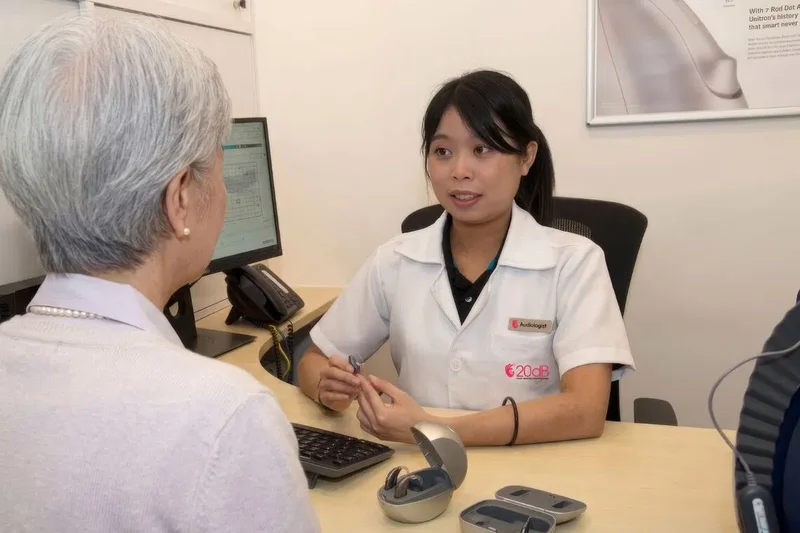
That understanding continues to shape how 20dB Hearing approaches hearing care. Rather than focusing solely on hearing aids, audiologists first seek to understand each person’s hearing profile, lifestyle and communication challenges before recommending a personalised solution.
Beyond the hearing test, says Wong, she seeks to understand how hearing loss affects each client’s daily life, communication needs and lifestyle, as well as their medical history, expectations and preferences.
Regular reviews, counselling and ongoing support then help patients adapt as their hearing needs evolve over time.
Hearing technology has advanced significantly over the years, says Wong. Modern hearing solutions, including those from leading brands such as Phonak and Unitron, are smaller, smarter and more personalised than ever before.
They use artificial intelligence to adapt to different listening environments while improving comfort and performance.
She has also noticed changing attitudes towards hearing aids. “People are generally more open to adopting them as technology becomes more discreet and advanced, and there is greater awareness that they do more than address hearing loss,” she says. “They support communication, improve quality of life and help people stay socially connected.”
With 12 hearing care centres across Singapore, 20dB Hearing supports patients across the island, making hearing care more accessible.
To further enhance accessibility, 20dB Hearing recently celebrated its 24th anniversary with the official opening of its 12th hearing care centre in Kovan.
Mok Yong Yaw, founder and group chief executive officer of 20dB Hearing, says: “For 24 years, our purpose has been to help people hear better and live better. The opening of our Kovan centre reflects our commitment to bringing trusted hearing healthcare closer to the communities we serve.”
After supporting thousands of patients, Leu shares that the biggest lesson has never been about technology, but about people.
She says: “Every hearing journey is different, but they often begin in the same way, with someone deciding they no longer want to miss the conversations that matter.”
After 24 years, that remains the goal of every hearing journey at 20dB Hearing.
“Better hearing is not only about restoring sound. It is about restoring confidence, participation and connection,” she adds.
For more information or to book an appointment visit 20dB Hearing*. *