Branded Content
AI, sanctions and geopolitics: What they mean for businesses operating across borders
As cross-border business disputes grow more complex, legal experts from around the world will gather at Singapore Convention Week 2026 to explore solutions
Rachel Chia, Brand Newsroom
An employee uses artificial intelligence to draft a report, write software code, or create a design for a client project.
The work may be done more quickly. But legally, tricky questions could arise: Did the AI model have permission to use the data for training? Who owns the resulting work? And who is liable if the output infringes someone’s copyright?
It becomes even more complicated when the AI provider, the user and the data all sit in different countries.
The use of AI is creating new types of disputes over areas like data rights, model outputs and technology transfer, says Ng Sook Zhen, director at Zenbridge Law, whose firm specialises in cross-border corporate and commercial matters.
It is one of three trends reshaping the complexity of cross-border disputes, says Ng. The other two are geopolitical tensions pushing businesses to diversify where they operate, and more regulatory layers such as sanctions exposure, data localisation and corporate governance rules.
Against this backdrop, Singapore’s reputation for neutrality, reliability and the rule of law has become increasingly valuable to its competitiveness, says the Ministry of Law’s (MinLaw) deputy secretary (Development) Charlene Chang.
The rule of law is a legal principle that requires everyone, including the government, to obey the law.
How cross-border commercial dispute resolution can adapt to these pressures – without compromising fairness, integrity and the rule of law – will be a key focus of Singapore Convention Week (SC Week) 2026.
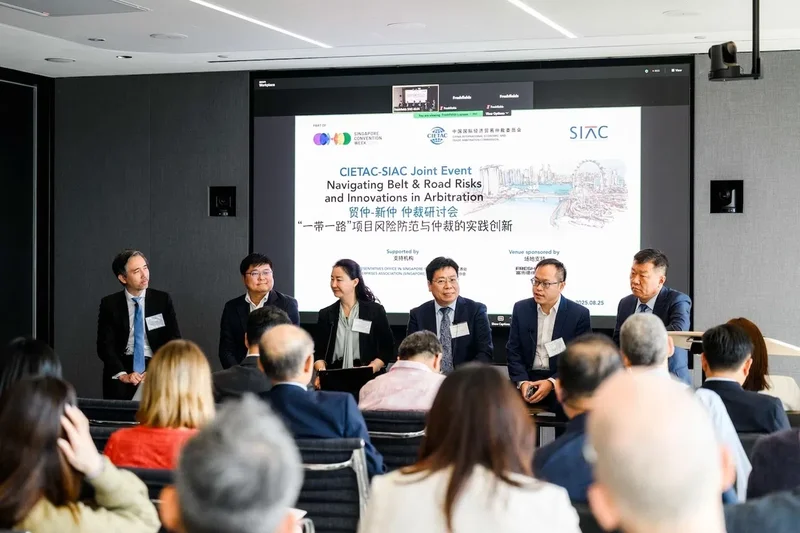
Organised by MinLaw, SC Week will run from Aug 24 to 28, 2026, at locations including Shangri-La Singapore, Gillman Barracks and Marina Bay Sands.
SC Week was first organised in 2019 to commemorate the Singapore Convention on Mediation, or SCM. (see box)
Since then, SC Week has expanded into a global platform to foster understanding of mediation and the SCM, as well as for legal, business and policy communities to discuss emerging issues influencing dispute resolution, such as geopolitical developments and AI.
Last year’s SC Week saw over 5,600 participations across 60 partner and associated events.
The Singapore Convention on Mediation (SCM)
- What it is:
SCM is the first United Nations treaty to be named after Singapore, which played a key role in the negotiations and drafting of the text. The landmark trade law treaty makes it easier for businesses to enforce mediated settlement agreements across borders.
It opened for signature in Singapore in 2019. As of August 2026, SCM counts 60 signatories, including China, India, and the United States, and over 20 contracting parties.
- What it does:
Under the SCM, businesses involved in international commercial disputes can engage in mediation, with outcomes enforceable in jurisdictions that are contracting parties. This gives businesses greater certainty in international commerce.
Growth through trust
Chang notes that Singapore’s dispute resolution ecosystem offers businesses “strong confidence that there will be a fair, efficient, transparent and trusted path to dispute resolution” through institutions, including:
- The - Singapore International Arbitration Centre(SIAC), an internationally recognised institution providing arbitration services - where a neutral third party is appointed to settle a dispute - to parties from around the world;
- The - Singapore International Commercial Court(SICC), part of the Supreme Court of Singapore, is designed to deal with transnational commercial disputes; and
- The - Singapore International Mediation Centre(SIMC), which promotes dispute resolution through mediation, capacity building and thought leadership.
A strong legal system also attracts multinational corporations (MNCs), investments, and “high-value business activities”, Chang adds.
Over the past decade, the number of Singapore-qualified in-house legal counsel has more than doubled. This figure is consistent with the rise of MNCs that have chosen to locate in Singapore, according to MinLaw.
“For ordinary Singaporeans, the rule of law may seem like an abstract concept,” Chang says, “but it has driven our economic growth.”
She explains that as businesses expand across borders and transactions grow more complex, “disputes will inevitably arise”.
“Businesses will require dispute resolution mechanisms that are neutral, efficient, trusted, internationally enforceable, and also commercially practical. This is where we hope Singapore can play a part,” Chang adds.
Milestones and mandate
SC Week 2026 is themed “Timeless principles, timely solutions: Nurturing trust in a changing world”.
Chief executive officer of Singapore International Mediation Centre (SIMC) Chuan Wee Meng says the focus captures the key challenge in dispute resolution today: preserving fairness, integrity and the rule of law while navigating a changing global environment.
SIMC has been a partner organisation of SC Week since 2019.
In 2023, SIMC organised a declaration signed by 43 international business associations and MNCs, including Meta and Microsoft, to support mediation to resolve commercial disputes.
Chuan notes that this year’s SC Week will commemorate two legal milestones:
- SGLaw200, which commemorates 200 years since the foundation of Singapore’s legal system; and
- The - 60th anniversary of the United Nations Commission on International Trade Law (UNCITRAL), which marks six decades of advancing and promoting international trade law across the globe.
“These milestones provide a foundation for asking what institutions, practitioners and policymakers must do next to sustain confidence in international dispute resolution, including mediation,” says Chuan.
Headlining this year’s SC Week lineup is UNCITRAL Academy – jointly organised by MinLaw and UNCITRAL.
The UNCITRAL Academy is targeted at international leaders from the legal, business and government sectors. Its programme includes a government capacity-building workshop on mediation and the SCM, catered for government officials.
Despite rapid changes in the global landscape, what should not change, says Chang, are the principles disputes are resolved by: fairness, impartiality and the rule of law.
“As we embrace new technologies and respond to new challenges, we must ensure that these enduring principles adapt to the shifts and continue to guide the way disputes are resolved,” she says.
In partnership with the Ministry of Law