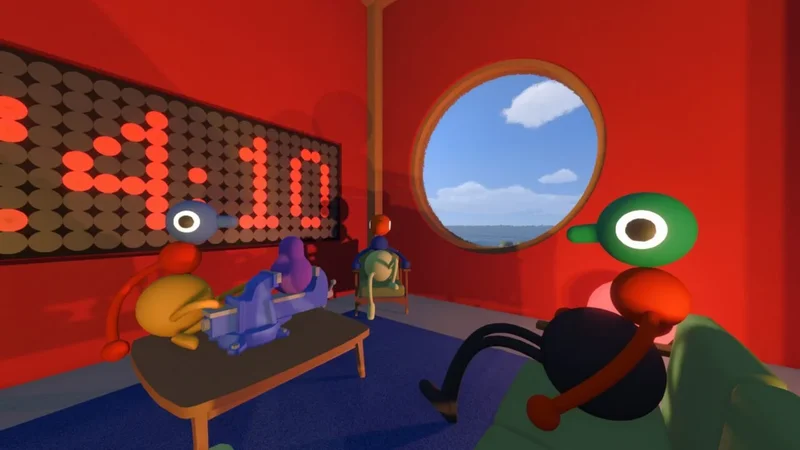
After over a decade of remote work in a very remote industry covering an equally remote industry, Iâm a little exhausted by Zoom interviews. The vast, vast majority of my conversations with developers take place in little video boxes, often with poor-quality webcams and audio and everyone feeling a bit disconnected and unusual. That doesnât mean all or even most of my interviews are bad ones (I hope!), but thereâs certainly something far more exciting, tangible, and emotional about getting to do one in person. Itâs often easier to connect with the other person, and I feel like I get better answers.
But even those can be a bit stilted, perhaps just because of the inherent oddness of sitting down with someone for a period of time and grilling them with questions. Itâs often led me to wish there were better, more comfortable ways to speak to people, especially in situations where Iâm not grilling a CEO on their latest terrible practice, but rather chatting amicably with an artist whoâs made something I deeply, deeply love.
I am so happy that the developers of Big Walk not only agreed to my invitation to be interviewed within Big Walk, but that it went as well as (if not better than) I could have hoped. I went on a nearly 90-minute stroll with Stuart Gillespie-Cook, Jake Strasser, and Nico Disseldorp, three of the five full-time members of House House. For a lot of the walk, we werenât doing anything more complex than sitting somewhere and waving our little charactersâ arms around. But there was just something delightful about the environment, the silliness of it all, and just existing within their creation that broke through the stiffness I often feel in Zoom interviews.Â
Maybe it was the effect of the interview space, or perhaps itâs just that Gillespie-Cook, Strasser, and Disseldorp are entertaining people and artists who gave great, thorough answers to all my questions. But whatever the case, I didnât want to split this interview up into a bunch of smaller stories, or summarize or truncate it in any way. I think the whole conversation was worth printing, so here it is. Responses have been lightly edited for length and clarity. One question and its answers, regarding the âlog outâ noise, was moved from its actual location in the interview at the very, very end to a spot where it flowed a bit better for readers, but otherwise the pacing is untouched.
All three of them told me their official title was just âdeveloper,â but did give me a bit more preliminary info on what their roles were.
Stuart Gillespie-Cook does âcapital G Game Design,â âlooked at the animation,â and lately has done a lot of QA. Heâs depicted as (from top to bottom) red, blue, and yellow in the attached screenshots.
Jake Strasser is âresponsible for the worldâ alongside (not present) Kalonica Quigley, who is House Houseâs first new employee, hired when the studio grew from four to five between its previous release, Untitled Goose Game, and the new Big Walk. Strasser says he âput all the rocks everywhere,â did a lot of technical art, and âprobably made it really hard to walk for you.â Heâs in the screenshots as the green, red, and brown character.Â
Finally, Nico Disseldorp is a programmer and designer, and made a bunch of Big Walkâs challenges along with Gillespie-Cook. Heâs blue, red, and gold in the images.Â
The final member of House House, not present, is Michael McMaster, who was in charge of âaesthetics.â
One last note: this interview covers every aspect of the game, including the ending. Major spoilers are ahead, so please proceed with caution.
[We start our walk from the tutorial room and head out a big door to a section of the island players tend to visit later on. Weâre headed to a train station we know is just over the hill, and the train will take us to a place I call the âFive Minute Roomâ where I suggest we conduct part of the interview. Gillespie-Cook takes along an orb-shaped item from the tutorial room that can be turned on and off to use as a light.]
I’ve read a bunch of other interviews with you guys coming into this. I read that this was a pandemic game, and you guys talked about having a prototype of Big Walk within one week. What was that prototype that you had in one week? What did it look like? What did you do in it?
Disseldorp: I think you looked pretty much like this, I think. You’re just like a model that jumped up and down, right?
Strasser: No!
Disseldorp: Youâre gonna get us arguing now.
Gillespie-Cook: There were a few different characters, before. I think you could spawn as one of two characters and there was one and this was another.
[At this point weâve reached the train station. We all go to stand on the platform and wait for the train. Strasser checks the train schedule.]
So this little three balls, with legs and arms, and a little duck-like face? This was, from the beginning, you looked like this?
Disseldorp: Pretty early on, but they didn’t animate. And then there was a big, it was a pretty big space. You’d walk around, but there was nothing in it at all. Like it was, it was just a terrain basically. And it had proximity voice chat that meant you could only hear people if you’re pretty close. And we were just having so much fun, just walking around and making sure we were staying together and making sure no one got too far ahead. If you started running off, you’d have to really turn around and say, like, “Is everyone here? One, two, three. Okay.”
Was there anything in it? Was it just like a big blank space? Did you throw some random physics objects in it or anything?
Disseldorp: Yeah, I think you could probably throw a physics object. I think there was one of these. [He indicates the orb-shaped light Gillespie-Cook has been holding, takes it from him, and turns it off.] I don’t think it had a light.
Gillespie-Cook: Yeah. That one was very early.
Strasser: Was that the Faroe Island photo scan?
Disseldorp: Yeah, yeah it used a photo scan. I think it was Faroe Islands at that point.
**Is that the island [that  **
Big Walkâs map] is based off?
Disseldorp: No, this is Wilson’s Prom[ontory National Park] in Australia.
Strasser: When I say Bjork’s house, does that mean anything to you?
No, butâ¦like the musician? Maybe?
Strasser: That’s just an idea, I think. I donât know if itâs actually her house?
What?
Strasser: There’s this incredible house onâis this, is this just a me thing or is this an everyone thing?
Disseldorp: I have no idea what you’re talking about.
Gillespie-Cook: I can picture the image you’re talking about.
Strasser: I think if you Google-search Bjork’s house, this turns up. I’m not sure.
Gillespie-Cook: Wait, this is, this is a vibe thing, right? It’s not where Bjork lives. Is that correct? It’s the kind of place Bjork would live.
Strasser: I think it’s maybe through a Reddit post. Maybe it is Bjork’s house. I don’t know. It’s the first result.
[Everyone is laughing at this point.]
Gillespie-Cook: Imagine the kind of place where Bjork would live and that’s where the first game took place.
Strasser: The Faroe Islands are like, they’re north of the UK and they’re incredible.
Disseldorp: I think they’re part of Denmark or something.
[Itâs not Bjorkâs house, but given that thereâs a whole Snopes article about the image Strasser is thinking of, I can see why he thought it was. And heâs correct, it does look like the sort of place Bjork would live. I was a bit confused during this part of the conversation so I’m not sure which of the Faroe Islands was the actual terrain map used at the time, but I think their explanation paints a pretty clear visual picture either way.]
Strasser: They’re very isolated, beautiful islands. It made sense as a video game level because they’re so small. And it seemed, when the game felt like it would be smaller, it seemed like it could be a spot to set something like this. But I think we very quickly realized that we wanted to make something that was more local and, you know, responded to things we knew about more.
[We can hear the train coming at this point.]
Gillespie-Cook: I think, especially after Goose Game, right? Why aren’t we just making a game about our backyard?
[We all leap onto the train, which has just arrived. Disseldorp drops the light orb into the little storage bin near the front, then leaps off the train to grab the clock stuck on the wall at the station before jumping back on.]
Disseldorp: Sorry, I just thought Iâd bring a clock.
Our group has been trying to figure out what the clock is for.
Gillespie-Cook: Oh, would you like a spoiler?
Yeah, sure.
Gillespie-Cook: Itâs for telling the time.
[Weâve all sat down in the passenger area of the train. Disseldorp is next to me, the others sit across.]
I’ll let them know. They’re going to love that.
Disseldorp: There are a couple of weird solves you can do with a clock if you’re really in the mood. Like, um, a couple of really far-away synchronized button presses. And you can say like, all right, I’m going to hit it on the minute, every minute. And then you can sync up without communicating just with that as you play it, provided everyone brings a clock.
[I can briefly see the sun starting to set out the windows behind Gillespie-Cook and Strasser as the train chugs along around the west side of the island.]
So you have this photo scan of Bjork’s house, I guess. And you guys are just running around in proximity chat and this is really fun. And you’ve decided you were going to turn this into something. What is the first thing you do to turn this into something that you can, I guess, sell people and say is a game?
Disseldorp: I think the idea that we were going to sell this to people was way later.
Gillespie-Cook: Yeah, it was potentially just a tool for sharing around to friends or something.
Disseldorp: We can have a party here.
Strasser: Let’s play a game.
Disseldorp: I think our most immediate goal was like, if we get this good enough, we can have a little party with our friends here. In like a month.
[The train starts to go through a tunnel. Everyoneâs voices echo as we speak.]
What would “good enough” have looked like? What were you doing with it at that time?
Gillespie-Cook: Being desperate for human connection of any kind at all.
Is it still 2021?
Gillespie-Cook: I think maybe the most concrete design goal I had in mind was that, I’ve told this story before, but like going on a bunch of Zoom calls with everyone, because it’s someone’s birthday or whatever, and everyone’s trying to talk over the top of everyone else. And it’s absolute chaos. I imagined that experience, but there were just breakout rooms in a very natural way where you could just walk around the corner and not have to have the same conversation as everyone else. And that seemed so appealing to me.
[We exit the tunnel. Still some daylight left, and I can see the ocean out the window.]
Strasser: When we were talking about bringing it into a space or setting that we knew more about, the house party came up for sure. I remember just like, you can walk down to the park that’s nearby and go hang out there, and just the urban experience of being at a party felt very appealing. I’m not sure what then made us expand the world into this.
Gillespie-Cook: I remember making a first challenge. I remember making that gauntlet.
That obstacle course thing where youâre climbing over trying to get to the end?
Gillespie-Cook: Noâ¦
Disseldorp: It was one that doesn’t exist anymore. It was a bunch of doors, basically. And one player had to walk through a tunnel and the other player had to open all the doors to let them through. And it was just like real basic co-op stuff.
Strasser: It was un-fun. Uh, should we jump off at this station? Walk over the hill?
[Everyone agrees. I get too eager and start to jump off but they stop meâweâre getting off at the next bridge. We enter another tunnel as Disseldorp speaks.]
Disseldorp: I think that the moment we had these characters, though, lwe weren’t necessarily as focused on “you’ll be able to split up” as much as “it’s fun to have a character and pay close attention to each other.” I think the scale of the interaction was actually the revelatory thing. If you don’t have something else to do and you’re really just focusing on the people you’re playing with, then you can put in things like hand movements and waves and picking people up. And rather than it feeling like a bit of added noise or something, it’s something that you really pay attention to and can feel really intimate and make you feel connected to the people you’re playing with. And we realized that that was the scale where we wanted to be making the game was this place where you’re making lots of eye contact and everyone’s noticing things you’re doing and lots of your verbs were about showing and expressing and communicating rather than anything else. And it got more and more communication in it, both with the proximity voice chat stuff and we’re putting in radios and things like that, as you want to do if you’re making a proximity voice chat game. But also these bodily communication styles and stuff as well. And I think at some point it started feeling rich enough that we could make challenge out of it.
[Weâve exited the tunnel. The sun is almost fully set at this point; itâs dim outside but thereâs still a tinge of pink. Gillespie-Cook grabs the light orb from the storage bin. Disseldorp jumps off the train and down a cliffside slope before Gillespie-Cook can say the following:]
Gillespie-Cook: I’m so sorry to interrupt, Nico, but let’s go.
[We all follow him, falling into a dense brush far below the tracks.]
Wheee!
[Everyone bonks on the ground and is briefly stunned, but we managed to stay together, and Gillespie-Cook still has the light orb, which is a good thing because itâs getting very dark.]
Gillespie-Cook: We havenât done many interviews in Big Walk and I’m shocked every time how derailing it can be that you just all of a sudden have to do a big jump.
[We start walking into the forest, with the three developers alternating leading the way and Gillespie-Cook holding the light. They are adept in a way I am not used to at remembering to turn around and make sure that weâre all staying together and they havenât lost the journalist somewhere. We can only see a few feet in front of us at any given time but having, you know, made the game, the trio knows where theyâre going.]
So you added this challenge and even though you say that that challenge was scrapped and was not good, it was clearly fun enough to keep going with, to make more of them.
Gillespie-Cook: Well, it was maybe, it wasn’t even the fact that it was good enough. It was like, it was bad in ways that were interesting, that we were like, “Well, how come that was bad? What is the good kind of interaction and the good kind of cooperation you can have in this game that doesn’t just feel too easy or rote or something like that?” And I think that turned out to be a very interesting question to answer. Like, what is the cooperation you can have that doesn’t feel like either one person is just in charge of everything and is taking the lead and everyone’s just following them, or just feels like everyone’s participating but in a nothing-y way where no one really feels like they have any ownership of it. And just trying to answer those design questions became a good little interesting puzzle for us to sink our teeth into.
[We reach a beach and begin walking along the shoreline. Itâs fully dark now, with a clear sky of stars overhead.]
What was the first puzzle that you guys came across that clicked for you?
Disseldorp: I can’t remember, though I feel like there was a week where we probably made like 15 challenges in a week, which is weird to say now because by the end of the game, it would take us like a month to make a challenge. But there’s something about the start of a project where everything’s really fast and it’s not clear why that ever stops. [We begin climbing up a bunch of rocks near the shore.] And I think we ended up keeping about half of them in the end. Like this one was probably made in like the first week of making challenges.
[Heâs referring to the puzzle weâve just entered, a small house on the beach with two large windows. It contains a three-person couch, a chair, a coffee table with a weird device on it, and a giant timer on the wall set to five minutes. There are four switches on the back wall. We each press one, which locks us all in the room, and the timer begins to count down from five minutes. In Big Walk, this âchallengeâ is just to sit in the room and wait out the timer. Gillespie-Cook takes the chair, Strasser and I sit on the couch, and Disseldorp stands for a while before eventually sitting on the coffee table that holds the challengeâs reward.]
Really?
Disseldorp: And we kept this. Like it got a new model and it got a fancy timer and stuff, but we had a version of this pretty early on without really thinking too much about it. I think our heuristic for what made a Big Walk challenge at that point was just, what’s something that we can get you to do that involves a bit of cooperation, but never takes the focus away from the people you’re playing with?
Apparently for this one, the answer is nothing. You can get people to do nothing.
Disseldorp: Yeah, you get it.
So we’ve got this thing here. [I point at the prize in the middle of the table. Itâs a red object shaped roughly like a stereotypical Kong dog toy, and itâs being held in place with a big blue clamp.] You’re not going to tell me what the name of this thing is, are you?
Everyone, at once: Oh, no.
Disseldorp: You know what this thing is, itâs whatever you call it. Thatâs the name of it.
Do you have a name that you all call it though? Even if you won’t tell me what it is.
Disseldorp: Yeah, we call it something, but it’s really unimportant what we call it. And we shouldn’t have any more weight than any other group.
Do you have any favorites from among the things that you’ve heard other people calling it?
Gillespie-Cook: Oooh, that’s interesting. I do think it’s more about the aggregate. It’s more about how different it can be. There’s some impulses that are like, obviously, I like how very Freudian most people’s names are. It’s always a baby.
[Everyone laughs]
Strasser: Nipple and baby, yeah.Â
It’s a weird shape! Why is it likeâwhenâat what pointâwho designed that?! Who decided that is going to be the reward?
Gillespie-Cook: Oh, interesting. We’ve talked about this shape for a while before making this game, I would say. [Strasser is laughing] Me and Michael had a few conversations about how it was the perfect 3D shape. And it is lucky that it has a lot of good affordances in the game as well. It rolls in a funny way and like, I don’t know. It does, it does just look compelling. Something about it. Something alluring.
Strasser: I think, Stuart, you’re the most into this shape.
Gillespie-Cook: I’m the most into the shape, but Iâyeah, absolutely.
Strasser: You’re the most Freudian of us, all too.
Gillespie-Cook: No. No. [Strasser and Disseldorp laugh.] It just reminds me of my parents. It’s fine.
Do you recall at what point you all decided that this [shape] is the reward? That youâre going to put it in this sort-of-wind-up-clamp kind of thing, and youâre going to spit confetti and honk a clown horn at you when you do something well?
Strasser: This device [he indicates the blue clamp holding the red shape to the table] I made really, really early on. And I think it was one of those things [that I thought] weâd change at some point. Six years later, here we are.
Gillespie-Cook: It was an interesting conversation, actually, of like, how do you make this thing seem close, but far away? [Gillespie-Cook gets up from his chair and stands next to the table, gesturing at the red shape.] Like, how do you communicate? It’s not ready for you yet, but it is still like, tangible. You can get up and touch it. It’s, it’s so close to your grasp. It’s not in a box and it doesn’t spawn in and it doesn’t, whatever. It’s in the world and you can see it.
Disseldorp: You’re not like, “What are we going to get? Oh, it’s one of these again.” It’s like, no, it’s right here. It’s very clear what this is all about.
And then the, I guess I’ve been calling them the hard-mode ones… [Iâm referring to a version of the red shape that is purple, which you receive as a reward from harder puzzles. They are identical in form and function, just a different color.] It’s the exact same thing. It’s purple. I don’t have any questions about that. It’s just, it’s a purple one.
Gillespie-Cook: Yeah. Yep. Makes a different noise when you put it in the thing. [The receptacle for the shapes, where you effectively âturn them inâ to unlock things in the game.] Pretty straightforward.
[Strasser laughs.]
Disseldorp: That’s game design 101, right? Get a hard one, make it purple.
What compelled you to create an antagonist for this game?
Gillespie-Cook: What compelled us? [Everyone pauses to think.]
Why is the antagonist a bell? Because after Untitled Goose Game, do you all have something against bells?
Gillespie-Cook: I am gladâwe’ve had that conversation internally. I’m glad someoneâI don’t know why that is. Why do we dislike bells?
[The clock on the wall begins counting down the final ten seconds of the puzzle as Disseldorp speaks.]
Disseldorp: I think someone fromâoh, we’re running out of time. Are we still allowed to answer your question if we run out of time?
[They all chuckle.]
I don’t know. I suppose that’s up to you. Maybe Iâll just vanish.
[The clock runs out. Thereâs a clown honk sound and a shower of red, blue, and yellow confetti falls from the ceiling. A second later, thereâs a slow ratcheting sound as the clamp begins to loosen from the table to release the red shape.]
Strasser: We can go to the 30-minute one.
Yeah, we can do that. That’s a little bit more of a journey too. We can go on the ski lifts.
Gillespie-Cook: All right. Yeah, yeah, sure. [The red shape is freed from the table and I grab it.] Leave this thing here, it’s probably not important.
I was going to kick it off the cliff.
[We head toward the door. Itâs now daytime outside again. Gillespie-Cook has the orb light.]
Disseldorp: I did hear, so Panic have their preview room. [I walk outside as Disseldorp speaks and boot the red shape off a cliff toward the ocean.] I’m sure you’ve seen an image or something of their special rooms set up to kind of isolate the different stations. So even though you’re in the same room, you can’t really hear each other. And they said someone came in the room and they were looking at the game and going, “I think maybe House House made this game.” And then they saw the cowbells and they were like, “Oh, definitely House House made this game.” They really got us pegged as being obsessed with giving our video game characters little bells.
Was there a point where you were just trying to find annoying items to put in here?
Disseldorp: I mean, always, we were always trying. [As he speaks, the other two briefly converse as to the direction we should walk and start leading the way into the woods again, up some slopes.] Every item has to be a bit annoying to be able to put it in here. But yeah, the antagonistic bell, I think it just feels right that, like, the antagonist in this game is about sound. And I guess for us, that’s bells. That’s what bells are, an object that affects sound.
Were there any items that you had to cut because they were too annoying or not fun?
Disseldorp: I’m sure we have cut a few things. Maybe there are a few things that went through some evolutions as well, like the music player went through a few different evolutions, which were just kind of less and less practical until we got to the ones that we’ve got now, which I think work really well for everyone.
Is the music player just for musicâaaaah baah bah! [I briefly get stuck on some rocks, they wait for me.] I kept trying to solve a puzzle with it, but it’s just a radio that you can attach.
Disseldorp: Yeah, it’s just for listening to music. I think you can solve some challenges with it if youâagain, I’m just telling you, there’s unusual solves, like with the clock.
Oh, I’m sure. Speedruns of this game are going to be absurd. People are going to come up with the weirdest stuff to do.
Gillespie-Cook: I started watching my first glitchless speedrun.
Disseldorp: Wait, where are we goingâ
[Strasser is in the lead and is guiding us up a rock face via a series of particularly tricky jumps. Itâs a little tough to navigate.]
Disseldorp: I would never have known about this spot.
Gillespie-Cook: No.
Strasser: This is a bit tricky here, maybe. I’ll pick you up.
[Strasser lifts me up to the next rock. We all begin chaining picking one another up and handing each other off to someone on the next rock above to scale to the top.]
Amazing.
Disseldorp: Is this a real path, Jake?
Strasser: I thought it was, but it’s feeling less so.
[I try to pick up Gillespie-Cook to get him up the last rock, but accidentally take the orb from him and drop it off the cliff.]
Oh, shoot.
[Everyone laughs on and off as we struggle the rest of the way up, until we all make it up and continue walking. Strasser continues carrying Gillespie-Cook for a short ways.]
So you’re watching a glitchless speedrun?
Gillespie-Cook: Yeah, yeah, very first proper glitchless speedrun this morning.
How fast did they do it?
Gillespie-Cook: I’ve watched maybe the first 10 minutes, and I really want to savor it. I think they’re playing with one other person. You can coordinate the stream, so you’re watching it at the same time. Yeah, it deserves a little afternoon, I reckon. I’m very excited for that.
Disseldorp: Where are we going, Jake?
Strasser: In my head, I thought we were heading over there, but I got mixed up for a second. [Everyone laughs]
Disseldorp: Wow, Jake himself, lost in Big Walk.
How many times have you gone through this game?
Disseldorp: Um, Stu and I go through more than Jake.
Strasser: I fly around it all the time. I think I know it the best.
Disseldorp: But not on foot, it would seem. We’ve probably played through all the way to the end, as a group of all of us, probably like 10 times or something. But Stu and I have probably played more like 30 or something. A lot of the time we just kind of drop in. Sometimes we’ll just drop in for the day and just have a little meeting in here, or have a scout or something. It’s like we’ve got a new thing that needs a location, so we’ll kind of walk around looking for a really good spot to put it. And it’s often more convenient to do that in-game than it would be to scout around someone’s monitor.
I guess you guys can just have work meetings in here, huh?
Gillespie-Cook: Yeah, yeah. It turns out it’s very useful to like, if you’re pointing at a tree and being like, “Oh, this is no good,” you can just walk up to the tree and point at it. It’s very convenient.
Disseldorp: Yeah, like when we were meeting with Sam and Luke, who made the music, for the first time. We’d go sit in the five-minute room like we did just before and sit on the couches and talk to them and stuff.
So I want to ask about the music. I saw that Panic posted the band and I immediately ran to Bandcamp and listened to all that. Who are these people? Like, what is this band?
[Weâve finally arrived at the ski lift. I look out over the top of the mountain to see weâve essentially walked across half the map for some reason. Only two people can ride on a chair together, so weâll have to split up.]
Whoever’s answering this question has to get on the ski lift with me.
Disseldorp: Jake, you go together.
Strasser: I’ve known them both for the longest, soâ
Disseldorp: Yeah, Jake’s made a video for them.
Gillespie-Cook: Bye!
[Strasser and I hop on a chair. Disseldorp and Gillespie-Cook ride on the one behind us. We canât hear them at all thanks to the proximity chat.]
Strasser: So their names are Sam Gill and Luke Neher. I went to primary school with Sam and high school with Luke. And I would say they’re two different best friends from different stages of my life. At the end of high school, they started making mashups and would DJ at the kind of clubs that would cater towards underage people for a while. And then they got more serious and started releasing music under the name Ara Koufax. And I think we tweeted about it, but their first video game credit was in the GTA Nightclub expansion. So they had a track that, I don’t know this stuff very well, but one of the DJs had their track in his set.
Fun fact:
Big Walk is actually Luke and Sam of aksfx's SECOND videogame credit.Their first was this track in GTAV: https://t.co/nL7NcS7n8c
— House House (@house_house_) August 1, 2026
That’s amazing.
Strasser: Yeah. I think they sort of wound up Ara Koufax a bit, and have just been doing more, I guess, just professional, being-a-mid-30-year-old work. And so the spin-off for this is called AKSFX, which is “Ara Koufax Sound Effects,” unofficially, I guess. And yeah, we love to work with people that we know. Just working with your friends, but also in the sense giving back to your friends by giving them work and that sort of stuff. And so when we were thinking about what we could do for music for the game, that came up as our friends who are cool music producers. We got them on board and just the results have just been, I don’t know, incredible, I think, for us. Especially just like having a part of the game that we didn’t have our fingers all over has been really special.
[As we ride the chair lift across the map, the sun is setting again. Iâm looking at Strasser while he speaks to me but behind him I can see the sun dip down beneath the ocean horizon, with the light going from gold to orange to blue to black. We donât have a light with us anymore, so as the conversation goes on eventually all I can see is Strasser in front of me, the dim lights shining from various puzzles in the forest below me, and the stars above.]
Did you guys give them prompts or any particular direction on what kinds of stuff you wanted?
Strasser: I mean, Luke came up with “Jumping Voices.” Pretty much, we needed music for the trailer and we described what the vibe was and stuff like that, and he was aware. I don’t think he’d played the game at that point, but he knew of the game. And yeah, he just, that came out pretty much as-is very early on. I think that set the tone for a lot of the other music. I’m trying to think how much there was in terms of, like, back-and-forth on that track specifically. I don’t remember heaps, particularly just with the time limit of a trailer and needing to get it out. But, you know, I think maybe the acapella thing was our pitch. I hope it was our pitch, just like, you know, centering the voices and all that. And then from then on, we knew that we wanted these, I think early on we kind of came up with the music that matched the day-night cycle idea.
Yeah, okay, I saw they have time stamps on the tracks, which I don’t think I fully clocked what was going on in game, but it seemsâso it’s per station, and then each station the music changes at the time stamp. Is that right?
Strasser: Yeah, or just the piece of music is a looping 15 minutes, and the day-night cycle is 15 minutes, so the music is composed to orchestrate, you know, it’s the soundtrack to a stage of the day. So that way, like, if you put on “Breathwork” at sunset, you always hear the same thing, and it sounds sunset-y, if that makes sense. I think it’s in [in-game radio station] Journey Beat. There’s a point, and you can sort of see it in the timestamp of the track names, but, there’s a point where you can really hear the sun, the moment the sun sets. Like, the music really comes down to a point, and I think it’s at the moment that the sun dips below the horizon in the game.Â
[We reach the end of the chair lift and hop off. We turn around, but the other two arenât behind us. Uh-oh.]
Strasser: We love that feeling of being with your friends, and being out in the world, and picking music for an adventure, and I guess we didn’t want to give people tracks. But we wanted to try and, we wanted to find a way that could make the music feel appropriate to the moment you’re in. And so scoring the day-night cycle was a good way to, if not guarantee, then at least push what was happening in the music into a space that hopefully feels appropriate for what you’re doing in the time of day, and soâ
[Gillespie-Cook and Disseldorp arrive. They have with them a single walkie-talkie. Itâs totally dark now, but thereâs another light orb near the chair lift that I grab and turn on for this next part of the walk.]
Did you guys go get one walkie-talkie? Is that what happened?
Disseldorp: Yeah, that’s why we were on the car behind the car that we originally got on. I got off to get a walkie-talkie that we went past. Not really thinking about how useless it would be. I see a walkie-talkie, I pick it up. What can I say?
[We enter a dark tunnel with purple walls.]
I imagine we all must have an item that’s like that. Unfortunately for all my friends, in my case it’s the flare gun.
Strasser: Oh, you’re one of those.
We got to the point where we started sticking the flare guns on the belts of the people who were being annoying with them, so that they couldn’t reach them.
Gillespie-Cook: That’s good. Yeah, it’s a kind of tantalizing experience for them. So close, but just out of reach.
Disseldorp: Yeah, like putting it on a high shelf for a toddler.
[We emerge from the tunnel. The sun is beginning to rise. Weâre up on a high peninsula on the south edge of the map, where all the more challenging puzzles are. Gillespie-Cook and Strasser have both also gotten ahold of light orbs now too, while Disseldorp is carrying the one walkie-talkie.]
So in scaling these puzzles, were there any that you found particularly difficult to scale? Like, the crane at the very beginning seemed very easy, and you just make it taller, but some of these I feel like must be quite hard.
Gillespie-Cook: I bet if you asked me as I was in the middle of it, whether it was fun trying to find a bunch of different variations for something that still had the same flavor, I bet I wouldn’t have found it as interesting. But I do think, looking back on it, that the conversations we had trying to distill the essence of a challenge down to its base components, I’d be like, well, what is that? How if that feeling is X with four people, how can it also be X with two?
Disseldorp: I felt like it was generally harder to go down than up. You can make, like, more stations, or put more doors between you, or make you convey more information along a telephone. But sometimes going down, it was like, okay, we’re really gonna have to be incredibly precise about the elements we use in order to keep the feeling working with just two people, and especially to keep it feeling unique. Because it’s like, okay, the obvious way to make this work with two people would be to do this, but then it’s so simple at that point that it’s maybe another challenge. It doesn’t feel like a telephone game or something. So you’d have to figure out, as Stuart was saying, not just what is the same activity, but with less people. It’s like, how can you preserve the thing that is unique about that challenge with less people?
[We arrive at a house nearly identical to the one we hung out in before, but with a 30-minute timer on the wall instead of five minutes, and a purple shape in the clamp instead of a red one. We enter, dump our orbs and walkie-talkie on the floor, push the buttons, and shut the door. Everyone sits in the same configuration as before, unprompted. Gillespie-Cook puts his orb in the chair and stands on it briefly before removing it and taking a seat.]
Are there any sort of solves for this that you found that you thought were particularly clever?
Gillespie-Cook: Oh, the absolute spoilers, but the whole series of challenges at the end of the game, I do feel like that went through so many evolutions. Went through bleak periods of us being like, “Oh, we’ll never get this.” If people are having a bad time in this particular section of the game, it’s so, like, socially difficult, right? Like the fact that you can’t talk to each other makes it that the danger is so much higher. And I think getting those in tune and getting them working was very rewarding. Not in any particular “oh, we solved the one particular thing that was holding us back” [way]. Just like a million little small changes that signposted things a bit clearer.
Strasser: So it took real faith to keep pushing through that.
Gillespie-Cook: We knew the bits where it worked, it was so good.
Disseldorp: We were chasing a feeling. The first time that we lined them all up and they were like rough and prototype-y and just a bunch of boxes and stuff. But we went through ourselves, just me and Stuart I think, and solved them all just to make sure they could be solved. And it took us a while and we got through to the end and suddenly could talk again. And it was such a rush. I was like, shaking with excitement and I knew that I wanted everyone to have that feeling no matter how much work it took. It’s like, it was such aâyeah, there are so many risks of it going wrong and I’m sure it will still go wrong for some people and that’s regrettable. But I wanted to make sure that people could get the feeling I could have.
I feel like we brushed right up against that. There was one puzzleâ¦we had gone back and forth multiple times where we were all in there, like assigning a gesture to each thing in the puzzle with each other. And I don’t know which one of our group members it was, but one of them came up to the window and did something that none of us had agreed was anything. And I just had this brief moment of frustration. We failed it. We came back. We went through all of them again, frantically gesturing, trying to get it down. And I had this brief moment of feeling bad, like, oh my gosh, am I just like…Am I shaming one of my friends right now for not understanding this? But then we got it and it was okay. It was so interesting.
Gillespie-Cook: Yeah, that feeling of like, is someone actually sad right now? Am I bullying my friend? Yeah. I do think, yeah, that relief that Nico’s talking about, the fact that you all get to kind of debrief afterwards immediately, that I think is reallyâWe really tried to pad out that space as much as possible, like give you as much time to just kind of like go over the war stories, I guess, of what happened in there.
Sorry, now this is just me telling you about playing your video gameâ
Gillespie-Cook: Which is secretly what we love. That’s the thing we love most in the world.
Disseldorp: Can we ask you our questions? [They laugh]
**It was the same group of six people, but at one point we shrunk down and did most of the purple hard puzzles with just three of us. On one of the obstacle courses, you have to lift someone up to hit a button at one point. And there was a part during the gauntlet where you have to chuck the timer back and forth, where we couldn’t figure out how to get through the door. You can’t tell who’s who in there, but someone came behind me and lifted me up to see if there was a button on the ceiling in that moment, and I knew it was a callback to the obstacle course in that moment and I knew exactly who had lifted me up, because no one else would have thought that might be a solution. **
Gillespie-Cook: I do think that is one of our favorite debriefing moments of like, “Was it you who was sitting down? It looked like you. It looked like you, had your body language.” Like both the puzzle-solving brain, but also just like, oh, okay. You’re so in tune with these little characters that you can read people’s body language a bit. It’s beautiful.
We, I mean, I don’t think you should ever apologize for telling us about your experience with the game. This was like a very-heavily-informed-by-playtest type of game. And I don’t think I ever got sick of just watching hours and hours of footage. It’s the best. It’s so good.
What is the weirdest thing you’ve seen someone do in this game?
Gillespie-Cook: I don’t think I’ve ever seen someone do something like, “wow, that was crazy” or whatever. I do think there’s been moments of playtesting where it’s just been like, “Oh, this is a bit personal.” I’m overhearing these two people have gone off alone, but they’re a couple and they’re kind of just chatting about their domestic lives in a way that I feel like-
Disseldorp: “Have you fed the dog yet?” “I’ll take him for a walk after we finish playing,” and stuff. And it’s like, we shouldn’t be hearing this.
Strasser: This was in the period where we were literally invisible in the game.
Disseldorp: I watched a group. I don’t think either of you two have seen this video, but I watched a group where people started doing what…I thought they were pretending to have a meeting. They were saying all this generic work stuff, like, “Oh, should we do like a stand up?” And “What are you doing for the next sprint?” And all this sort of stuff. And I thought, “Oh yeah, they’ve really got the language of this down pat.” And then I found out afterwards that they worked together and they were just talking about work. Oh my gosh. I really thought it was a joke. They were like, they were doing kind of little bits, the whole game. I really thought it was a bit. But it turns out that I was just overhearing them talking about their next week of work.
So I checked out the accessibility features, which is essentially like, it puts a button that lets you skip a puzzle if it’s not completable. Was there thought to doing anything more with that? Because Big Walk is very interesting to me as a game that is in some ways, I think incredibly accessible. Like if you have difficulty hearing things, there’s all sorts of little visual cues you can do to communicate with people. But the contrast to that is there’s a bunch of puzzles that you just can’t do.
Gillespie-Cook: Yeah. I think, I do like how broad the skipping feature is. We just let people decide what would be fun or interesting or possible for them. And to what level they want to engage with it. Like there’s potentially this, there’d be people who could get most of the way through a puzzle and then couldn’t do one little bit. And letting them choose their level of engagement, I think has worked pretty well for us so far.
Strasser: I think the game does offer a bunch of different tools that lend themselves to accessibility or different methods of solving. So you could give them the voice chat instead or text chat. If you can’t hear things specifically, like I think it doesn’t hold your hand in a lot of those ways.
Disseldorp: But I mean, it’s kind of inherent to the design of the game that we’re asking you to use different senses and often translate between senses. Like I’m going to describe sounds or use my body to act out sounds visually. I feel like those kinds of challenges, they only work because they involve both of those senses. There’s, like, the traditional video game way of increasing accessibility is like, if there are ever two things that sound different and that’s important gameplay information, they should look different as well. But that unfortunately wouldn’t work for that challenge. So we try and avoid that unless it’s being done deliberately, but we know that not everyone’s going to have that work for them. And that’s why it’s really important to us that there is the ability to skip if you need it.
I hope for some groups that that’s something that they can maybe overcome by using the different abilities of the people within the group as well. Maybe you can pick a particular role in the challenge where you can participate using your abilities while other people are using their abilities. Like there’sâI don’t know if you’ve played, there’s one where you sit in a chair and listen to microphones. So you can solve that without using hearing by using text chat. It works with a text chat. It’ll show up as though it’s coming through the microphone. Because text chat represents something that you’d hear rather than something that you’d see.
Oh, that’s cool. I never thought about that as a possibility.
Disseldorp: But also maybe you’d rather just have, if someone in your group is hearing and someone in your group is hard of hearing, then maybe you’d get the person who hears better to sit in the chair and the person who’s harder of hearing to walk around and make all the noises at the different stations.
[The sun has set again outside and everything is dark. We didnât turn on the overhead lights, so weâre chatting in the warm pink and gold glow of three light orbs scattered on the floor.]
What can you tell me about the extremely interesting audio design in this game apart from the musicâthe stuff like the megaphone, the text chat, the fact that when you shout off a cliff, it echoes in the valley and people can hear you from a distance. Who did all that?
Gillespie-Cook: That would be highly worth an interview in itself. That, on a technical side, is Nicholas Zhang, who works along Em Halberstadt, who’s our sound designer. Both of them work for a company called Shell in the Pit in Vancouver. And they are absolute geniuses. It’s been so good working with them. I think, as part of the game, we don’t actually getâI was going to say, we don’t get too hands-on withâmaybe that’s a bit insulting to you, Nico, because I bet you’ve had your share of audio. But I think that their work seems the most like magic to me. Like you get to come in in the morning and see some new thing that Nicholas has put in to make your voice echo. And it just improves the game so much. And like, from what we thought we were hiring them for, which was just like, “they’ll kind of like implement it for us. And make sure all the, the sounds work…”
Disseldorp: Yeah, so for context, if I can interrupt. So we worked with them on Goose Game, where they did a fantastic job. So we were like, obviously we’d love to work with them again. And a few people from Shell in the Pit came into the game and we gave them a tour, kind of like what we’re doing now. And [we] said what we’re doing and how we’d like it to work. And they took one look at it and said, “You need to get Nicholas to come and work on this game.” And we were like, that’s a surprise. Surely hooking up sound effects, I could do that. I’ve done that before. But we took their word for it. And it was absolutely the best thing that happened to us on this game in terms of things that we would never have been able to imagine all of the richness of the sound of this game ourselves. But they just had this incredible vision that they really understood what we were going for and what it had the potential to be. And then took it way further than we could have ever imagined. And then that ended up informing the design of the game itself as well. Like they’d come out with echoes and, like, great, this is now part of what it means to be split up in Big Walk is that you can climb up on the top of a hill and echo across a valley. Even Nicholas was pretty integral to coming up with the musical challenges in the game. He’s often thinking about that kind of stuff too.
Gillespie-Cook: Yeah. The disparity between what we thought we were getting and what we were actually getting was huge and yeah, just so formative. It was the best.
Strasser: I think getting to work with people that talented as well and just giving them free rein has been such a pleasure. I guess the way that we work, we like to think of the people we work with as collaborators because we bring them on and work together too. I think part of why we’ve kept House House so small is that we don’t particularly want to be managers. And we like to make the game and not be hands-off. We like to be hands-on. But yeah, getting to get someone in and bring them into this world and just let them run free a little bit has been so rewarding.
Who made you go pbbbbt when you log off?
Gillespie-Cook: That was a classic decision by Em, which seems so bold to just do on your own and not ask anyone.
Really?! She didn’t ask? She didn’t say anything? She just put it in?
Gillespie-Cook: I think so much of the stuff in the game, it’s not like we’re briefing her. We might be telling her, “Oh, this material sounds like this” or whatever. But she’ll really go rogue a lot of the time. Sheâll make everything sound pretty natural, and then every now and again she gets to have fun. The sound of putting these things away [he indicates the purple object] was just her having a great time.
Were you all surprised? Did you just one day play the game and then it made that sound [the putting away of the object] and you were startled by it?
Disseldorp: Yeah. It was actually shocking, yeah. [Everyone laughs.] And we talked about it, we were like, this is weird. The sound in this game is always deliberate. It’s so diegetic. We can talk about that, that’s a whole other thing. It’s so important to us that whenever you can hear something, it’s really obvious that other people will be able to hear it too. Because there’s nothing more frustrating in a video game than hearing something and being like, “Oh, I’ve got such lovely music playing. Isn’t it so nice?” And then someone else will be like, “I don’t hear any music.” I don’t know if you’ve ever had that with a Minecraft sunset. But we heard that sound and we’re like, “Oh, it’s so strange. It sounds so disembodied. It’s hard to place where that sound would be coming from. Is there meant to be a little speaker inside the thing?” And then the more we thought about it, we’re more like, that’s actually so special that that moment in particular gets to break the rules. So we ended up saying, “Why don’t you make that sound play really, really loud from really far away?” And then it became a gameplay moment as well, where if you’re ever not with people while they’re putting one of those away, you get to be part of the celebration, even though you’re not there.
Did you all have any particular expectations for how Big Walk was going to be received?
[Gillespie-Cook lets out a huge sigh.]
Strasser: We had hopes.
Gillespie-Cook: We hadâ¦[he trails off]
Disseldorp: I think I was confident that someone was going to love it [the other two make affirmative noises] because we’d seen enough people play it and we knew that when our playtesters, when the game clicked with people, they really, really felt really strongly about it. That was really clear to us. I still thought it was a really risky game. And I think it still is, I think it’s an easy game to end up having a bad experience with. Maybe you’re playing, I don’t know, with the wrong people or maybe you and your friends are having a bad day and you don’t have the patience for the kind of long-form, spacious walking around that this game’s asking you to do. I think that there are a bunch of ways it can go wrong, but I think often through development, we were chasing the high-risk, high-reward option where it’s going to be a little bit dicey, it could go wrong, but I think it would be really interesting if it goes right. And I think I expected that to mean that maybe heaps of people bounce off this game, but some people really love it. And I think now that the game’s out, more people have loved it and less people have bounced off it than I thought, even though there still has been a bit of both.
Gillespie-Cook: And more people have liked the high-risk decisions. I think a lot of this last week has been a little bit self-congratulatory of like, “Damn, so glad we stuck to our guns on proper dark nights. So glad we didn’t sand off too many of the rough edges.”
Did you update the proximity chat because people were talking about it?
Gillespie-Cook: Yeah, that one we hope is just a pretty straightforward fix. I think it was just that people’sâwhich, yeah, it’s crazy that we tested this game so much and just have not really seen the issues that people are having. But from what we saw, people’s mics were just way too low. They maybe just weren’t normalized quite as well as we thought.
Disseldorp: Well, it’s something complicated. I’ve seen people say, I’m just going to be really diplomatic here, because some people have said, “My microphone setup is very loud and it’s still not working well.” So I think it just, for whatever reason, it wasn’t coming out as well normalized as it should. And we’re hoping, it seems to have played out in our testing at least that people’s voices should, when they first start playing, be more similar in level and more similar to the intended level that we imagined people would have.
You called this a very high-risk, high-reward game, which I feel is very true. What let you take a risk on this? I feel like the games industry is actively collapsing under us. You guys were able to sort of play around with something you didn’t really ever expect to be a commercial game for…six years?
Strasser: Goose Game is the easy answer to that.Â
It did that well?
Strasser: Definitely enough for us to work without worrying too much about what we did next.
Disseldorp: I think I went into this project going, Goose Game has meant that we can afford a flop.
What a great sentence.
Disseldorp: We could do one flop. And I think that was part of what made us want to do this game as well, is we had a taste of that certain kind of success with Goose Game, and thought it’d be more fun and less pressure on us if we purposely made a game that we thought was a bit more anti-commercial. We weren’t trying to have a hit like that again. We were trying to make something that we thought was a bit more personal, and a bit more weird, and maybe a bit more of a niche taste. And then fast-forward six years later, and everyone’s saying proximity voice chat multiplayer games are the commercial thing to be doing.
You guys were technically ahead of the trends, really.
Gillespie-Cook: So we didn’t see any of that coming. It’s very bizarre to be working on a local proximity co-op multiplayer game, and watch Lethal Company come out, and be like, ah, damn, maybe the world will be sick of this by the time our game is released. And then just watch the rise of all those games, and kind of come out into the environment we are now.
I noticed we are very carefully avoiding the term “friendslop.”
[Strasser laughs.]
Gillespie-Cook: Of course.
What do you guys think of the word?
Gillespie-Cook: Uhâ¦bad word. I don’t, yeah. I do think slop isâ [he pauses]. We’ve had lots of conversations about how it has just particular connotations of carelessness, which I don’t think any of those games are made with. As just likeâIt’s shorthand for a genre that is completely divorced from its, like, the second you take out the “slop,” it’s fine. I donât care. It’s a genre. I appreciate being able to kind of sum up all those games in a way. Artists never get a say in the name of their genre.
Disseldorp: And importantly, all artists hate the name of the genre. Itâs a universal.
Like months ago, we were complaining about Metroidbrainia, and now we’ve got friendslop on the table instead.
Disseldorp: Yeah, I’m looking forward to the next new low of the genre names.
[All chuckle]
Regardless of what you call it, do you feel that Big Walk fits into a similar genre along with stuff like Peak and Meccha Chameleon and stuff?
Gillespie-Cook: I think it’s really funny that we’ve probably played very little of what people would consider the main parts of the genre. Like, I reckon I’ve played maybe 20 minutes of Lethal Company. Not for lack of interest, I’m very curious to play them all. I think we had a little bit of worry about being influenced, and I think part of it was just like, we just don’t have time to play many social media games anymore in our lives.
But I think maybe what happened is that, like, during lockdown, and maybe even leading into that a little bit, we were playing a lot of, like, just weird Roblox games, or, like, these kind of, like, proto-friendâ [he pauses, unwilling to say “slop”]
Disseldorp: Go on.
Strasser: Games.
[All laugh]
Gillespie-Cook: No, I’m not putting one on the record. Yeah, one of these friend games that I think, I assume there must have just been so much common influence. I think, I mean, that’s my little headcanon anyway, was that everyone was playing stuff like this.
Disseldorp: If you look at any big genre of any art movement through history, you can go back a little bit further and see the ingredients were kind of all there, just out of plain sight, for years ahead of time. And I think that’s definitely the case here. There’s such a strong lineage of strange co-op games that these things are building on.
Strasser: So you’re saying that we invented the lightbulb at the same time, but one person gets the credit.
Gillespie-Cook: So you’re saying, Nico, that Bee Simulator on Roblox is Iggy Pop? The kind of Iggy Pop ofâ¦[Everyone laughs again]
A bee simulator on Roblox? Is that what you guys were playing?
Gillespie-Cook: I don’t know. I can’t remember the actualâ
Disseldorp: Scuba Diving at Quill Lake, that’s the good one.
Gillespie-Cook: Scuba Diving at Quill Lake. Somewhere, Wales was a big one.
Disseldorp: These are our big-influence Roblox games, yeah.
Okay, the clock’s ticking down. [Referring to the clock on the wall of the puzzle room.] We’ve got five minutes. I might get the name here wrong, but I saw on the credits, is it the Sunday Night Games group? Who is that?
Gillespie-Cook: So that’s a good segue. [Disseldorp runs across the room at this point to turn the lights on for some reason, then returns to his seat.] That’s who we were playing all these games with. That’s a group of mostly Britishâthere’s some people local to us, a lot of our friends who we’ve made over the years fromâ
Disseldorp: GDC and things like that.
Strasser: Do you want to name-drop them?
Gillespie-Cook: No, no. I’m trying to think of the best way to sum them up. Because I guess they’re all Wild Rumpus people, right? They all used to run video game parties.
Strasser: We met them in the Push Me, Pull You era. So there’s Marie Foulston, who’s a curator and game maker now. Ricky Haggett and Dick Hogg and Pat Ashe, who are all part of Hollow Ponds. And made Wilmot’s Warehouse and Flock, et cetera. Goldie Bartlett, who’s a Melbourne game maker and artist.
Disseldorp: Faye Buckingham?
Strasser: Faye, yeah.
Disseldorp: Creative technologist.Â
Strasser: Faye Buckingham, also game maker.
You guys just get together and play games together?
Gillespie-Cook: So this was like tryingâ
Disseldorp: During lockdown, yeah.
Strasser: Is that the whole list? Did we miss anyone?
Gillespie-Cook: Well, now that you’ve started listing, it’s going to be really rude if we miss anyone.
Disseldorp: You’ve got to be careful starting a list. I’m just going to open the group chat in the other window. [Disseldorpâs character suddenly tenses up, arms lightly spread.]
**I am just now realizing that that pose that you’re making is what happens when you tab out of the window. I think nobody did that while we were playing, or I didnât clock it if they did. **
Disseldorp: [His character relaxes again.] I think you got everyone, yeah.
Gillespie-Cook: It’s nice seeing tweets every now and again with people discovering stuff like that. It’s like, that couple of weeks of work was worth it. This one person saw this thing. I’m glad.
Disseldorp: But I think it’s all part of the philosophy of making the characters for this game. It’s so important that you know that there’s a person behind the character. If someone’s taken their hand out of the puppet because they’re in another window or they’re gone AFK or something, then it’s important you know, because the rest of the time you’re doing your action for them. It’s not like, I can still do my crafting of potions or whatever it is I’m doing in the other games I love to play. And it doesn’t matter that they’re gone. All the actions I’m doing are for you. So if you’re there, it’s really important I get quick feedback that that’s the case rather than continue to act for the person who’s not watching anymore.
It very quickly forces me to make sure that even if we’re just standing here talking, I’m always moving a little bit because in real life I wouldn’t want to appear bored while someone is talking, even if I’m just looking at the screen. I don’t want to fall asleep while someone’s talking. That feels very rude.
Okay, my last question. Can each of you tell me about your favorite personal moment from playing Big Walk with your friends?
[Thereâs a long pause, Strasser and Gillespie-Cook both give a low âOohâ under their breath.]
Strasser: Thatâs tricky.
Gillespie-Cook: Yeah. I think for me it’s not an explicit moment, but there’s a particular feeling that I think about all the time with this game, which is being alone, but knowing that someone else is somewhere in the world doing stuff and seeing little evidence of them. Like finding a little clue, a little bread crumb [showing that] they were there, seeing them light up something in the distance, that I think is so uncommon in video games and which I love so much every single time it happens.
[Authorâs note: Hi. Before you read Disseldorpâs response, I wanted to stop you and recommend that if you have not yet seen everything you want to see out of Big Walk, you may want to stop reading here. Disseldorpâs response isnât explicitly a spoiler, per se, but it does give a lot of context to both of the gameâs endings that I think is far, far more meaningful once youâve seen them, and it kind of gives away the emotion of them just a little. If you never intend to play Big Walk, or if youâve already seen as many of its two endings as you intend to see, go on ahead. But if youâre still in the process of your adventure, please come back later and read this. I think his anecdote is really special, especially with that context.]
Disseldorp: I think of a memory all the time where some friends of ours played the game for the first time. And it was before there was a big fancy ending with a finale and all the stuff that you would have played. It just got to a point where you ran out of challenges to do. And then we were like, “Oh, wow, they’ve done all the challenges. How are we going to make an ending for them?” It felt like we needed to make the catharsis ourselves. So we all jumped in and just like, appeared to them as the developers and were like, “Oh, you did it! Congratulations!” Then I don’t know how it happened, but we’re all on the beach and they just decided to swim out. And it felt like that was their thing to do, to go for the swim. We’d just come to congratulate them, but it wasn’t. It wasn’t our party. It was for them. So we just all sat on the sand and watched while they got further and further swimming away.
[The clock on the wall begins to tick down the final ten seconds.]
Disseldorp: Oh, I ran out of time on my story. Youâll just have to imagine the rest!
No!
[The clock runs out and confetti sprays from the ceiling. Thereâs a mechanical clank noise as the clamp slowly unwinds and releases the purple object.]
Disseldorp: They swam out and we were watching them and we couldn’t really hear them anymore. We could just get little snippets of laughter as they were doing whatever they were doing as they were swimming out of the water together. [Disseldorp picks up the purple object and holds it above his head as he speaks.] Then they all just logged off and went all stiff and got the crosses in their eyes out of the water one by one. And that was it. They were all gone. And the last thing that we’d heard of them was the little snatches of laughter as they were playing in the water.
And I just couldn’t believe how good that ending was for them. And I feel like having that experience organically in the game was really informative for the endings that we did end up putting in the game. Having this ritualized goodbye as part of the game’s ending felt really important, especially after experiencing that moment and realizing you can’t just go, “OK, I’m bored now. Let’s log off.” Something had to happen at the end that felt like it met your accomplishment and met the devotion to each other that you’d brought to it.
[Thereâs a long silence. I’m glad again this isn’t a Zoom interview because I’m tearing up a little.]
Strasser: I’m not going to match that.
[Everyone laughs, and I let him off not responding to it. We say our goodbyes and thank yous, and I pbbbbt my way out of the world.]