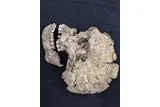
One hundred thousand years ago, someone may have stabbed a young man in the face with a sharp object. Today, his remains are an archaeological marvel.
The fossil, named Qafzeh 25 after the Qafzeh Cave in Israel, where it was found, is between 92,000 and 145,000 years old — a time when archaic Homo sapiens began venturing out of Africa.
According to the team involved, this may be one of the earliest known examples of trauma inflicted with a sharp tool. An unedited version of the paper describing the injury has been published in Scientific Reports.
Evidence of Early Violence
(Image Courtesy of Professor Israel Hershkovitz, Tel Aviv University)
For the study, the team examined the fossil using macroscopic and microscopic analyses with high-resolution micro-computed tomography (micro-CT). They found a lesion on the lower jawbone and one of the lower premolars, which appears to show trauma caused by a sharp object. The researchers believe it is very likely an example of interpersonal violence, though it remains possible that it was accidental.
Crucially, the researchers found signs that the wound was starting to heal — some areas of the bone showed higher porosity, whereas other regions appeared thicker. This is evidence that though deep, the cut itself was not lethal and the individual survived for some time after the incident.
In addition to a micro-CT of the skull, the team conducted a taphonomic reassessment of the skeleton. This led them to conclude that the individual was most probably buried. There was no evidence of damage caused by predators or any indication that the remains would have been left in the open for an extended period of time.
"These findings provide new evidence in the ongoing debate about the origins of complex behaviors such as interpersonal violence, the care of injured or ill individuals, and funerary practices – fundamental aspects for understanding the social and cultural evolution of our species," first author, Ana Pantoja Pérez of the DEATHREVOL research group at the Centro Nacional de Investigación sobre la Evolución Humana (CENIEH), in Spain, said in a statement.
Read More: 146,000-Year-Old Dragon Man Skull Confirmed as Denisovan Through Dental DNA
Burial Practice at Qafzeh Cave
There are multiple individuals buried at Qafzeh Cave, and Qafzeh 25 is not the only one to show evidence of trauma.
According to a 2014 study published inPLOS One, a skeleton of a 12-to-13-year-old boy, named Qafzeh 11, displays injuries consistent with blunt force trauma thought to have occurred in early childhood. Like Qafzeh 25, Qafzeh 11 appears to have been purposefully buried — the skeleton was found with two red deer antlers placed across his chest.
Archaeologists have also unearthed grave goods, stone tools, animal bones and lumps of red ochre — a pigment associated with funerary practices at Qafzeh and other contemporary sites, according to a study published in Nature Human Behavior.
Shells that would have had to have been carried at least 20 miles (35 kilometers) from the beaches of the Mediterranean Sea are also present at the site. According to a 2009 study published in the Journal of Human Evolution, they may have been strung like beads.
Early Ventures Out of Africa
Fossils like Qafzeh 25 continue to offer new clues about what life was like in the Middle Paleolithic (circa 250,000 to 40,000 years ago), an era in which anatomically modern humans were beginning to explore areas outside Africa.
The remains at Qafzeh and other contemporaneous sites, such as Skhul, are among the earliest evidence of such expeditions. Their discovery challenged existing narratives regarding human dispersal, and it is now thought that there were multiple migrations over tens of thousands of years or more.
Read More: What a 1.5-Million-Year-Old Face Reveals About Early Human Migration
Article Sources
Our writers at Discovermagazine.com use peer-reviewed studies and high-quality sources for our articles, and our editors review for scientific accuracy and editorial standards. Review the sources used below for this article: