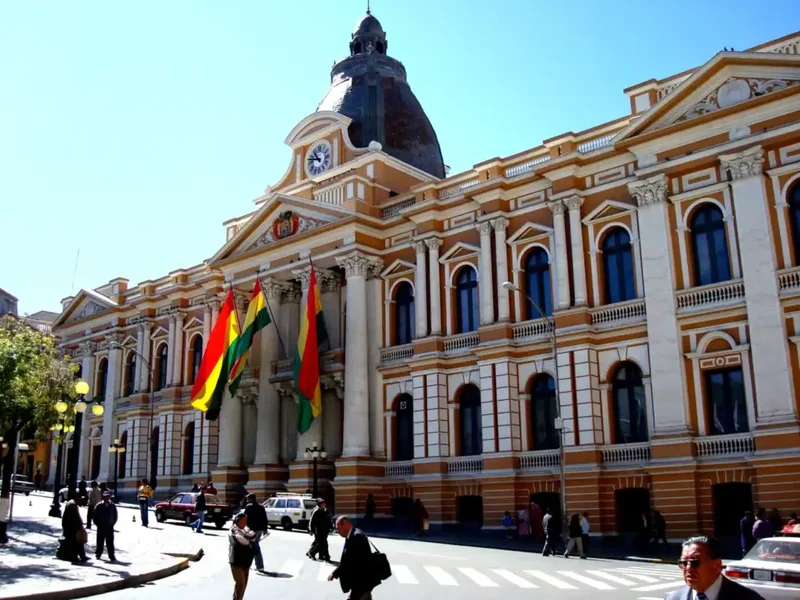
Bolivia’s Congress Votes to Force Out Its Economy Minister
Bolivia · POLITICS
Key Facts
- The vote91 in favour, 34 against, four abstentions, of 129 legislators present.
- The bodythe Asamblea Legislativa Plurinacional, in plenary session.
- The dateTuesday 18 August 2026.
- The effectcensure implies destitution under the constitution and Law 1350.
- The deadlinethe president must remove him within 24 hours of formal notification.
- The ministerJosé Gabriel Espinoza, economy and public finance.
Bolivia’s legislature censured Economy Minister José Gabriel Espinoza on Tuesday by 91 votes to 34, with four abstentions. The constitution gives the president 24 hours to remove him once notified.
What Bolivia’s legislature did
The Asamblea Legislativa Plurinacional approved a motion of censure against Espinoza in plenary session on Tuesday. The count was 91 in favour, 34 against and four abstentions.
That is more than two thirds of the 129 legislators present, which is the threshold that matters.
Bolivia’s legislature and its executive have been at odds for much of the year. This is the sharpest instrument it has used.
Why censure is not symbolic here
In many systems a censure motion is a rebuke and nothing more. In Bolivia it carries a legal consequence.
Under the constitution and Law 1350, censure implies the minister’s destitution. The president is obliged to remove him within 24 hours of being formally notified.
The practical question is therefore not whether he goes, but when the notification lands.
The threshold is two thirds of those present. The 91 votes cleared it with room to spare.
How this came about
The censure followed Espinoza’s failure to appear for questioning by legislators. The motion turned on that absence rather than on a single policy.
The government has called the move unconstitutional.
Espinoza had been summoned to answer questions and did not attend. That is the procedural ground the motion rested on.
The economy he was running
Espinoza took the economy portfolio into a year of acute fuel and dollar pressure. Only weeks ago he put Bolivia’s fuel spending at around US$40 to US$50 million a week.
On 16 August the government moved diesel for large buyers to a world-linked price of 18 bolivianos a litre. That was two days before the vote.
That decree drew objections from farm, transport and mining groups. The censure lands in the middle of that argument, not outside it.
Bolivia has been short of dollars and short of fuel for months. The ministry is the place where both problems land.
What happens next
A replacement has to be named. The fuel-pricing decree is already in force, with its methodology still to be set by ministerial resolution.
Whoever takes the portfolio inherits both the decree and the objections to it.
Bolivia goes to the polls later in this cycle, which shapes how any successor will be received.
Why this matters beyond Bolivia
Bolivia sits on some of the largest lithium resources in the world. Investment terms for them are set by the ministry now changing hands.
For anyone tracking the region’s energy transition, the identity of the next economy minister is a live variable rather than a formality.
Bolivia’s lithium is still largely in the ground. Who signs the contracts matters more here than in countries already producing.
Frequently Asked Questions
What was the vote in Bolivia’s legislature?
Ninety-one voted in favour of censuring Economy Minister José Gabriel Espinoza, 34 against, with four abstentions. There were 129 legislators present on 18 August 2026.
Does censure remove the minister automatically?
Under Bolivia’s constitution and Law 1350, censure implies destitution. The president is obliged to remove the minister within 24 hours of formal notification.
Why was he censured?
The motion followed his failure to appear before legislators for questioning. The government has called the censure unconstitutional.
What was he responsible for?
Economy and public finance, at a moment of severe fuel and foreign-currency pressure. Bolivia moved diesel for large buyers to a world-linked price two days before the vote.