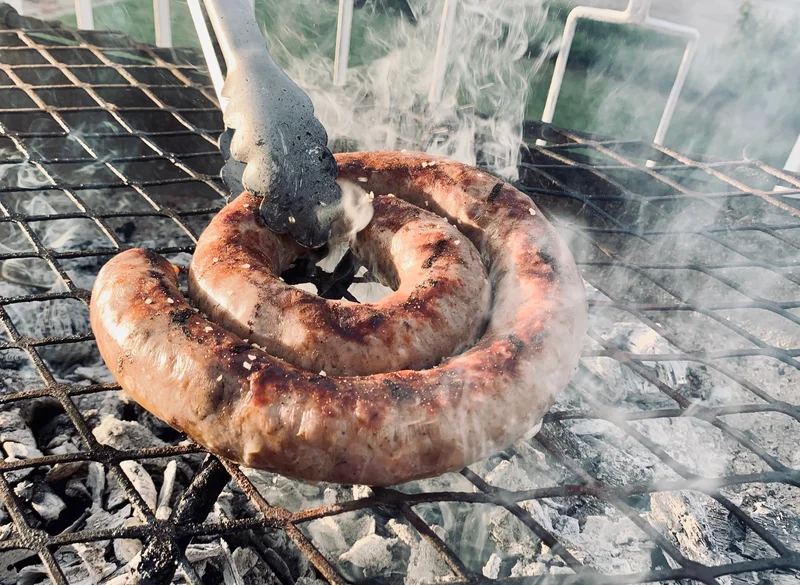
Itâs solace in a bun. Itâs what you trade for wine with your friends from Cape Town when they visit. Itâs what you buy by the metre and eat sizzling hot off the flames at Mzoliâs in Gugulethu. Itâs eaten with All Gold or chakalaka or smoor. Itâs an ode to our collective history as a nation. Itâs spicy, fatty, succulent boerewors.
I grew up on an Angora goat farm in the Midlands Karoo and farm-to-table living has always been the norm. Since I was tall enough to see over the kitchen table, Iâve been taught and trusted with food processing â from tomatoes and apricots in summer, to venison and other meats in winter.
Like a meat-filled thread connecting the dots of our combined pasts, boerewors nods to our colonial influences but celebrates the ingenuity of the first people who put together this unique blend of beef, fat, coriander seeds and vinegar.
So highly considered is the boerewors here that the Health Department set out regulations in 1990 to determine what can â and cannot â be classified as the âreal makoyaâ. It reads like Biblical scripture... and so it should.
âBoerewors shall be manufactured from a mixture of the meat of two or more animal species [including beef, goat, sheep and pork] and shall be contained in an edible casing. It shall contain a minimum of 90% total meat content and not more than 30% fat content. There shall contain no offal except where such offal is to be used solely as the casing of the raw boerewors. It shall contain no mechanically recovered meat,â among other things.
When youâre buying or selling BoereworsTM in South Africa, youâre not playing around.
My mother, Lani, says itâs excessive. Sheâs been living on the farm in the Karoo for the past 35 years and not a week goes by where she doesnât make wors in our glorified farm âbutcheryâ. My grandmother, Delene Lombard, taught her how and she, in turn, taught me.
âBoerewors started with real farmers utilising what they had. It is grounded in sustainable living and eating. Once a year during winter, a young ox and one pig would be slaughtered for the pot.â
Cattle were and are farmersâ livelihood in more ways than one. Itâs a big decision to slaughter an animal, and when you do, you dare not waste anything. In the old days, skins were used to make âkarosseâ or slippers. Bones were cooked to make gelatinous sult or brawn, often curried to keep longer. Even the intestines were used... which brings me back to boerewors.
Washed and cleaned until translucent, intestinal tubes served as the perfect casings for the spiced ground meat. âIt was just another way to optimise usage from the product, wasting nothing,â mom says.
Making wors from scratch is, in fact, part of a whole series of processes starting with a whole product, say the young ox.
First, you have to break it down from prime to lesser cuts. Fillets are tops; these are removed with utmost care. Or left intact partially to produce T-bone steaks. Hindquarters are next, used for other delicacies such as biltong or sosatie cubes. Before there were refrigeration facilities, thick cuts like silverside (which ran the risk of rotting before it could dry out completely) were kept whole and pickled in a brine bath (typically in the attic) for a couple of weeks.
Main attractions removed, meat for wors would be sourced from selected lesser cuts and what remains on the carcass. Itâs never offal, rather small pieces of meat trimmed away when cutting biltong or fatty meat cubes from the chuck.
Fat is then added, typically from beef and also pork. Pigs were reared with peelings and other inedibles from the kitchen back door, creating a full circle food chain. Crucially, real boerewors should contain tiny cubes of pork lard â what my gran likes to call âdobbelsteneâ â to ensure that it can be grilled over the coals without drying out.
Who makes the best boerewors? Rerad our companion story for more...
Braaierâs tip
For wors to braai perfectly, it needs to be âwinddroogâ or âdry to the touchâ. This ensures the casing forms a crispy, crackling skin and juicy inner over the coals. You can achieve this by putting your wors on a cooling rack over a plate in your fridge for a day before braaiing.
In many small-town butcheries, modern ways to source casings, for example, have eased the process slightly. But the product largely remains the same. Fienkie Swart is the second-generation owner of Karoo Slaghuis in Kirkwood, famed across the Eastern Cape for its biltong, venison processing and, of course, boerewors.
Boerewors needed to be regulated because chancers started selling C-grade products made from inferior meat, fat and spices at an A-grade price, Fienkie says. âDie ouens het die verbruikers bedonner.â (loosely translated: the guys pulled the wool over the consumersâ eyes).
The word boerewors doesnât only mean quality for consumers, he says. âIt also evokes a cultural pride in our food heritage and quality produce. In this regard, the regulations are necessary.â
However, especially in a small-town butchery, trust is key. Karoo Slaghuis sells the popular 100% accredited boerewors, as well as a range of other more affordable, high-quality wors.
âIf you choose your butcher wisely he will always give you a superior-quality product regardless of whether it is pure âboereworsâ or not.â
Like Karoo Slaghuis, many small-town butcheries sell a different style of wors to satisfy a wider clientele. Fienkie says they sell about double the amount of âplaasworsâ at R77/kg, as opposed to the real boerewors at R99/kg. It just offers the average South African boerie-lover a much more financially accessible product.
Because essentially, bureaucracy and marketing aside, boerewors is so much more than a mix of vinegar, spice and everything nice. Coiled on the colder section of the coals, it shares the shrine of âiconic South African foodâ alongside the likes of lamb, skilpadjies and roosterkoek.
Itâs solace in a bun, courtesy of the ACVV stall at the local athletics meeting after coming in stone last. Boerewors is what you trade for wine with your friends from Cape Town when they come to visit once a year. Itâs what you buy by the metre and eat sizzling hot off the flames at Mzoliâs in Gugulethu. Boerewors is sold from a braai stand at every worthy taxi rank and annual agricultural show. Itâs eaten with All Gold or chakalaka or smoor. Itâs an ode to our collective history as a nation, and to sustainable living and what it really means to produce and process your own food.
Lombard family boerewors
If youâd like to make your own, this is our trusted and endorsed Lombard family recipe:
11.5kg fatty beef, cubed
9kg pork, cubed
6 Tbls Salt
6 tsp pepper
3 tsp ground cloves
2 tsp ground nutmeg
2 tsp dried thyme leaves
8 Tbls freshly toasted coriander seeds, coarsely ground
375 ml brown vinegar
2kg pork lard, cut in tiny cubes (about 5mm) and rolled in enough Maizena to keep from clumping together
1 bundle 26" sheep casings (you can ask your local butcher to source this for you, or buy it at specialised shops) soaked in lukewarm water to remove all salt.
In a large container, season beef and pork cubes with salt, pepper, cloves, nutmeg, thyme, coriander and vinegar. Leave to infuse for at least one hour. Mince together. Add pork fat cubes and mix in well.
Place mince mixture in a sausage maker and thread one casing onto the nozzle and start the stuffing process. Ask for assistance; one person should regulate the outflow of mince into the casing while the other pulls the stuffed sausages in a steady flow to ensure a uniform end result.
Coil, wrap and freeze for no longer than three months.
Take note: If you overstuff the casing, it may burst. Understuffing will result in an unstretched casing thatâs chewy when cooked. Practice makes perfect. DM