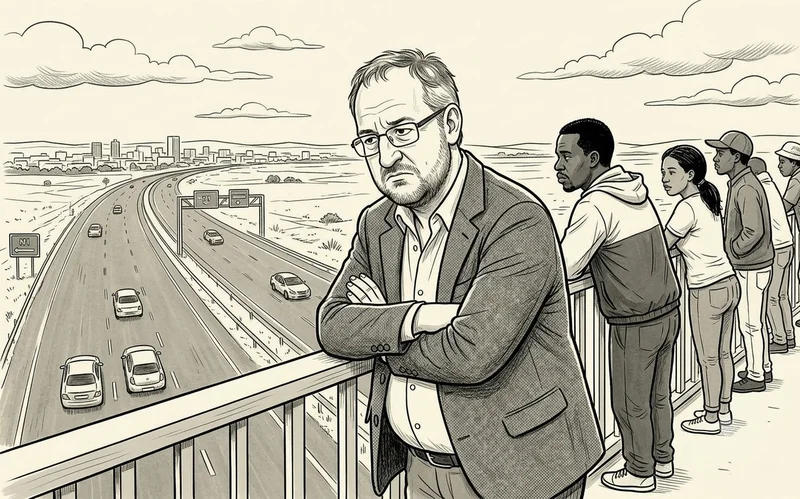
I think, for younger people it must be quite strange to think that there were days of the week when you couldnât really get anything. When even most petrol stations were closed and, in fact, on a Sunday afternoon nothing really happened.
According to Joburg urban legend, on Sunday afternoons people in Bloemfontein who were bored (we were convinced that was all of them) would drive to a bridge over the N1 and watch cars and trucks on their way to Joburg.
It was a time when if you really really needed something, perhaps a size-D battery, or just some milk, you would have to drive for hours to find a cafe that was open.
Itâs tempting to say something along the lines of how peaceful things were, or that those times were better.
Perhaps.
But they were also a lot less profitable. There was simply less scope to make money and all that happened was that people who wanted to buy things couldnât buy them from people who wanted to sell them.
Now, we are at the point where it appears that 24/7 trading for most commodities and shares is nearly with us. Not quite but almost.
While the real markets are spread over most time zones there is still the weekend period when all serious markets are closed.
You might remember when Jacob Zuma fired Nhlanhla Nene in 2015? And then appointed the Guptasâ mate, Des van Rooyen, as finance minister?
The reason Zuma had to release a statement appointing Pravin Gordhan so late on a Sunday night was because real trading was about to start in Asia. And the rand, along with everything else associated with South Africa, was about to take the most massive hit.
In the past few months we have seen Donald Trump starting bigger attacks against Iran on weekends, when oil is not being traded. While itâs hard to know what is really going on in the White House (apart from the absolute certainty that the Trumps are getting incredibly rich during this period), it does look like theyâre trying not to shock oil prices too much.
But, as the Bloomberg columnist Javier Blas pointed out this week, it looks like 24/7 oil trading is on the way.
Itâs amazing how quickly things have changed.
He says that it was only in 1983 that you could start to buy a futures contract for West Texas Intermediate oil (in case youâre wondering, thatâs a particular flavour of oil known for its lighter, sweeter notes â the product, obviously, of a different terroir from Brent crude). Almost quaintly, when they started, the exchange was only open Monday to Friday from 9am until, wait for it, 2.30pm.
Back then that probably didnât leave you enough time to walk to your local bank branch, which probably closed at 3pm.
About a year ago the JSE publicly floated the idea of 24-hour trading.
The main argument seemed to be that with so many of our shares being dual-listed, it would make sense to sort of align with other bourses. And, since so many people trade on their phones now, if it doesnât matter where you are when you trade, why should it matter when you trade?
There are some serious problems, though.
Even though we sometimes come close to being a 24/7 society, Iâm sure there have been times when you have found yourself at a petrol station in the middle of the night.
You were unlikely to be in a joyful frame of mind â lusting after the last garage pie is not an obvious sign of happiness.
But you might have noticed how very few other people were there. But somehow still, all the cheese grillers had gone.
The same will probably be true of 24-hour trading. Instead of being stuck with the spinach and feta pastry, there will be the problem of liquidity.
As a result, trades made during that time would have an outsize impact on the market.
There is an even bigger problem.
A few years ago a research group called Viceroy made unsubstantiated (a longer word for âfakeâ!) claims about Capitec. That forced the share price to drop and eventually the Reserve Bank even had to issue a statement saying the bank was secure.
Imagine that kind of behaviour at a time when the companyâs management is not able to respond. As trading speeds up, companies have to respond more quickly.
But there must be limits to their ability to respond quickly literally all the time.
The result would surely be a lot more lying. And a lot more liars benefiting.
Despite that, Iâm sure, 24-hour trading, and 24/7 oil trading, are on the way.
And people will ask one day: when you were in Joburg in the 2020s, where did you watch the N1? DM