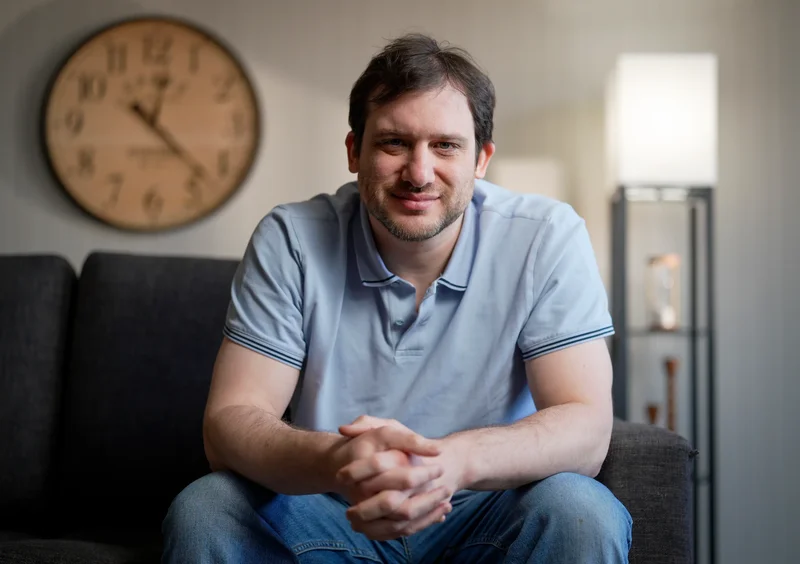
A Toronto mathematician known for making inspired leaps across subdisciplines to solve challenging problems in the domain of arithmetic geometry has won the Fields Medal, the profession’s highest accolade.
Jacob Tsimerman, a 38-year-old professor of mathematics at the University of Toronto, shares the honour with three U.S.-based scholars: Yu Deng at the University of Chicago, John Pardon at New York’s Stony Brook University, and Hong Wang of New York University and France’s Institut des Hautes Études Scientifiques.
Dr. Wang is only the third woman to receive the Fields Medal since it was first awarded in 1936, while Dr. Tsimerman is the first person based at a Canadian institution to do so.
The four medal winners were announced on Thursday at the opening ceremony of the International Congress of Mathematicians in Philadelphia.
Named after John Charles Fields, a Canadian mathematician who proposed and championed the prize nearly a century ago, the medal is bestowed every four years. It can be won by two to four individuals who each receive $15,000.
Often described as the Nobel Prize of mathematics, the Fields Medal differs from the Nobels in some important respects. The four year gap between awards creates a sense of anticipation that, for mathematicians, is akin to the build up ahead of a FIFA World Cup. It is also limited to mathematicians who are under the age of 40.
The age restriction reflects Fields’s original intention that the medal nurture future promise as well as recognize past achievements.
In an interview with The Globe and Mail, Dr. Tsimerman said he was aware that his name was likely in the running for this year’s medal because of a series of contributions he has made over the past five years, including proving the André-Oort conjecture and the Griffiths conjecture, both outstanding problems in the field of arithmetic geometry.
As the time approached when winners were likely to be notified, “I was definitely paying attention,” Dr. Tsimerman said.
The Fields Medal is the highest-profile award received by Dr. Tsimerman, who has previously won recognition throughout his career, starting with two successive gold medals for a perfect score while representing Canada as a high-school student at the International Mathematical Olympiads of 2003 and 2004.
He won the Canadian Mathematical Society’s Coxeter-James Prize in 2019, the Breakthrough Prize Foundation’s New Horizons in Mathematics Prize in 2022 and the Ostrowski Prize, administered by the University of Basel, in 2023.
The Fields Medal carries some additional significance for both Dr. Tsimerman and his colleagues. While it was established by a Canadian, it took generations before any mathematician with a connection to the country was named a winner.
That first happened in 2014 when Hamilton Ont.-born Manjul Bhargava was awarded the medal – though Dr. Bhargava mainly grew up on Long Island, N.Y., and now teaches at Princeton University.
However, until Dr. Tsimerman, no mathematician living and working in Canada has taken home a Fields Medal.
“This is Jacob’s day,” said Kumar Murty, a fellow faculty member at the University of Toronto who was chair of the mathematics department when Dr. Tsimerman was hired. “We’re celebrating intellectual achievement.”
He said the award marks an important milestone for U of T, where John Fields was a professor until his death in 1932. It is also significant for Canada, whose academic institutions must compete with far wealthier schools in the United States and elsewhere in the battle to recruit top talent.
Having a Fields Medal winner means “we’re able to stand on the world stage and say we’re equal to the best,” he added.
Dr. Tsimerman was born in the Russian city of Kazan, east of Moscow, and moved with his family to Israel when he was still a preschooler. The family came to Canada in 1996 where he attended school in Toronto.
Already a math prodigy who loved puzzles, Dr. Tsimerman began his undergraduate studies at the University of Toronto at the age of 16, completing his degree in just two years.
“I was lucky that the thing I had an affinity for is also a thing that I liked very much,” Dr. Tsimerman said. “So by the time I knew what a job was, it was just sort of natural to think that I would be a mathematician.”
He did his graduate work at Princeton University, where his advisor was Peter Sarnak, a prominent expert in number theory. The experience would prove foundational for Dr. Tsimerman’s future work. He earned his PhD in 2011 and joined the faculty back at U of T in 2014.
Dr. Kumar said by then it was already apparent the young mathematician had qualities that distinguished him from he peers.
Among them is Dr. Tsimerman’s ability to avoid being siloed in particular area of research and draw from other areas of math to find new approaches to the problems he tackles.
“The breadth of knowledge and versatility of techniques that his work displays is inspiring,” said Deirdre Haskell, director of the Fields Institute for Research in Mathematical Sciences, which is also housed at the University of Toronto.
Dr. Tsimerman stressed that fruitful collaborations with other mathematicians were a key part of his success.
“When I work alone, I start to suspect I’m crazy or that everything I’m doing is wrong,” he said. “At least if you’re with someone else and you’re both deluded, it’s more comforting.”
He added that while the feats of reasoning that lead to mathematical breakthroughs may seem like magic to non-experts, it is important to recognize how often things go off track rather than lead to success.
“I always tell my students I don’t know how to succeed as a mathematician but I know a thousand ways to fail,” he said, “and I’m slowly going tell you how to avoid all those different ways.”