South Korea and the United States have agreed to end their ongoing Ulchi Freedom Shield (UFS) exercise early on Friday and scale back some combined field training exercises, Seoul’s Joint Chiefs of Staff said Wednesday.
The allies agreed to adjust the duration and scale of the exercise, which began Monday and was originally scheduled to run through Aug. 27, at the U.S. side’s request. They will also scale back some combined field training exercises, with details still under discussion, according to JCS.
The exercise's computer-simulated command post drill consists of a first phase focused on defensive operations and a second phase involving counteroffensive operations. The allies will complete the first phase Friday, while the second phase, planned for Aug. 24 to 27, is expected to be canceled.
"It looks like that's the direction we're heading," Defense Minister Ahn Gyu-back told reporters Wednesday.
Some of the 14 combined field training exercises at the battalion level or above originally planned for this year's UFS will also be scaled back. The allies are discussing conducting some of them separately, including as South Korean-only drills, or postponing them until later in the year.
Asked whether more than 10 field exercises could be canceled, Ahn said, “No, not that many,” adding that drills not held during UFS would be conducted later in the year. He said the allies still plan to conduct 159 field training exercises this year.
The adjustment came three days after U.S. President Donald Trump said he had instructed Defense Secretary Pete Hegseth to substantially scale back joint military exercises with South Korea.
In a Truth Social post Sunday, Trump cited his “very good relationship” with North Korean leader Kim Jong-un and the North's "unthreatening and respectful" behavior, while also expressing displeasure with the long-running South Korea-U.S. exercises. The Pentagon said the following day that it was working to carry out his directive.
The U.S. Department of Defense confirmed the adjustment. "Based on direction from the President and Secretary of War, the Department has substantially reduced Exercise Ulchi Freedom Shield while continuing training that enhances tactical capability," a war department official said.
"The exercise will conclude on Aug. 21, six days earlier than scheduled. Associated live-training events have been reduced, with certain events canceled or converted to simulations. These adjustments preserve essential readiness and training objectives. There will be no degradation to U.S. training objectives."
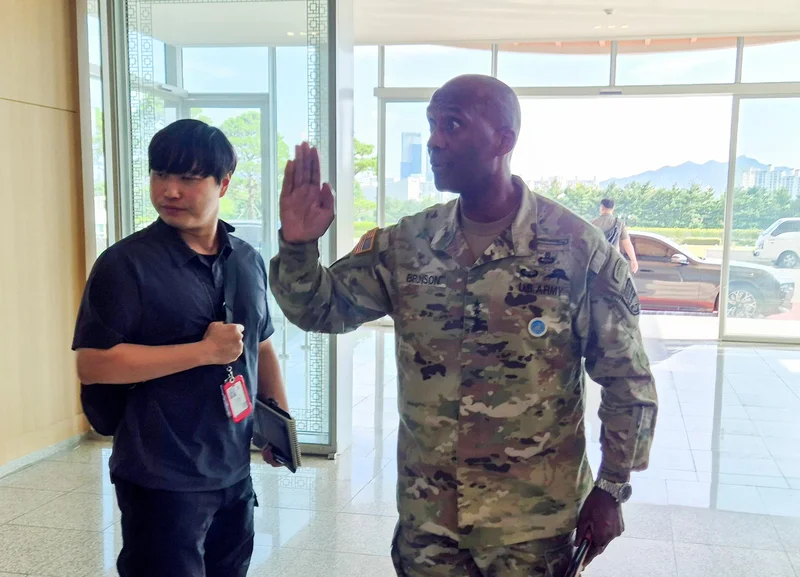
Gen. Xavier Brunson, commander of U.S. Forces Korea and the South Korea-U.S. Combined Forces Command (CFC), visited the defense ministry in Seoul on Tuesday and met with Ahn to discuss UFS.
Asked why he had come to the ministry, Brunson referred to Trump’s social media post and said he came to discuss it. The meeting lasted about 20 minutes.
Foreign Minister Cho Hyun said Wednesday that Seoul had not been informed of Trump’s decision before it was announced on social media.
“Neither our government nor U.S. government officials knew in advance what Trump would post on Truth Social,” Cho told lawmakers during a National Assembly Foreign Affairs and Unification Committee session.
Cho said that immediately after Trump's post, he instructed the South Korean Embassy in Washington to contact relevant U.S. agencies and discuss possible responses, while the foreign minsitry summoned U.S. Ambassador to South Korea Michelle Steel for consultations.
He added that Ahn had been in close consultation with the U.S. side following Trump's post, and said the subsequent changes to UFS were not unilaterally decided by Washington.
“Since our (defense) minister took part in the consultations, I don’t consider it a unilateral notification from the U.S.," Cho said.
Ahn also dismissed concerns that the shortened exercise could affect preparations for the conditions-based transition of wartime operational control, saying the relevant assessment will be completed during the first phase of UFS.
The CFC is conducting the exercise from two command posts: CP Tango in Seongnam, Gyeonggi Province, and U.S. Army Garrison Humphreys in Pyeongtaek, according to the Joint Chiefs of Staff.