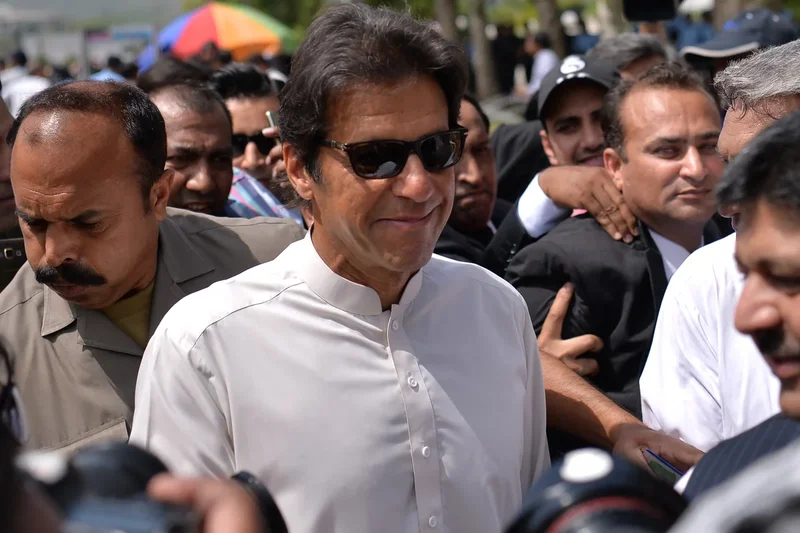
Pakistan’s government has said it will challenge a Supreme Court order to shift former prime minister Imran Khan to a hospital in Islamabad for medical treatment.
In a video statement on Tuesday night, law minister Azam Nazeer Tarar said the court would be approached for a review of its order, arguing that a convicted prisoner should be treated either inside the jail or at a public hospital.
The country’s top court on Tuesday ruled that the 73-year-old should be transferred to the private Shifa International Hospital in the capital Islamabad from the Adiala prison within 48 hours.
The court directed the authorities to allow Khan to meet his personal physician.
It also said Khan should be allowed to meet his family once a week and have a phone call twice a week with his sons who live in London.
The ruling came after medical records submitted to the court showed that Khan had complained of palpitations, headaches, restlessness and severe anxiety, with doctors recommending more frequent contact with his wife and family to help manage his anxiety and blood pressure.
Mr Tarar, however, said: “This order is not within four walls of the law”.
“After an assessment of the court order, authorities have said this is not within the legal framework meant for providing facilities to a prisoner,” he said.
He said a convicted prisoner has to be treated either inside the jail or at a public hospital according to law, adding that a review appeal will seek a modification of the court order.
The Supreme Court’s ruling marked a relief for Khan, a cricketer-turned-politician, who has been in jail in the garrison city of Rawalpindi since August 2023.
He is serving a prison term after being convicted in two different cases. He was found guilty of obtaining land from a business tycoon in exchange for facilitating the transfer of £190m ($257m), which was recovered by the UK’s National Crime Agency during his premiership.
He was also sentenced 17 year in prison over the purchase of state gifts such as jewellery, and watch, at undervalued prices.
Khan denies all the charges, calling them “politically motivated”, and both convictions are under appeal.
The former cricket star was removed as prime minister in April 2022 following a parliamentary vote of no-confidence.
Khan’s Pakistan Tehreek-e-Insaf party and his family have been demanding his release for years, raising concerns over his deteriorating health.
The former leader received treatment for his right eye after it was found he had lost most of his vision in it. The family also accused jail authorities of not allowing them to visit him since December 2025. His two sons, Kasim and Sulaiman, who live in the UK, said they have not seen him since 2022 and last spoke to him over a call in March.
Pakistan’s former leaders who have faced criminal charges or jail terms under successive governments have a long history of travelling abroad for medical treatment and later remaining there.
Former prime minister Nawaz Sharif, the brother of current prime minister Shehbaz Sharif, was permitted to travel to the UK for medical care in 2019 while serving a prison sentence. He remained in the UK for several years before returning to Pakistan in 2023.