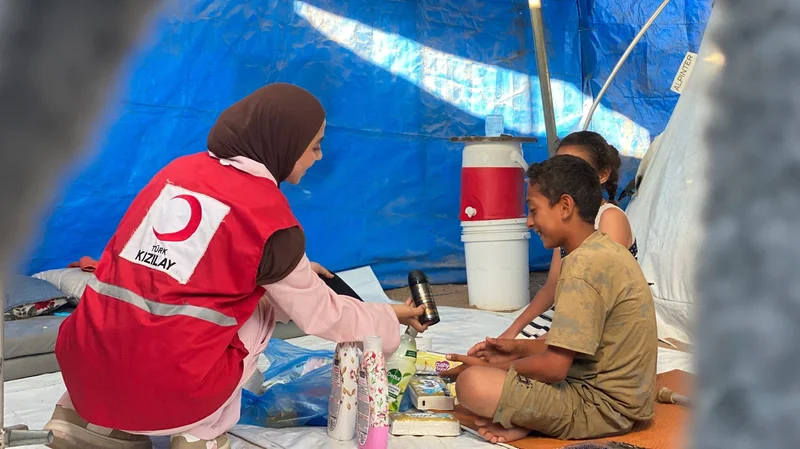
There is something fundamentally paradoxical about the contemporary humanitarian world: never have the needs been so great, and yet never have those trying to meet them been so vulnerable. Conflicts drag on, forced displacement continues to rise, and climate disasters are exacerbating already fragile situations. At the same time, humanitarian workers face growing risks, while the resources needed for their work are becoming harder to secure.
Each Aug. 19, the world does not fail to celebrate humanitarian workers: the men and women who enter conflict zones to respond to disasters, distribute food and medicine, protect displaced populations, and support communities trying to rebuild their lives in the aftermath of crisis. However, this year, simply paying tribute is far from enough. We are forced to confront a troubling reality as we ask a deeper question: What is the value of our humanity if those trying to defend it are no longer safe?
This critical issue casts a heavier shadow over this year’s World Humanitarian Day, which arrives at a time when the humanitarian system itself is under unprecedented pressure. Needs are increasing while funding is decreasing. Humanitarian workers are being killed, injured, detained or prevented from reaching the people they are meant to help. And civilians, those whom international humanitarian law is specifically designed to protect, continue to pay the heaviest price in these escalating crises.
In response to this breaking point, the United Nations’ message for 2026 has been particularly straightforward: “the time for mere concern is over; now is the time for consequences and accountability.” In fact, the distinction emphasized here is crucial. For many years, the international community has grown accustomed to empty statements of concern following attacks against civilians or humanitarian workers. And as a response, condemnations are issued. Meetings are held. Reports are written... just for a new crisis to capture the world's attention again. Yet one thing is sure: humanitarian aid cannot operate indefinitely on moral outrage alone.
Numbers can often obscure the human reality, making a crisis feel distant and abstract. Millions displaced. Thousands killed. Billions of dollars required. Countries labelled as “complex crises,” etc. But behind each statistic, there is human life. A mother crossing a border with her children. A farmer who has lost his entire harvest to drought. A student whose school has been destroyed by war; a doctor or nurse who continues to treat patients in a clinic that is no longer safe. And then there are the humanitarian workers who decide to stay, regardless of what the field looks like.
On Aug. 19, 2003, a horrific attack on the United Nations headquarters in Baghdad killed 22 people, including the U.N. Special Representative for Iraq, Sergio Vieira de Mello. Five Years later, the U.N. General Assembly officially designated Aug. 19 as World Humanitarian Day in their memory. And today, more than two decades after this tragedy, the core question remains painfully relevant: how can we ask humanitarian workers to save lives if we cannot even protect their own?
For millions across Africa, humanitarian crises are not distant stories broadcast on a news screen. Many countries of the continent continue to struggle with a compounding mix of armed conflict, forced displacement, food insecurity, climate disasters and institutional fragility. From Somalia to the Sahel, and across South Africa, millions are enduring consequences that will echo for generations.
Yet, humanitarian action on the continent has another vital dimension that rarely receives the attention it deserves: Africans are not just beneficiaries of aid; they are its primary providers. This is because local humanitarian workers understand the languages, cultural patterns, and social realities, not easily navigated by international organizations. Most importantly, they are often the ones who remain on the ground long after international staff have been evacuated.
This is why strengthening local humanitarian capacity must never be considered a secondary objective. In fact, local organizations and community actors cannot be treated as mere implementing partners waiting for decisions and funding from abroad. They possess the knowledge, networks, and legitimacy essential for a truly effective humanitarian response.
While the humanitarian system frequently speaks of “localizing” aid, one must realize that true localization cannot simply mean transferring risks without also transferring power. If local actors are expected to take on the greatest risks, they must be entrusted with equal resources, autonomy and decision-making power.
There is also a profound danger in the way many humanitarian crises are presented. The language of charity often reduces entire populations to passive victims. And yet it's fair to say that at its core, true humanitarian action is not about a group of generous outsiders arriving to rescue those in need.
Rather, humanitarian aid must be perceived as the act of safeguarding human dignity when extraordinary circumstances have deprived them of their safety, livelihoods, and fundamental rights. Such a nuance is particularly important in Africa, where communities impacted by crises possess their own resilience, deep-rooted institutions and solidarity mechanisms. Consequently, a humanitarian response should go beyond only asking, “What can we give?” by equally asking, “What can we protect, strengthen and enable?”
The goal must never be to create a permanent dependency on external aid. Instead, it should be to help people navigate the crisis while preserving their dignity, creating the necessary conditions for them to rebuild their own future.
Humanitarian crises are too often presented as if they were unavoidable natural phenomena. A drought occurs, a war breaks out, people flee, and humanitarian organizations intervene. But the truth is that many of those crises are political, or at least in the African context.
Wars are decisions. The destruction of infrastructure is a deliberate act. Restrictions on humanitarian access are choices. Attacks against civilians and aid workers are never inevitable. International humanitarian law exists precisely because the global community has recognised that, even in times of war, certain limits must never be crossed. Civilians must be protected; humanitarian workers must be safeguarded, and aid must reach those who need it.
When these principles are repeatedly violated without real consequences, humanitarian action risks becoming nothing more than a way of treating the symptoms while the causes continue to claim new victims. That is why accountability is essential. Concern without consequences risks becoming another form of impotence.
World Humanitarian Day must therefore be more than a day dedicated to thanking humanitarian workers. Of course, we must honour them, and it's important to do so. But what is more important is not to forget to interrogate the international system that is built around them. Are funding and decision-making power available to local humanitarian actors? Are humanitarian organizations equipped with the fundamental resources and tools required to do their jobs? Does international law still possess the power to protect civilians? Are attacks against humanitarian workers subject to systematic and thorough investigations? Are those responsible held accountable? And most crucially, is the global community effectively addressing the structural and political roots behind these crises?
As for 2026, the United Nations estimates that 239 million people will need humanitarian aid, though funding constraints limit the U.N.’s target to assist 135 million. These figures must not make us feel powerless; on the contrary, they must compel us to examine the political decisions that make these figures possible. Humanitarian workers cannot indefinitely compensate for political failures. They can distribute food. They can provide care. They can build shelters. They can protect children. They can help communities rebuild. But they cannot negotiate peace on their own. They cannot enforce international law. They cannot replace functioning public institutions. And they cannot shield themselves from those who deliberately choose to target them. That responsibility lies squarely with those who wield political and military power.
Perhaps the most important message of this World Humanitarian Day is ultimately very clear: our humanity is not measured solely by the amount of aid we afford to provide. It is also measured by our capacity to protect those who make it possible. A humanitarian worker should never have to choose between helping someone and saving their own life. A civilian should not have to wonder if a humanitarian convoy will reach them. And a community struck by crisis should not depend on whether the global news cycle chooses to care or not. On this day, we will once again hear stories of courage, solidarity, and compassion. We must honor these moments. But praise without action is meaningless; celebration must demand accountability. Because those who save lives should never have to pay with their own lives to do so.