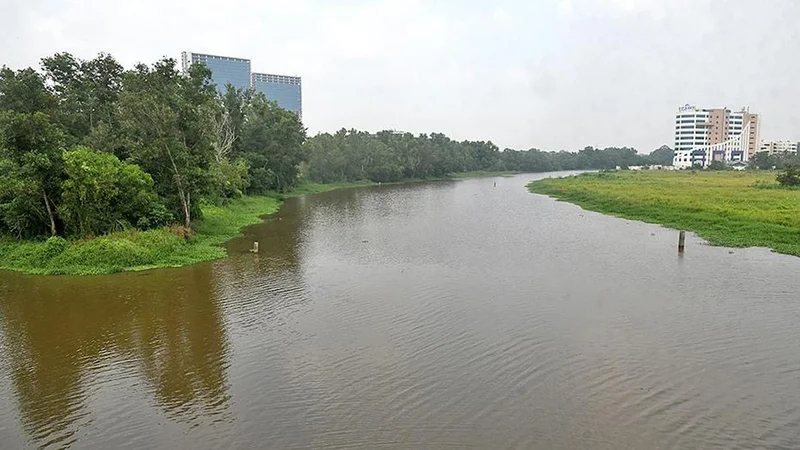
An analysis of water samples carried out as part of the National Water Quality Monitoring Programme of the Central Pollution Control Board (CPCB) has revealed exceeding levels of faecal contamination along the monitoring stations on the Karamana, Periyar, Kadambrayar, Chitrapuzha, Chalakudy and Kallai rivers in Keralam.
The total coliform count, indicating faecal contamination, recorded at the polluted stretches varied between 4,500 MPN (most probable number) per 100 ml to 5.5 lakh MPN from February 2026 to May 2026.
The maximum permissible limit of total coliform in bathing water, as prescribed by the CPCB, is less than 2,500 MPN per 100 ml. Samples are collected and tested from fixed locations along the 32 polluted river stretches in Kerala every month as part of the monitoring programme. The results are compiled by the Kerala State Pollution Control Board (KSPCB) and submitted before the Ministry of Jal Shakti.
The total coliform count along the monitoring point at Moonattumukku in Karamana river in February 2026 was 27,000 MPN/100 ml, while the faecal coliform count was 11,000 MPN/100 ml. The water samples collected from the five monitoring stations along the Periyar river showed a spike in total coliform levels in April 2026.
At the Eloor stretch, the count was 7,000 MPN/100 ml. At the monitoring station in Aluva, the corresponding figure was 4,600 MPN/100 ml. In Pathalam near the Edayar industrial area, the total coliform count was 2.5 lakh MPN/100 ml and 63,000 MPN/100 ml at the Kalamassery monitoring station.
The situation was no different in the water samples collected from the monitoring stations along the Kadambrayar at Brahmapuram and Manakkakadavu. The total coliform count at Brahmapuram was 79,000 MPN/100 ml, while the figure at Manakkakadavu was 40,000 MPN/100 ml.
Highest count
The Irumpanam stretch of Chitrapuzha recorded the highest total coliform count of 5.5 lakh MPN/100 ml.
In Pulikkkadavu station on Chalakudy river, the count was 7,000 MPN/100 ml. The total coliform levels in the six monitoring stations of Kallai river in May 2026 varied between 15,000 MPN/100 ml to 2 lakh MPN/100 ml.
Unchecked discharge
Attributing the spike in total coliform levels to the unchecked discharge of untreated wastewater into the water bodies, V. Sivanandan Achari, Dean of the Faculty of Science and Professor at the School of Environmental Studies, Cochin University of Science and Technology (CUSAT), pointed out that the release of domestic effluents from households and townships through the drains resulted in higher levels of faecal contamination in the water bodies.
The untreated wastewater is often directed into the drains through outlets from these sources. It also showed the gaps in proper management of sewage, he said.
Senior officials of the Department of Local Self-Government said necessary directions have been issued to the secretaries of civic bodies to initiate stringent action against those responsible for the illegal discharge of wastewater into the rivers and other water bodies. They have also been told to step up surveillance against such illegal activities, they said.
Published - August 19, 2026 05:05 pm IST