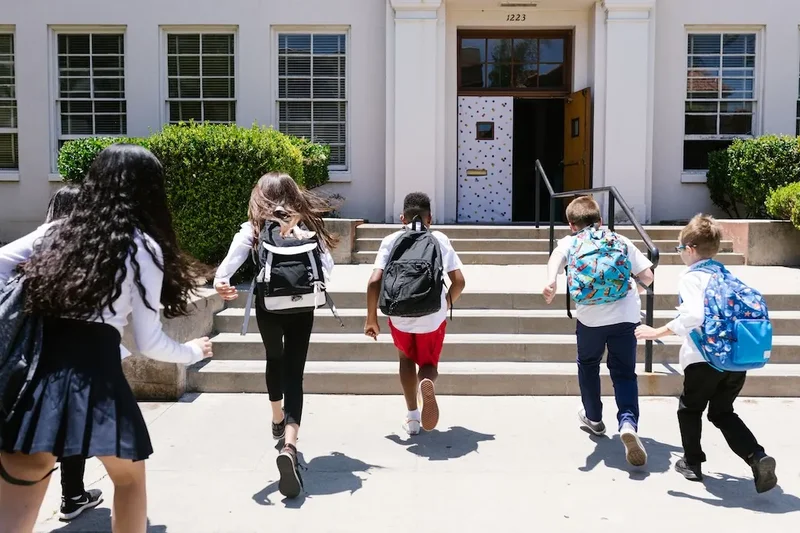
There’s a lot to prepare and organise for your kids returning to el cole (school) or el instituto (sixth form/high school) in September, including finding out the specific school calendar dates for your region, buying new textbooks, backpacks and sports uniforms.
There are also several changes you need to be aware of.
Dates
The exact start date will depend on where you live in Spain. Most regions will start classes again between September 7th to the 10th.
The earliest to go back will be those in Madrid on the 7th and 8th, while Cantabria, Murcia and Catalonia also start on the 8th. Castilla y León, Valencia, Galicia, Asturias and La Rioja will head back on September 9th. The Balearic Islands and Andalusia will be some of the last to go back on September 10th.
Dates may change slightly for specific schools or ages, particularly if they are international or private.
We'll publish an article with more specific details for each region soon.
**READ ALSO: How bad is bullying at schools in Spain? **
**School supplies **
In preparation for the new school year, many parents will be thinking about buying new supplies.
According to a study by the price comparison website Idealo, back-to-school spending will cost an average of €505 per student this year. If you have two or more children, that's a significant amount of money.
This represents a one percent increase compared to last year and is €80 more per student than four years ago.
Backpacks stand out among the most expensive showing an 11.25 percent increase compared to last year. Stationery has also become €50.80 more expensive, increasing by 5.26 percent. Other products that have also increased are textbooks, which have risen slightly by 1.6 percent.
The good news is that some items are actually cheaper than last year. For example, tracksuits are 19 percent less expensive dropping from €26 to €21, and sports shoes are 9 percent cheaper.
According to Idealo experts, despite the obvious price increase for back-to-school supplies in recent years, the overall cost of school supplies in 2026, compared to 12 months ago, remains almost unchanged, although this will also depend on what your child needs.
**READ ALSO: How Spain became the biggest hub of British schools in Europe **
**Nursery schools to guarantee healthy meals **
Back in June 2026, the Spanish government announced that their healthy and sustainable meal plans would be extended to nursery school children too. This plan was first brought in in April 2025. It now means that toddlers will be guaranteed to have five healthy meals a week in schools as well. It includes more consumption of fresh fruit and vegetables daily, more fish and more whole grains. Water and milk will be the only drinks allowed and fried and pre-cooked foods will be limited.
**Changes to science classes in Catalonia **
There are a few changes this coming school year too. In Catalonia, the Department of Education has published an amendment to the Bachillerato course (upper secondary education).
It will mean that science subjects are merged during the first year instead of having separate lessons for each type.
The department has indicated that these changes are necessary to comply with regulations, but states they will not affect students sitting for university entrance exams in 2026.
In the first year of Bachillerato, biology will be combined with geology and environmental sciences. Physics and chemistry will also be combined. These subjects will also get an additional hour of instruction.
**READ ALSO - Inside Spain: How schools aren't equipped to deal with the early heat **
**Social media bans **
Spain has been talking about introducing a social media ban for children for a while now. Back in September last year the government initially approved the legislative processing of the Organic Bill on the protection of minors in digital environments. Then back in February of this year, Prime Minister Pedro Sánchez reiterated his stance on it.
More recently, the Minister for Youth and Children, Sira Rego told Europa Press that she is confident that the new legislation can be approved "after the summer," although a specific date for its approval has not yet been set.
She said that the final modifications to the text still need to be completed and said that regulations will need to be developed to specify how the new rules will be implemented.
AI and robots for children with special needs
Another new change in Madrid is that ten schools in the region will introduce robots and artificial intelligence in order to strengthen support for students with special needs.
The the pioneering ROBIC programme uses social assistance robotics and AI as support tools in certain schools.
It also provides teachers and therapists with an additional tools to adapt activities to each child. In these sessions, students interact with a humanoid robot that incorporates 3D cameras and sensors to interpret the child's response and adapt the activities in real time.
AI helps select the most appropriate exercises to reinforce aspects such as communication, oral and body expression, psychomotor skills, and self-awareness.
Reduction in student-teach ratios for 2027/2028
Another change will happen in the region of Madrid, although not until next year.
The Ministry of Education has approved a reduction in student-teacher ratios in early childhood education, which is from ages 0 to 3.
There will be four children ages 0-1 per teacher, six children per teacher aged 1-2 years and eight per teacher aged between 2-3 years old.
For those aged 3-5, the student-teacher ratio will be 20 children per teacher.
These changes will begin to be implemented in the 2027/2028 academic year and will be phased in gradually until 2030/2031.