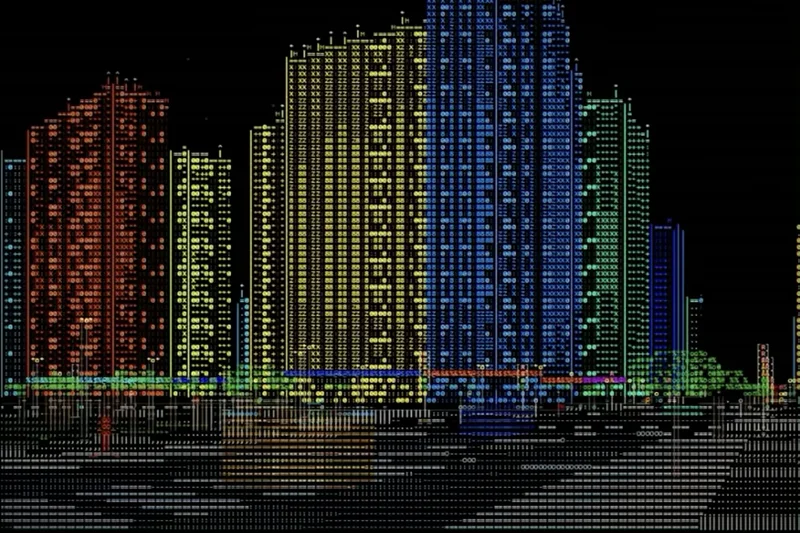
Like many art forms, especially digital ones, ASCII art began as an exercise of working within limitations. It involved using the limited, fixed-width ASCII character set to create recognizable images, and in doing so, it created a distinctive aesthetic that lives on today. You can see it in all sorts of places: games like Dwarf Fortress and Cataclysm: Dark Days Ahead, the elaborate Unicode °ââ¢Â°text decorations°â¢â° that were everywhere in the 2000s, and the iconic cascading green characters of The Matrix, to name a few.
The idea of using letters, numbers, and other characters to create images also continues to evolve. The first ASCII art was two-dimensionalâwell, OK, technically everything on a computer screen is two-dimensional, but it was hard enough creating recognizable 2D images with ASCII characters and a fixed-width display, let alone trying to also incorporate a sense of depth. But today, thereâs nothing stopping people from taking the character art aesthetic into a third dimension.
Thatâs exactly what a solo developer who goes by Grow Now Games did with a demo posted on YouTube this week. As its creator explains in the video, the idea was âto create something that looks like youâre walking through a world made of data without it being just a flat visual image.â
The effect is really striking, and to me itâs most reminiscent of the braindance sequences in Cyberpunk 2077, where the authorâs view of the world is broken into multiple granular streams of data. It’d also look right at home in the upcoming Neuromancer series, although no doubt the depiction of cyberspace therein will cost gazillions of dollars and look a whole lot fancier than actually befits the book.
Perhaps the most interesting thing about this demo is that it isnât accomplished with 3D models or shaders, the most obviously straightforward approach to creating an effect like this (hereâs an article on how to create such an effect in Blender). But no, in this case, the world is instead rendered with a custom ray-casting engine: âJust JavaScript and Canvas, in a single HTML file.â The world is laid out on a grid, à la Wolfenstein 3D, but whereas the latterâdespite its nameâwas not in fact fully three-dimensional, this little engine appears to allow the player to look up and down to their heartâs content. The world contains moving cars, semi-transparent trees and people wandering around, and it looks cool as hell.
Despite being rendered with JavaScript and HTML, it doesnât seem like thereâs a version online that we can explore ourselves. Weâre hoping that this is because the engine will appear in an actual game, because exploring Cyberpunk 1977* looks like itâd be a whole lot of fun.
- Iâd love to take credit for âCyberpunk 1977,â but sadly I must admit that someone in the YouTube comment section beat me to it. Curses.