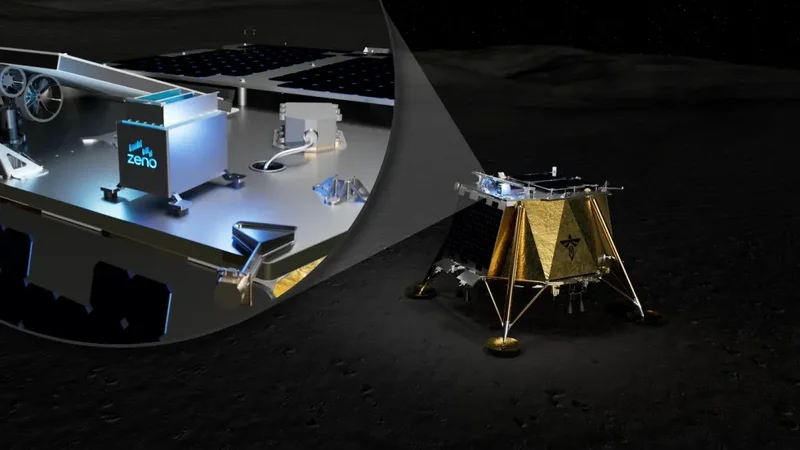
WASHINGTON — Firefly Aerospace will fly a payload from Zeno Power on an upcoming lunar lander mission to test a radioisotope heat source that could enable future missions to survive the lunar night.
The companies announced Aug. 19 that a Firefly Blue Ghost lander mission planned to launch in 2028 will include a “Survive-the-Night” package from Zeno that is designed to operate during the lunar night.
The self-contained package includes a small radioisotope heating unit, or RHU, using americium-241, a radioactive isotope, to produce 5 watts of thermal energy. That will keep the package and its other components, including communications, electrical power and related subsystems, warm during the lunar night as temperatures drop to minus 170 degrees Celsius.
The package has one simple purpose, said Tyler Bernstein, chief executive of Zeno Power, in an interview: “After five days into the lunar night, send a ping back and say, ‘I am still here.’”
Doing so, he said, would meet the requirements of an incentive NASA included in a recent Commercial Lunar Payload Services, or CLPS, task order to demonstrate survive-the-night technologies. Firefly was one of three companies selected for that task order in June.
The ability to operate through multiple lunar days is becoming increasingly important as NASA develops a lunar base. “There is that call for solving the power problem to support all the Moon Base initiatives that NASA has communicated to us,” said Farah Zuberi, director of spacecraft mission management at Firefly, in an interview.
“I think this demonstration is really going to teach us a lot about what the future looks like when it comes to power, specifically on the moon and in support of the Moon Base,” she said.
The companies did not disclose technical details about the Zeno Power package, such as its mass and volume, but Bernstein said the RHU itself is about the size of a silver dollar.
The payload on the Firefly lander will be the first space mission for Zeno and also the first of this class of commercial radioisotope power sources. In July, City Labs launched the first commercial satellite with a nuclear power source, a tritium battery that produces microwatts of power.
“This is a technology demonstration, but this also will be a regulatory pathfinder,” said Bernstein, referring to launch approval processes established several years ago but only exercised for the first time recently with the City Labs cubesat. “Both of those are just as important to show that this technology can be built, but also that it can be flown.”
“The regulatory piece is going to be just as hard as the nuclear payload technology piece,” said Zuberi. Firefly is working on processes for safely incorporating the Zeno payload onto the Blue Ghost lander and going through testing and launch preparations.
Zeno Power is working to scale up production of RHUs in anticipation of future missions that need to survive the lunar night. “We are seeing the demand in the future where there will be the need for hundreds of these RHUs when you look at the number of missions that are going to the lunar surface in the coming years,” Bernstein said.
The company is also working on radioisotope power sources that use Stirling generators to produce electrical power. He said the company has worked to secure a sufficient supply of americium-241 to meet those needs. “We’re spending time and capital building out the supply chain to meet the future demand that we believe is going to be here from NASA, from industry and from international partners.”
Zuberi said Firefly is studying how to incorporate this technology on future missions, which could involve RHUs for specific payloads or for the entire lander. “We have this initial demand signal that NASA is looking into survive-the-night capabilities and technologies and wants to have these demonstrations,” she said. “We will learn a lot from this mission, and we will assess on a case-by-case basis what customers’ needs are going to be.”
Firefly Aerospace is not the only lander company planning tests of RHUs. Vince Bilardo, executive director of nuclear space programs at Intuitive Machines, said at the Space Nuclear Industry Symposium on Aug. 13 that his company also pursued the survive-the-night incentive in that CLPS task order.
Intuitive Machines was awarded a lander mission in June that he said is scheduled to launch in August 2028. The survive-the-night incentive, he said, is worth $15 million, and the company also plans to use an americium-241 RHU to achieve that.
One issue, he said, is that NASA needs to provide indemnification for that nuclear payload, citing a lack of a commercial market for insuring such payloads. “We can’t fly that mission without that indemnification.”