(ATTN: UPDATES with more info in paras 9-11)
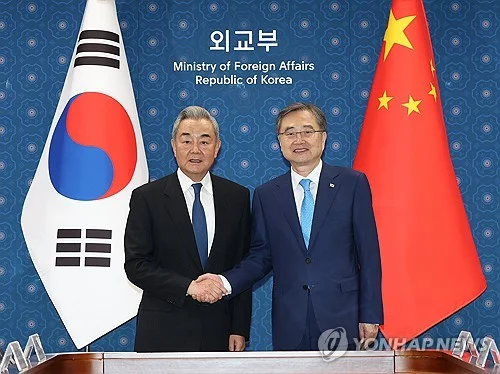
SEOUL, Aug. 19 (Yonhap) -- Chinese Foreign Minister Wang Yi said Wednesday that Beijing will continue to make efforts to ensure peace on the Korean Peninsula, expressing hope for a peaceful coexistence for the two Koreas as he met with his South Korean counterpart in Seoul.
Talks between Wang and Foreign Minister Cho Hyun came shortly after President Lee Jae Myung proposed multiparty dialogue to formally end the 1950-53 Korean War.
At the start of Wang's two-day visit, the two diplomats exchanged in-depth views on areas of mutual concern, from bilateral relations and the situation on the Korean Peninsula to regional and international issues. It marked their first meeting in 11 months, following their talks in Beijing in September last year.
"I hope that progress in restoring bilateral relations will contribute to peace and stability in the region, including on the Korean Peninsula," Cho said in his opening remarks.
"As President Lee Jae Myung has presented a blueprint for peaceful coexistence on the Korean Peninsula in his recent Liberation Day address, the South Korean government will continue efforts to achieve denuclearization and peace on the Korean Peninsula," he added.
Cho expressed hope for continued bilateral cooperation based on the shared interests of the two countries in bringing peace and stability to the peninsula.
In response, Wang said China will "continue to play a constructive role" in promoting peace and stability on the Korean Peninsula, calling it the peninsula's "most important neighboring country."
"We also hope that South Korea and North Korea will gradually move toward peace and coexistence, and sincerely wish for lasting stability and progress on the Korean Peninsula," he added.
Wang's remarks came as U.S. President Donald Trump said he ordered the U.S. military to scale down combined military exercises with Seoul, citing the financial burden and his good relationship with North Korean leader Kim Jong-un, in an apparent bid to reengage with the reclusive leader.
When asked by reporters whether China could mediate a summit between Pyongyang and Washington, Wang said the matter was for the two countries to decide.
"That is up to North Korea and the U.S. to decide, and the U.S, for its part, should change its longstanding hostile policy toward the North," he told reporters.
Park Doo-soon, the ministry's spokesperson, earlier said the talks were expected to "serve as a chance to review the achievements made in fully restoring South Korea-China relations, and to begin preparations in earnest for the next steps and high-level exchanges ahead of the Asia Pacific Economic Cooperation (APEC) summit slated for November in Shenzhen, China."
The talks were to be followed by a banquet.
On Thursday, Wang will pay a courtesy call on President Lee at Cheong Wa Dae, where the two will discuss the development of Seoul-Beijing relations and regional security, according to the presidential office.
National Security Adviser Wi Sung-lac will hold a separate meeting and luncheon with Wang to discuss the security situation on the Korean Peninsula and other issues of mutual interest.
Wang's trip here came after Lee proposed multiparty dialogue to discuss a formal end to the Korean War in his Liberation Day speech Saturday, in which he vowed to pursue peaceful coexistence with the North and seek ways to prevent conflicts. The 1950-53 Korean War ended with an armistice, leaving the divided Koreas technically at war to date.
The speech was widely seen as reinforcing his vision for improving inter-Korean relations that remain badly frayed and Seoul's efforts to serve as a "pacemaker" in helping resume dialogue between the North and the United States.
The North has remained largely unresponsive to Seoul's rapprochement since Lee took office in June 2025.
"As the president has laid out his vision for peaceful coexistence on the Korean Peninsula, discussions are expected to take place on this matter," a foreign ministry official said of the Cho-Wang meeting, suggesting that proposed multiparty dialogue may also be on the agenda.
Other items likely on the agenda include expanding mutual cooperation and ties ahead of the 35th anniversary of diplomatic relations between Seoul and Beijing next year.
Wang had last visited Seoul in September 2021, while he and Cho last met in Beijing in September last year.
jaeyeon.woo@yna.co.kr
(END)
- N. Korea silent on Lee's proposal for dialogue to officially end Korean War
- (2nd LD) Lee proposes dialogue with N. Korea to officially end Korean War, halt Pyongyang's nuclear program
- Incheon airport ranks world's No. 1 in int'l passenger traffic in first half
- (LEAD) Gov't aims to supply over 230,000 additional homes in Seoul metropolitan area to tame housing prices
-
(2nd LD) Gov't aims to supply over 230,000 additional homes in Seoul metropolitan area to tame housing prices
-
N. Korea silent on Lee's proposal for dialogue to officially end Korean War
- Trump signs memo permitting foreign shipbuilders to build up to 2 U.S. ships in their shipyards
- (LEAD) Lee reiterates support for four-year, two-term presidential system
- (2nd LD) Lee proposes dialogue with N. Korea to officially end Korean War, halt Pyongyang's nuclear program
- Incheon airport ranks world's No. 1 in int'l passenger traffic in first half