What chances does the Cairo agreement on Gaza have of succeeding?
TEHRAN – Gaza’s residents are waiting eagerly for the genocide to come to an end and a sense of security prevail, but Israel’s refusal to compromise and the challenges of implementing the Cairo agreement make a quick breakthrough unlikely.
Crushed between the occupying regime’s war machine on one side and the helpless international stance on the other, Palestinians are trying to cling to whatever glimmer of hope they can find, even when they already know it may be nothing more than a mirage that will soon disappear.
Throughout every stage of this genocide, which continues to this day, residents of the Strip have searched for any opportunity to catch their breath and move, even from a distance, toward the life they lived before the genocide broke out, or at least some semblance of it.
Yet that life itself was difficult and harsh, and bore little resemblance to what the rest of the world’s population experienced, even those who endured complex and prolonged crises.
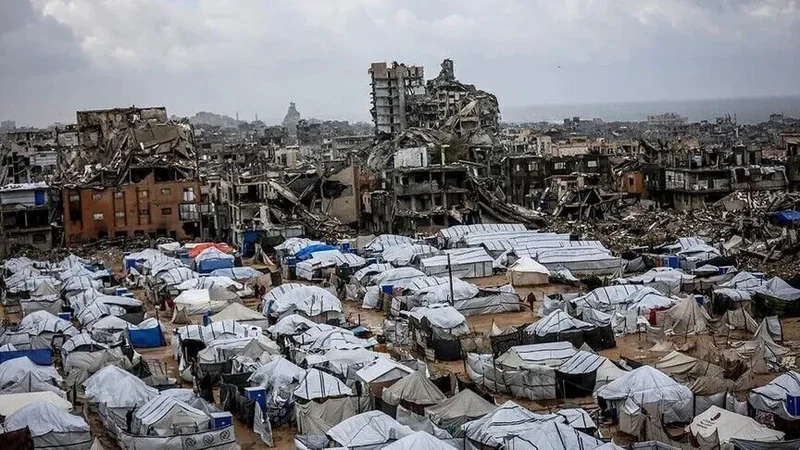
In the devastated Gaza, both before and after the non-stop daily massacres, life seems more like an adventure in survival than anything else. Residents have to navigate a path filled with danger just to secure the barest necessities for their children.
Every morning, these children wander the streets in search of scraps from dilapidated charity kitchens, while sick and wounded people, of whom there are countless numbers, struggle to find even a proper bed on which to lie their weak, exhausted bodies.
In the forgotten Gaza that many of its residents have come to believe they inhabit, people closely follow every piece of news, every report, and every bit of information being circulated, as well as rumors and fabrications deliberately spread.
Amid all of this, they search for anything that might calm their fears, offer some comfort, or provide even the faintest glimmer of hope for what lies ahead.
Over the past few weeks, the idea that the genocide might finally end completely, and that conditions might shift toward security and stability, has taken hold in the minds of Gazans.
This was especially true after they heard reports of understandings reached in the Egyptian capital, Cairo, where agreement was reportedly reached on a 15-point plan. The optimism was reinforced by meetings held on Sunday involving Jared Kushner, the U.S. president’s special envoy and son-in-law, and Nikolay Mladenov, executive director of the “Board of Peace.”
These developments generated an unprecedented sense of optimism among Gaza’s residents, who believed the agreement could bring an end to nearly three years of suffering. During that period, they endured the horrors of war on a scale rarely, if ever, experienced by any other people, paying a devastating price that surpassed everything they had endured throughout the previous 78 years of occupation.
Though the Israeli regime has publicly rejected the agreement, and declared that it would continue killing and seizing territory, as it has done during the ten months since the “ceasefire agreement” came into effect, optimism has remained the prevailing sentiment among residents of the Gaza Strip.
They have placed, and continue to place, their hopes in the efforts of the mediating and guarantor states. They still hope those countries will succeed in pressuring the Zionist regime, which, experience has shown, has never yielded to pressure, regardless of how intense it may be.
The Zionist regime, instead, has repeatedly turned its back and disregarded everything previously agreed upon.
Yet setting aside what is in the minds of people in Gaza, and regardless of the reassurances issued by some parties, reassurances that have been heard many times over the past few months, the available evidence and indicators do not leave much room for optimism in the coming weeks, at least, particularly during the period leading up to the Israeli parliamentary elections.
There are several observations in support of this assessment. Some may consider it pessimistic and lacking in realism, and they may be right. But Gaza’s experience over the three years of this criminal war has taught many to approach every development with extreme caution, and even to view it with suspicion and skepticism.
This is particularly true when Tel Aviv has shown no intention of ending the aggression, while its positions throughout the long months of genocidal war have been characterized by evasion, deception, broken promises, and repeated withdrawals from agreements, without regard for any international party.
The first reason for caution is the regime’s unequivocal rejection of the agreement reached recently in Cairo. Its position is entirely consistent with its approach to every previous understanding, including agreements it actually signed and publicly pledged to honor, such as the January 19 agreement last year and the October 10 agreement of the same year.
Both were subjected to clear and blatant violations by the occupation regime. The latter resulted in the killing of more than 1,300 Palestinians, left hundreds injured, and expanded Zionist-controlled areas to nearly 70 percent of the Strip.
Every Israeli statement following the latest Cairo Agreement made it unmistakably clear that the regime opposes it and rejects it outright. The regime has also reaffirmed its intention to continue the aggression in all its forms, particularly attacks on civilians using drones, as well as gunfire and artillery shelling that continues unabated, especially at night.
On the ground, this position has been translated into action in every detail. Killings carried out with incendiary missiles have become a daily occurrence, no longer deemed worthy of condemnation or even serious protest by the international community or by the sponsoring and guarantor states.
Those countries have not even dared to issue a statement condemning the aggression without first obtaining U.S. approval.
Judging by the situation on the ground, the construction of new Israeli military positions near the so-called “Yellow Line,” coupled with the upcoming Israeli elections, in which fugitive war criminal Benjamin Netanyahu appears desperate to win more votes, suggests that escalation is likely to remain the dominant reality for at least the next two months.
There may be some progress regarding humanitarian aid, but this would amount to little more than an attempt to divert attention, ease international criticism, and conceal the continued killing and occupation of land.
A second reason for withholding optimism concerns the lack of clarity surrounding the implementation of some elements of U.S. President Donald Trump’s plan. The plan appears to contain numerous hidden pitfalls and to have been deliberately loaded with a number of highly contentious issues.
The first and most complicated of these is the issue of disarming Palestinian resistance forces in Gaza. It has now become the most important element of the ceasefire agreement, surpassing in importance and in the urgency of immediate implementation every other provision, including those contained in the first phase of the agreement that the Israelis subsequently rejected and largely refused to implement.
On the issue of disarmament, there are two competing positions. The first is held by the Palestinian resistance and is based on the principle that heavy weapons should only be stored by a trusted Palestinian authority.
Such weapons, it argues, must not be handed over to the occupying regime or to any outside party, regardless of how trustworthy that party may be. Any such arrangement, moreover, should be reached through internal Palestinian consultation, with the Israelis not influencing the process, directly or indirectly.
The second position, held by the regime, its U.S. ally, and some members of the “Peace Council,” calls for the complete disarmament, heavy and light weapons, including arms held by families. It also demands guarantees that such weapons will pose no meaningful “threat” to the security of the Israeli regime in the future.
Unless this step is initiated, there will be no genuine breakthrough, whether in terms of beginning reconstruction, fully ending the aggression, or withdrawing the occupation forces to the original “Yellow Line” specified on the ceasefire maps ten months ago.
A second major point of concern is the deployment of the international “Stabilization Force,” which remains highly contentious, particularly given the regime’s intransigent position.
At least for now, many countries remain reluctant to send troops. Palestinians, meanwhile, fear what its future role might be, given its political mandate, which offers little reassurance. There is concern that it could eventually turn into an occupying force rather than a force for conflict resolution or for providing security to Palestinian civilians.
This issue also involves questions over where the force would be deployed, how many personnel it would comprise, and what responsibilities would be assigned to it. There is also the question of whether it would be able to carry out its duties while Israeli occupation forces remain positioned near its areas of deployment.
A third point, no less important than the others, concerns the entry of the technocratic committee to begin managing the affairs of the Strip and providing residents with the basic necessities of daily life, most of which have been unavailable since the genocide began. More importantly, the committee would have to begin removing millions of tons of rubble and undertaking reconstruction, tasks that appear to be the most difficult responsibilities facing a committee with limited resources and restricted authority.
So far, the occupation regime has prevented the committee from entering the Strip and has clearly obstructed any opportunity for it to take over the administration of Gaza. In doing so, it seeks to prolong crises, some of which have already reached critical levels, and tighten the siege on residents of the Strip in an effort to make them lose hope of any forthcoming breakthrough.
Other considerations also give cause for concern, including the U.S. position, which remains biased toward Tel Aviv, as Kushner and Mladenov once again demonstrated during their Cairo meetings several days ago. There is also the fact that the guarantor and mediating states appear to have no meaningful leverage over the occupation regime.
In any case, the coming days and weeks will be extremely important, as they may bring the signs and indications that all Gaza residents are waiting for with intense anticipation and longing.
Many believe such developments are possible and within reach. Yet the realities on the ground do not suggest that they are likely to occur anytime soon, at least for now. It may instead require greater effort and broader diplomatic initiatives to force the regime to make genuine concessions and honor the majority of its commitments under the agreement it accepted in October 2025.