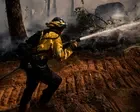
The US has faced a critical shortage of firefighters at the US Forest Service (USFS) this summer as thousands of fires erupted across the country.
Despite officials’ claims that the firefighting workforce was stronger than ever, the agency has failed to keep pace with escalating conditions and the catastrophic fires fueled by them, according to nine firefighters who spoke to the Guardian anonymously, because they are barred from disclosing the information to the public.
Several people familiar with internal hiring data at the agency said there were also large gaps in important leadership roles, which had caused bottlenecks and operational challenges during a busy and dangerous year.
They described a response system that’s been pushed to the brink, as unsustainable pressure is put on skeleton crews with months to go before the highest fire risks subside. Last year, many firefighters had to work more than 1,000 hours of overtime – the equivalent of cramming an extra five months of work into an already busy season. This year is expected to be even worse.
“We just do not have enough people,” said a federal fire captain who works in the Pacific north-west, where wildfires recently devastated neighborhoods in Washington state’s second largest city, Spokane. “Every firefighter is engaged at the highest priority we can possibly engage them, but houses are burning. When it’s not Spokane, it’s going to be the next town, and the next town.”
The USFS, housed under the Department of Agriculture, employs the bulk of the federal government’s fire workforce and manages more than 193m acres across the country. The agency has struggled with recruitment and retention for years, an issue that’s come to a head as the climate crisis fuels a rise in dangerous fire conditions.
A fire captain put the shortages in context by comparing crews to players in a soccer match, where each team has 11 players allowed on the field but an active roster of 30 in case substitutions have to be made. In the forest service, he said, there are no backup players.
“Showing up to a game with 13 people is insane. Playing a whole season with 13 people is abuse,” he said. “That’s how we fight fire – and nobody gets to take a day off.”
The picture stands in stark contrast to the one painted by Tom Schultz, the USFS chief, who has repeatedly assured lawmakers and the public that the agency’s firefighting workforce is at full capacity.
“Our firefighting workforce is stronger than at any point in recent years,” Schultz said in testimony to a congressional subcommittee in July. “We are fully staffed and equipped to respond aggressively to every unplanned ignition.”
The agency has avoided disclosing breakdowns in its staffing totals, even after repeated requests from journalists and members of Congress. Instead, the USFS points to a hiring goal of 11,300 positions as the benchmark for operational staffing levels – a number that has remained flat for years.
John Winn, a spokesperson for the USFS, declined to answer questions about the staffing challenges or provide clarity on the numbers. He doubled down on Schultz’s claims, saying in an email that the agency was “fully staffed at the level we are funded for, and our posture allows us to respond effectively – just as we have for decades”.
But the minimum “operational” staffing levels are far different from what’s required to have a functioning firefighting force in the current climate, according to several firefighters.
Firefighters who have seen internal staff totals said the actual number of people who were able and available to be deployed when large blazes erupt was likely far smaller than what the USFS had reported to the public.
The disparity between the rhetoric repeated in public and the situation on the ground has added to the burdens borne by exhausted crews.
“Having more firefighters means I have a higher probability of coming home,” a fire captain said. “How are we supposed to feel when our leaders – the same people who get up and speak to the mourning families when firefighters die – are lying about our capacity?”
Gaps in leadership
Firefighters who spoke to the Guardian were most concerned about the widening gap at the management level. Specialized positions needed for running large-scale fire suppression operations, including taskforce leaders, division supervisors and heavy equipment bosses, require decades of experience. Losses in these on-the-ground leadership roles have become extremely difficult to replace.
Seth McKinney, a fire management officer with the Boulder county sheriff’s office, spent 12 years working for the USFS before leaving the agency, but he returned this summer to help because the forest he previously worked for was short on chief officers.
“It shouldn’t really surprise anybody that we’re in the situation that we are in, because we haven’t invested in our federal firefighters,” he said, adding that the workforce has become a shadow of what it once was.
For years, escalating job hazards paired with low pay pushed scores of people with experience to leave the USFS. Even after an overdue bump in pay was finalized in 2025, the damage was already done. The USFS lost nearly half of its permanent employees between 2021 and 2024 alone, leaving the agency scrambling to fill leadership positions during the most active parts of the year.
The agency lost roughly 20% of its workforce during the Trump administration’s mass-firing spree in 2025, according to a recent government report. While the cull wasn’t directed at firefighters, it affected included vital support roles that crews are now searching desperately to fill.
“Without experienced middle management you don’t have anything resembling effective coordination,” a firefighter familiar with the shortages said. “It’s no small thing to be short in those areas and it is a significant safety issue.”
These positions oversee thousands of people deployed when big blazes erupt. When there are gaps, it can mean that other parts of the fire-suppression workforce can’t be utilized.
When fires tore across Oregon this summer, private contract resources sat idle, because there weren’t enough qualified managers available to supervise them, the state senator Mike McLane said. He found out about the issue from constituents and then confirmed with the incident management team staff and the Oregon department of forestry.
The problem has been compounded by decades of mismanagement at the agency, according to a firefighter who explained that the losses in positions critical to coordination and supervision left holes that exponentially affected response efforts. “We are now completely unequipped to deal with the sort of fire seasons we will see more and more of.”
A destructive summer adds more pressure
It’s already been a destructive wildfire season. The country has been classified at “preparedness level 5” – the highest level of resource deployment and an indication that new requests for support may go unanswered – since 18 July.
As of Tuesday, more than 49,200 wildfires have erupted and burned more than 7.2m acres (2.9m hectares) nationwide since the year began, eclipsing 10-year averages, and the dangers are far from over. In many regions, fire risks will remain high through autumn and could linger into winter.
Inter-agency complex-incident management teams, specialized groups that are crucial for organizing responses to large-scale disasters, have also taken a hit, with fewer experienced leaders to run them. There were 46 teams in 2023. Now there are just 38.
Dave Upthegrove, the commissioner of public lands for Washington, a publicly elected official who manages the state’s roughly 6m acres (2.4m hectares) of public lands and directs statewide wildland firefighting efforts, said the USFS has been an important partner. But he raised the alarm early this year about the agency’s diminished capacity.
“There are fewer teams, which was true in 2025 as well,” Upthegrove said. “The difference this year is the extreme weather conditions, dangerously high winds at times, very dry fuels and a fourth year of drought. All of that has combined to make us highly vulnerable to large and catastrophic fires like we have seen throughout the state, especially in Spokane.”
With resources spread thin , it’s also been increasingly challenging to meet the needs for equipment and manpower when new fires ignite.
More than 600 requests went unfilled during a 72-hour period last week, according to an internal dataset shared with the Guardian, the bulk of them coming from the Pacific north-west region currently being hammered by fires. Requests for aircraft, crews and equipment were unable to be filled 265 times over the three-day period. Dozens of requests for experienced managers and supervisors also went unfilled.
Staffing shortages have also affected urgently needed landscape treatment work that helps stop blazes before they spread.
More than half of federal firefighters who responded to a survey, conducted in March by the firefighter advocacy group Grassroots Wildland Firefighters and the National Federation of Federal Employees union, said their unit had to cancel prescribed burning projects due to staffing shortages.
Last year, the USFS treated 35% fewer acres than in 2024, according to an analysis from the non-profit Center for Western Priorities. In Oregon, a state now in the midst of a historic season when more acres have burned than in any other recorded year, treatments fell by 47%.
Only a quarter of federal firefighters who responded to the survey said their unit was fully staffed. A fifth reported that unqualified personnel are filling the vacant positions.
This comes amid a major consolidation of the federal firefighting workforce under a new agency, known as the Wildland Fire Service, housed under the Department of the Interior. Officials say the strategy will ensure better coordination and streamline costs.
While many federal firefighters are supportive of a centralized approach, there are also widespread concerns about how this consolidation will be achieved and whether officials will make good on promises to improve working conditions for the crews who undertake a severe mental and physical toll trying to protect communities year after year.
After years of raising the alarm about the widening gap between limited capacity and growing catastrophes, federal firefighters are becoming disillusioned with the sacrifices they’re being asked to make.
“What’s the purpose of the fire service? That’s the hard question we’re starting to ask ourselves,” one fire captain said. “Is it actually to manage fire and to do what we’re telling the public we’re intended to do? Or is it simply to sell the public a belief so that they can sleep at night?”