One of the earliest documented examples of LGBTQ+ resistance against police happened on a hot summer night 60 years ago this month. It started not with the throwing of a brick, as it did in New York City’s 1969 Stonewall riots, but with the throwing of a coffee cup inside Compton’s Cafeteria in San Francisco.
When police attempted to raid Compton’s – a hub for the drag performers, trans people and sex workers in the city’s Tenderloin neighborhood – hundreds of people in the community fought back. A drag queen threw a coffee mug at a police officer; others threw dishes and chairs outside. It was the culmination of years of police harassment, arrests and violence against the community and the beginning of the city’s trans movement.
“The Compton’s story and the significance of that site are not nearly as well-known, by an order of magnitude, as the Stonewall story,” said historian Susan Stryker, credited with unearthing Compton’s story in her 2005 documentary Screaming Queens. “But it is something that is increasingly known and, particularly in San Francisco, is something that’s become part of cultural memory, trans community memory, San Francisco civic memory.”
Today, San Francisco’s Tenderloin neighborhood is home to the world’s first official Transgender District, and the Compton’s riot is memorialized in a historical marker on the former building’s facade. But inside the building, now known as 111 Taylor Street, the space that held Compton’s is occupied by one of the world’s biggest for-profit prison companies and ICE’s biggest contractor, Geo Group. (Geo Group did not respond to the Guardian’s request for comment.)
Opened decades ago, Geo Group’s 240-bed halfway house has been under investigation by city officials since last July, when a man was found dead near 111 Taylor after being held there. Local organizers Compton’s x Coalition – like their predecessors – treat current civil rights fights as interconnected, from ICE violence to the rollback of LGBTQ+ rights. And they are working to push out Geo Group not only through protest, but by petitioning the city to declare the interior of 111 Taylor a historic landmark.
Chandra Laborde, an organizer with Compton’s x Coalition, said the building is symbolic of the struggles and resilience of the Tenderloin from 60 years ago to today. “Sometimes we think about the corner of Turk and Taylor [streets, where Compton’s was located] almost as a microcosm of the world,” she said. “What Susan [Stryker] says is, if we can change the corner, we can change the world.”
An interconnected fight for civil rights
The Transgender District, initially called Compton’s Transgender Cultural District, has been home to trans people for at least a century. Starting in the early 1950s, Gene Compton’s Cafeteria, a 24-hour local chain of greasy spoons, played host to the Tenderloin’s community of trans and queer people who were effectively walled into the neighborhood after experiencing discrimination in housing and above-board work. Police often arrested trans women in the Tenderloin for wearing female clothing and “obstructing the sidewalk”.
According to Stryker’s groundbreaking Transgender History, the Compton’s riot in 1966 was “the first time direct action in the streets by trans people resulted in long-lasting institutional change”. What helped was the support of local churches and secret groups such as the “homophile” Mattachine Society, against the backdrop of Vietnam war protests and the weakening of gender norms in broader American culture.
Over the next few decades, the city began helping trans people access identification and healthcare, enabling them to access more jobs and housing.
Today, said Stryker, policing may be less visible in the Tenderloin, but “that neighborhood is still effectively a jail for a lot of people”.
Comptons x Coalition appealed the zoning of 111 Taylor last year, with hundreds attending public hearings in support of designating the entire building as a historical landmark. The next hearing has yet to be rescheduled.
The group wants the space to become a cultural hub centering safety and justice. Janetta Johnson – a Transgender District founder, the CEO of the anti-carceral trans advocacy group TGI Justice Project and who was once held in 111 Taylor – hopes it is turned into LGBTQ+ senior housing.
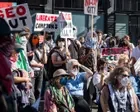
In July, the Compton’s x Coalition hosted a solidarity protest for hunger strikers in ICE detention facilities, including at Delaney Hall in New Jersey and the Adelanto facility in southern California. Stryker spoke to the crowd, along with a local drag queen who had been abducted by ICE and with people formerly incarcerated at 111 Taylor. Protesters held signs that read: “Geo Out”, “Liberate Compton’s” and “Free Them All!”
“Within activist circles, there’s certainly a lot that’s connected and lines drawn between anti-police resistance, police harassment of trans populations and the current history of the building that’s owned by Geo Group,” said Stryker.
A changing San Francisco
Organizers say the fight to push out Geo is a continuation of the kind of fight that transpired inside Compton’s: one for survival in a city now flush with tech money that affects everything from who can afford rent to who becomes the district attorney.
While the Bay Area remains a popular landing spot for trans people mass migrating from states with anti-trans bans, and San Francisco declared itself a sanctuary city for trans people in 2024, the city is not shielded from the anti-trans animus and anti-immigrant policies affecting the nation.
“We’re never going to be able to do enough,” Honey Mahogany, a Trans District founder who is now the director of the city’s Office of Transgender Initiatives, said last fall. “I’m continuing to work with the current [city] administration to do more for our community, because I think it is one of the most vulnerable. It is one of the ones being most targeted by the federal administration.”
Still fresh in the minds of San Francisco organizers is the 2023 killing of 24-year-old Banko Brown, an unhoused Black trans man shot by a Walgreens private security guard over shoplifting snacks. When the city’s district attorney declined to press charges against the security guard, saying he had acted in self-defense, protesters took to the streets.
More recently, at the city’s Trans March in June, police violently arrested protesters for vandalism, drawing guns and batons, after some people covered the lenses of nearby Flock surveillance cameras, an issue that has spawned its own resistance movement. The march terminated at the corner where Compton’s once stood. Nearly two dozen more people were arrested by police in riot gear the following night of Pride weekend at an unpermitted block party, on charges also stemming from “unlawful assembly” and resisting arrest, which their attorneys dispute.
In late July, the Compton’s x Coalition gathered in the historically gay Castro District, alongside other local organizations, to call for all charges from Pride weekend to be dropped. They said the arrests were evidence of a city government beholden to the city’s tech class while failing its trans community.
“San Francisco is not the queer utopia that people have long considered it to be,” said Stryker. “This is the frontline of anti-tech gentrification, where we are fighting end times fascism.”
The Compton’s x Coalition’s efforts within local government to push out Geo Group are slow-moving. San Francisco’s board of supervisors, the body considering the proposal, is currently in recess. On 14 August, Bilal Mahmood, the supervisor who represents the Tenderloin, was removed from the city’s land use committee, leaving the coalition’s proposal with one less advocate. However, Mahmood said: “We have every intention of proceeding with the historical landmarking of 111 Taylor.”
Meanwhile, local people continue to gather and organize.
At the end of the month, the Transgender District and the Compton’s x Coalition are hosting 60th-anniversary celebrations of the Compton’s riot, including a screening of Stryker’s Screaming Queens, where the historian will join a panel discussion. Ach Kabal, another Compton’s x Coalition organizer, said the group has been thinking about another milestone: the year of the fire horse in the Chinese zodiac, symbolizing independence and intensity, which only comes about every 60 years.
“It feels kind of random that in many ways, 60 years later, we’re in a very similar place,” said Kabal. “But the world does move in cycles.”