The student protest movement in India known as the Cockroach Janta Party (CJP) scored a major victory in July after Education Minister Dharmendra Pradhan stepped down following weeks of demonstrations in Delhi.
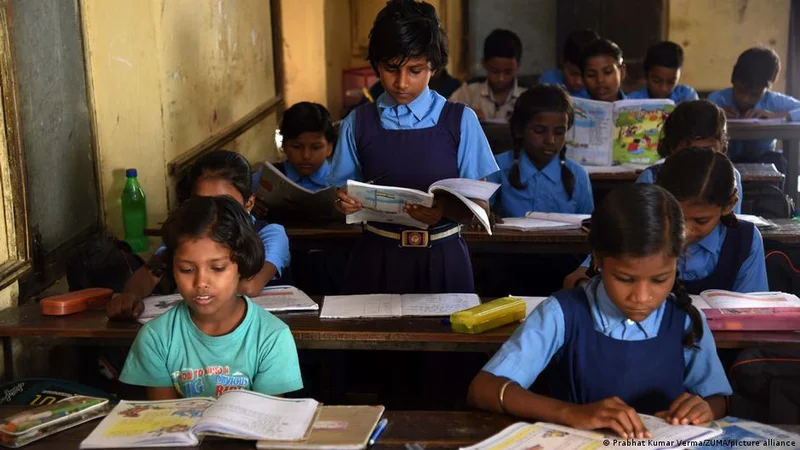
Now, the movement is aiming its campaign for accountability at improving India's government schools.
Last week on India's Independence Day, the CJP launched a nationwide campaign asking citizens to inspect government schools, document what is missing and pressure local authorities to fix basic facilities.
Dubbed "Fix the Schools," the campaign aims to mobilize citizens to identify problems locally and make them public.
CJP founder Abhijeet Dipke launched a campaign in the Indian state of Maharashtra from his native village in Hingoli district. He spoke to students and documented what he said were broken windows, lack of clean drinking water, missing classroom benches and unusable bathrooms.
"No matter which political party ruled, nobody worked for government schools in states. Now there is a need, and we can make them work by asking questions," said Dipke.
Government officials did not respond to DW's requests for comment on the CJP's accusations.
What does the plan call for?
The CJP has prepared assessment forms that parents, students and residents can use to document issues with local government schools. They are being asked to record video evidence, complete the assessment and send the material to CJP.
The organization plans to compile the reports into a public record of neglected schools and use them to pressure local authorities to respond.
The CJP has said the campaign will focus on five basic requirements: functioning toilets, electricity, clean drinking water, classroom benches and the quality of mid-day meals.
One element is to publicly recognize village heads who improve their local schools. The CJP plans to use before-and-after evidence to highlight villages where conditions have improved.
The organization has set an initial target of auditing at least 100 rural government schools over the next two months and pressing authorities to act on the findings.
CJP seeks to expand support
The youth-led CJP began in May as a campaign calling for accountability over a scandal involving a highly competitive university entrance exam. The news that the question sheet had been leaked ahead of the exam date in early May exposed long-running grievances over privileged access for some students.
Fueled by millions of young followers on social media, the movement soon tapped into wider frustrations over unemployment, shrinking opportunities and an education system many young Indians believe has failed them.
After the education minister stepped down, and the government promised steps towards accountability for those involved in the exam paper leaks, the CJP has shifted focus.
However, to be effective in localities around India, the youth-based movement, which has initially mainly been based in Delhi, will need to broaden its appeal.
This comes as Indian Prime Minister Narendra Modi, in his Independence Day address, placed youth power at the center of his vision for a developed India.
India's youth a political force
Aruna Roy, a prominent Indian social activist and former civil servant who helped lead a grassroots movement that resulted in India's landmark Right to Information Act in 2005, said the CJP's campaign could tap into a wider constituency of young people seeking greater accountability.
"The demands at Jantar Mantar resonated with young people across the country," Roy said, referring to the location in central Delhi where the protests were based.
"It was, in many cases, a spontaneous revolt against the state for failing to deliver on promises affecting their education, employment and future," Roy told DW.
"When young people have decided to fight against the destruction of their dreams, they are formidable," she added.
CJP opens door for 'citizen audits'
Responsibility for government school infrastructure is spread across state governments, local administrations and elected village bodies, while conditions vary widely across India.
The CJP's new campaign is a test of whether the movement's ability to mobilize students, volunteers, money and public attention outside traditional political structures can be sustained beyond last month's high profile victory.
Amrita Johri, an activist and transparency advocate, said CJP had tapped into larger issues with India's education system.
"Millions of young people have lost precious years and resources because of repeated failures to ensure fair examinations, with little accountability for those responsible," Johri told DW.
"Every government school should publicly disclose its spending, infrastructure, teacher vacancies and mid-day meal provision," Johri said.
"The CJP can make this meaningful by training volunteers to systematically document problems and follow up, while helping local communities use tools such as the Right to Information to demand change," she added.
Social activist Roy said citizen audits could turn public anger into sustained pressure for accountability.
"Citizen audits are vital because they expose corruption and the arbitrary use of power and bring people into the struggle for accountability," she said.
The campaign gives parents and residents a direct role in documenting what they see around them. CJP says they do not need to wait for an official inspection to identify a broken toilet, a school without drinking water or classrooms without basic furniture.
What comes next?
The first test will be whether its target of 100 schools produces visible changes, and whether the model can be replicated beyond the places where CJP already has organizers and supporters.
The organization has also indicated that it could extend the citizen audit model to public healthcare facilities, widening its focus from education to other basic government services.
N Sai Balaji, former president of the All India Students' Association, said CJP was broadening the fight over education reform and creating the possibility of convergence with student movements already campaigning on higher education.
"The two will meet, and there is a clear synergy. The impact will be felt as the momentum builds," Balaji told DW.
For a movement that began with a protest over examination irregularities, the next phase is less about taking to the streets and more about documenting what citizens encounter in their everyday lives.
"We have built a new parliament, a new PM house. Why have we not been able to build new schools in our villages? Do we not consider the children of farmers and laborers the future of our country?" asked CJP leader Dipke in a video message.
*Edited by: Wesley Rahn *