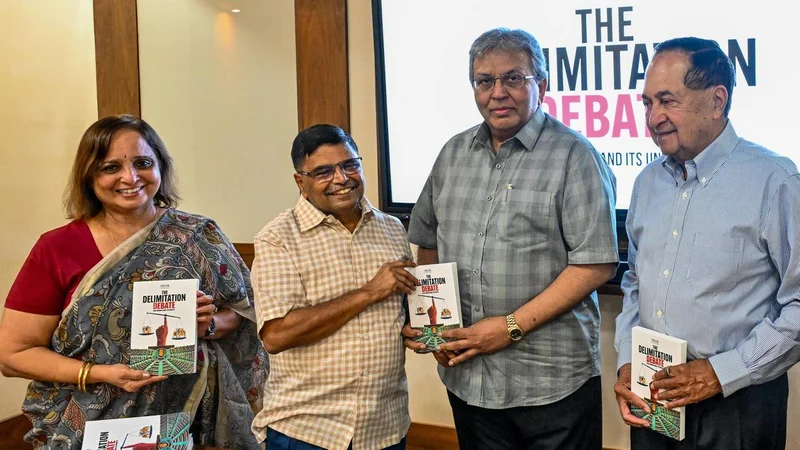
The freeze on delimitation of parliamentary constituencies should continue, and women’s reservation should be implemented immediately after being delinked from delimitation and the Census, former Madras High Court judge D. Hariparanthaman (retd.) said on Thursday (July 23, 2026).
Releasing the book, The Delimitation Debate: The Union and its Units, published by The Hindu Group at its headquarters in Chennai, the former judge cautioned that an increase in the number of Lok Sabha seats would hamper meaningful deliberations in the House.
“The problem of raising the numbers is that deliberations cannot take place,” he said. Besides, if the increase is based on population, southern States will stand to lose adequate representation in the Lok Sabha. This would amount to penalising the southern States for having implemented the national population policy well. “Taking into consideration other democracies, 543 itself is a good number,” he said.
Justice Hariparanthaman also batted for equitable representation of all States in the Rajya Sabha, much like the U.S. Senate model.
K. Ashok Vardhan Shetty, retired IAS officer and member of the High Level Committee on Centre-State Relations constituted by the Tamil Nadu government, said Article 329(a) places the Delimitation Commission’s proposals inside a constitutional “black box”, insulating it from executive, parliamentary, and judicial scrutiny.
The Commission comprises a retired Supreme Court judge as chairperson, the Chief Election Commissioner or a nominee, and the State Election Commissioner of the State concerned. “This is dangerous and has to be corrected. In Japan and Germany, the Delimitation Commission advises but the legislatures pass the delimitation legislations,” he said.
Mr. Shetty suggested the introduction of the “dialogue model” implemented in Canada where the delimitation commission’s proposals are deliberated by a parliamentary sub-committee and the remarks are sent back to the commission for clarification. To improve representation in both Houses, the Rajya Sabha, or the House of States, may be recast on the lines of the U.S. Senate while for the Lok Sabha, a digressive proportionality system, as in practice in Brazil, may be implemented to reduce the gap between the more populous States and the smaller ones. Delimitation should be frozen until all States fell within a narrow band of the National Total Fertility Rate, he said.
N. Ram, Director, The Hindu Group Publishing Pvt. Ltd., suggested that the ideas discussed in the book may be further distilled to make them accessible for all, which then may be translated to other languages.
Also present were Nirmala Lakshman, Publisher, The Hindu Group, and Suresh Nambath, Editor, The Hindu.
R. Srinivasan, head, Magazines and Special Publications, THG Publishing, said the title was the Group’s 219th publication since the formation of a Special Publications vertical in 2017.
The book is a collection of 17 essays — preceded by an introduction — on delimitation, federalism, representation, and Census, and highlights how the lack of access to key data makes delimitation studies difficult in India. Among the authors are Ashok Lavasa, former Election Commissioner; S.Y. Quraishi, former Chief Election Commissioner; G.N. Devy, linguist, cultural activist, and literary critic; Zoya Hasan, Professor Emerita, Jawaharlal Nehru University; and Radha Kumar, former Director-General, Delhi Policy Group.
Published - July 23, 2026 10:52 pm IST