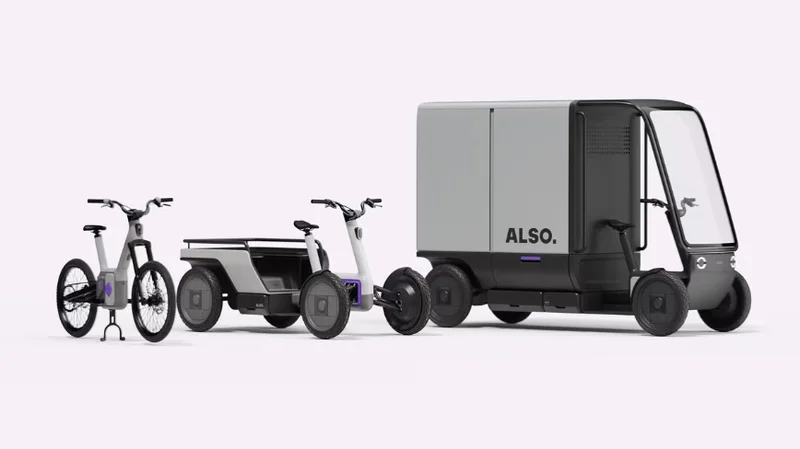
Also, the micromobility startup that spun out of Rivian last year, has raised $150 million in a Series D round. The round values it above $1 billion. The company told Fortune the money will go towards its real ambition, which is not e-bikes but small autonomous vehicles.
Prysm Capital led the round, according to TechCrunch. The existing backers Eclipse, Greenoaks and MVP Ventures also took part. It takes the Palo Alto company’s total funding to $455 million in under two years. Fortune, which first reported the raise, said it pushed the valuation past $1 billion. That is a big number for a two-year-old whose only shipping product is a bike.
What Also sells today is an electric bike. What it is building, its founders say, is a platform. The company makes its own motors, batteries, computing and software. It says that stack can be dropped into anything smaller than a car, from pedal-assist delivery quads to fully autonomous vehicles.
The e-bike is the wedge
Chief executive Chris Yu framed the bike as a starting point, not the business. “Its market is every vehicle smaller than a car,” he told Fortune. Using a 7,000-pound van or SUV to carry one passenger across town makes little sense on cost or congestion, he argued. The same goes for delivering a toothbrush or a burger.
The new money will fund that autonomous push. Also said it is developing several self-driving form factors at once, for both goods and passengers. All of them are built on the same electric architecture as its consumer bike and its commercial delivery quad. Yu said the aim is for small-vehicle autonomy to be an unremarkable part of the transport mix within five years. It would sit alongside self-driving cars, he said.
That shared architecture is the core of the pitch. Rather than design a new machine for each use, Also wants to reuse one set of parts across bikes, delivery quads and, later, driverless pods. Building several form factors on one base is what makes the economics work at the small end of the market, the company says. There, a full-sized robotaxi would be overkill.
The commercial side is where Also parts company with a “nicer e-bike.” It already supplies pedal-assist cargo vehicles to Amazon. It also has a multi-year agreement with the food-delivery firm DoorDash to build autonomous last-mile delivery machines. Those robots are meant to run on the same motors and compute as the bike.
Spun out of Rivian
Also began as a skunkworks project inside Rivian, driven by founder RJ Scaringe’s interest in micromobility. The team drew people from Apple, Google, Specialized and Tesla, and spun out in early 2025 with $105 million. A $200 million Series C followed this year, led by Greenoaks with Prysm, alongside the strategic investment from DoorDash.
Rivian keeps a close hold on the company. Scaringe co-founded Also and remains its chairman, and the carmaker holds a minority stake. That link is strategic as well as financial, even as Rivian keeps chasing its own first profit. Rivian’s growing fleet of on-road vehicles generates driving data. Also expects to need that data to train its own self-driving systems.
Jay Park, who led the round for Prysm, drew a line back to his firm’s early bet on Rivian. “We backed Rivian early because we saw the potential behind wonderfully designed, vertically integrated electric trucks, vans, and SUVs,” he said. Also, he added, is applying the same approach to smaller vehicles.
The founders’ road here has been quick and well funded. Also raised $105 million when it left Rivian in early 2025. A $200 million Series C followed this year, and it has now closed the $150 million Series D. Its team came out of Apple, Google, Specialized and Tesla, and Yu himself is a former Specialized product chief with an aerospace background.
A rough moment for e-bikes
The raise arrives at a shaky moment for the category Also sits in. Rad Power Bikes has filed for bankruptcy, Juiced Bikes has collapsed, and Porsche has quietly walked away from e-bikes altogether. Even so, the broader micromobility market, which spans bikes, scooters and small delivery EVs, is worth about $50 billion. Analysts expect it to more than double by the early 2030s.
The micromobility analyst David Zipper has pointed to the wave of failures as evidence the category is saturated rather than underserved. Yu pushed back on that reading. The struggles of existing products are “not a signal about the demand and the size of the market,” he said, but a sign of how hard it is to build something people actually want. Unreliable batteries and clunky anti-theft locks, he argued, are what have kept riders away.
Also has felt some of that difficulty itself. Its launch-edition bike slipped for months, TechCrunch reported, and has only just begun shipping. It has since opened preorders for its performance and standard models, with first deliveries due in the autumn.
On price, the accounts differ: Fortune put the bike at $3,500, while TechCrunch listed the TM-B two-wheeler at $4,500, with two delivery quads alongside it. On its own site, Also lists the TM-B two-wheeler and the TM-Q delivery quad as its first products. Whatever the sticker, its pitch is that the bike is the least interesting thing about it. As Fortune put it, the e-bike was never really the business.
Get the TNW newsletter
Get the most important tech news in your inbox each week.