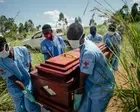
For months health experts have warned that the scale of the Ebola outbreak in the Democratic Republic of the Congo (DRC) could surpass the one that swept west Africa in 2014-16. This week, the authorities in the DRC announced that a grim milestone has already been passed: at least 2,325 people have died from the virus, making it the deadliest of the country’s 17 outbreaks and the fastest-growing in history.
There is no effective vaccine against Bundibugyo – a rare strain of the virus that spread fatally undetected during the spring, often being misdiagnosed as malaria or typhoid. In contrast to neighbouring Uganda, which succeeded in eliminating an outbreak, multiple factors are combining to let the disease rip through the DRC. The worst-affected region is contested by armed groups, and a context of population displacement and chronic insecurity has made monitoring and surveillance more difficult. Ebola treatment centres have been attacked as a result of misinformation and community distrust.
The impact of this dire set of circumstances has been disastrously compounded by choices made in the west and, above all, in the United States. International aid cuts have deprived the DRC of vital human and material resources with which to fight back. In 2014, as the scale of the Ebola crisis in Liberia, Sierra Leone and Guinea became clear, Barack Obama addressed the United Nations general assembly and mobilised a global response that was crucial in containing the outbreak. The US Agency for International Development (USAID) led efforts to train local health workers, pursue contact tracing and implement an eventual vaccination programme.
The contrast with the Trump administration is stark and shaming. Last year, as the de facto head of the now defunct “department of government efficiency”, Elon Musk was given licence to implement swingeing cuts that led to the eventual dismantling of USAID. In the DRC, the direct consequence was the weakening of local health infrastructure and surveillance capacities, leaving one of the poorest countries in the world still more vulnerable. Also lost was a wealth of institutional experience and expertise gained in combating emergencies such as the one now unfolding.
The US has further undermined the capacity for coordinated international action by withdrawing from the World Health Organization, to which it had been one of the biggest donors. European countries, notably Britain, Germany and France, have also been viewing international aid as luxury expenditure and cutting back. Last year, Sir Keir Starmer announced that from 2027 UK aid would be reduced from 0.5% of GDP to 0.3%.
Against such a backdrop, the lack of diplomatic urgency over the current crisis, compared with 2014, should not perhaps come as a surprise. But that does not make it any less disappointing. The Ebola outbreak in west Africa laid bare the risk of regional and global disruption as a result of inadequate health infrastructure. A thousand pieties were then uttered in the wake of the Covid pandemic regarding the need to invest in global health security and future preparedness.
Subsequent actions by governments have belied those words, leaving the DRC exposed to an epidemic that is threatening to spiral out of control. Belatedly, the global community needs to mobilise to address the threat. More fundamentally, it needs to draw the right lessons from a case study in why international aid matters.