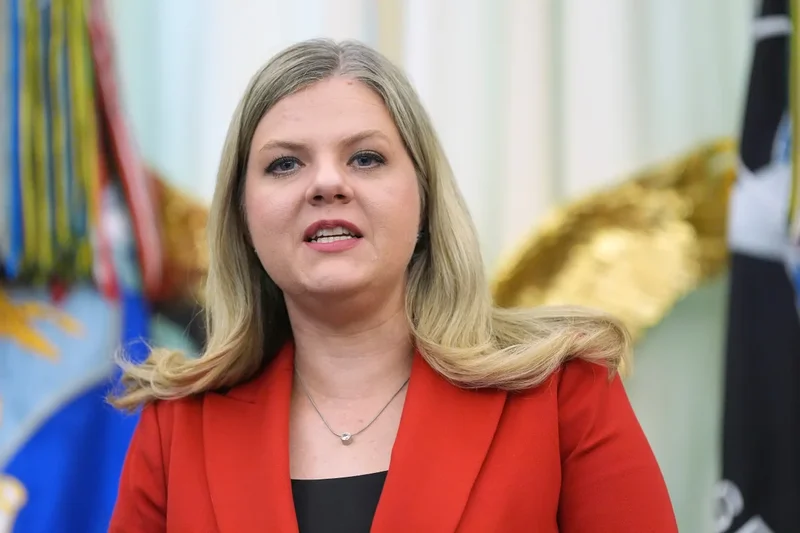
President Donald Trump announced Wednesday that Dr. Heidi Overton, a senior White House adviser, has been selected to head the Food and Drug Administration.
A medical doctor serving as deputy director of the White House Domestic Policy Council, Overton has helped direct a number of health initiatives in Trump’s second term. Through those efforts, she has established herself as a key administration figure aligned with the Republican president’s agenda.
Should the Senate confirm her appointment, she will have to navigate a range of competing interests, from Trump’s personal priorities to the deregulatory goals of mainstream Republicans and the anti-corporate focus of Health Secretary Robert F. Kennedy Jr.
Similar friction troubled the term of former FDA commissioner Dr. Marty Makary, who stepped down in May and left behind unresolved work surrounding ultraprocessed foods, antidepressants, and COVID-19 vaccines.
Writing on Truth Social and calling her "Dr. Heidi," Trump praised Overton as a sharp and widely respected "rockstar" who will advance his objectives of accelerating cures, fostering innovation, reducing drug costs, and delivering victories for Kennedy’s "Make America Healthy Again" initiative.
In a post on X, Kennedy commended Overton for having "exceptional judgment, professionalism, discipline and an unwavering commitment to the American people."
According to her LinkedIn profile, Overton earned her medical degree from the University of New Mexico and holds a doctorate in clinical investigation from Johns Hopkins University. Before joining the second Trump administration, she served as chief policy officer for the conservative think tank America First Policy Institute.
Over recent months, she has appeared alongside the president during announcements for major health policies, including "most favored nation" arrangements with pharmaceutical firms to reduce domestic prices to international levels.
She also appeared during his recent vaccine executive order, which sought to separate the combined measles, mumps, and rubella (MMR) shot into three individual doses despite opposition from medical organizations.
During an Oval Office gathering promoting that directive, she stood beside Trump as he falsely claimed that vaccine timing or dosage could contribute to higher autism spectrum disorder rates, an assertion rejected by scientific consensus and decades of research showing no connection.
Overton’s controversial abortion stance
Overton has previously criticized abortion medications and, if approved, would be positioned to roll back regulations that broadened access to those drugs. Anti-abortion advocates in the U.S. have voiced discontent over the administration’s failure to restrict online prescriptions for the pills, arguing that the practice undermines state-level bans.
Mifepristone, commonly administered alongside misoprostol, is used in roughly two-thirds of American medication abortions. Healthcare experts describe it as "among the safest medications" cleared by the agency.
Her confirmation depends on winning approval from a narrow Republican Senate majority and navigating questioning before the Senate Health, Education, Labor and Pensions Committee. The panel's chair, Republican Sen. Bill Cassidy—a Louisiana physician—has publicly criticized several of Trump’s statements casting doubt on vaccines, including the MMR separation order.
On social media, Democratic lawmakers forcefully denounced the choice.
"Heidi Overton is a far-right, anti-abortion extremist who has no business leading the FDA," stated Washington Sen. Patty Murray, who serves on the committee.
Makary’s replacement will face challenges left behind
Before his departure, Makary faced opposition from both healthcare executives and anti-abortion campaigners. Discontent culminated over the agency's inaction regarding flavored electronic cigarettes. While manufacturers like R.J. Reynolds seek approval to market to adult smokers, sweet-flavored products have been linked to youth vaping trends, leaving FDA scientists reluctant to approve them as adult cessation tools.
Shortly before Makary resigned, the FDA altered policy to allow a broader selection of unauthorized e-cigarettes and nicotine pouches on the domestic market, effectively circumventing agency scientists.
Drug companies are likewise anticipating shifts at the agency following rejections and reversals concerning biotech treatments for rare conditions. Objections from drugmakers, investors, and patient advocacy groups have intensified, drawing support from conservative members of Congress.
Makary sought to ease industry concerns by launching measures intended to streamline drug evaluations, though some of those initiatives created additional operational difficulties for regulators.
Several key deputies under Makary also departed the agency.
Dr. Vinay Prasad, who directed the vaccine and biotech division, resigned in April after facing heavy criticism from drugmakers, patients, and investors. Meanwhile, Dr. Tracy Beth Hoeg, who reviewed the safety of antidepressants, COVID-19 vaccines, and other prominent treatments, was removed from her role as acting drug center director.
Overton will also have to manage demands from supporters of Kennedy’s health platform, some of whom remain skeptical of her background.
Kelly Ryerson, an anti-pesticide campaigner known to her followers as "Glyphosate Girl," told The Associated Press that Overton repeated corporate arguments from pesticide maker Bayer during a White House MAHA roundtable event in April.
"I was stunned by the blatant, undisguised corruption," Ryerson stated.
A major task facing the incoming commissioner will be determining the regulatory framework for peptides. A federal advisory panel selected by Kennedy recently advised expanding access to several popular peptides favored by wellness influencers, despite warnings from FDA scientists that the compounds lack proven safety and effectiveness.
The FDA recently introduced a proposal requiring food manufacturers to notify regulators prior to adding new ingredients to processed goods. However, the agency continues working with the White House to establish a formal definition for ultraprocessed foods, which Kennedy links to rising rates of diabetes, obesity, and chronic illness.
Under Kennedy’s guidance, the FDA has imposed new requirements on vaccine clinical trials and restricted the release of findings regarding COVID-19 shot efficacy. Kennedy also joined Trump as the president signed the executive order reshaping childhood immunization guidelines, despite significant financial and logistical hurdles.
Additionally, the FDA maintains an ongoing evaluation of widely prescribed antidepressants to determine whether prenatal exposure correlates with elevated risks of autism or other conditions. Such medications have long been criticized by Kennedy, a former leader in the anti-vaccine movement.
In recent weeks, regulators have been investigating two summer foodborne contamination events: a cyclospora outbreak linked to iceberg lettuce that infected thousands, and a salmonella outbreak connected to jalapeño peppers spanning multiple states.