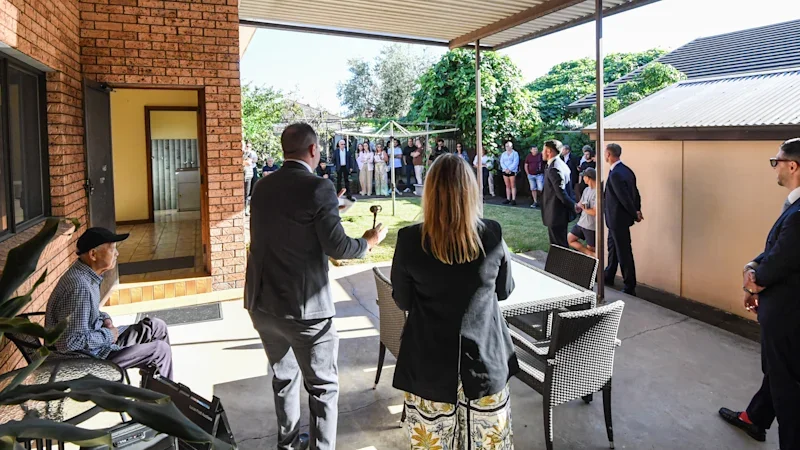
It’s a regular sight at auctions: there are plenty of onlookers around, but bidders? They’re thin on the ground.
Even where there are registrations, it’s not unusual for no bids to be placed, leaving auctioneers to place a vendor’s bid and pass the property in.
When it happens, sales agent for Pulse Property Agents Luke Lombardi said it gets down to one thing: incorrect pricing.
“[Properties are passing in because] agents are shooting themselves in the foot – they are not adapting to the pricing right now,” he said. “Every vendor knows the landscape. It’s the clear communication from the agent from the start – that’s why things are not selling. They are still aiming too high and not acclimatising.”
Auction clearance rates in Sydney have been declining this year due to three interest rate hikes and the federal budget’s changes to negative gearing and the capital gains tax.
The clearance rate for July was 48.9 per cent on Domain data, meaning less than half of the properties scheduled for auction sold under the hammer. The rest were either passed in, withdrawn from auction or postponed. The rate has fallen from 66.3 per cent in February.
Ben Horwood, principal at Horwood Nolan Real Estate, said even the official clearance rate did not provide the full picture.
“There are a lot of auctions being delayed or withdrawn and the ones that are going to auction, the buyers are hesitant,” he said.
In a market where fewer properties go to auction each week, it seems counterintuitive that competition to buy them has waned. But agents report buyers appear to be hanging back, letting a property be passed in and then moving in to negotiate with hopes of buying at a discount.
Campaign correction
In an unpredictable market, auctioneer Emma Brown-Garrett said buyers are struggling to cut through the campaign noise, leading to hesitation on the auction floor.
“The biggest problem is the agents have started to talk about too many numbers – ‘this is our guide, but the owner is expecting this, we might have an offer of this’. The campaign should be focused on your guide to get your competitors to the auction,” she said.
“If you talk about other numbers, you eliminate competition because people think they can’t afford to buy.”
Sales agent Lombardi said agents need to respond to buyer feedback.
“We know that prices have softened, and we are having the robust conversations with vendors before we go to market,” he said. “You [may] need to adjust [the price] and if you don’t, you’re losing traction straight away.”
Passed in, but open to negotiation
Buyer’s agent Lloyd Edge said there were advantages for buyers in letting a property be passed in, and some were holding back to see what happened.
“If it is passed in, you can negotiate other terms into a contract such as a cooling-off period for five [business] days, or a building and pest clause,” he said.
Lombardi said when a property is passed in, agents needed to move quickly to keep the sale on track.
“If they pass in, we go with a sale plan where we are overservicing those vendors,” he said. “The number of open for inspections will increase, the price guide is still advertised, and within two or three weeks of it being passed in, you should have offers, unless there is something wrong with it.”
Horwood agreed there is a two- or three-week window to sell a passed-in property post-auction before buyers start to question why it is still available.
“As long as the vendors are prepared to meet the market, the offers should come within a week or two [post-auction].
“If the property is still on the market two months or more after being passed in, people will start asking questions. If you want to keep the listing active, you need to keep adjusting the price in this market.”
The exception is the prestige market, where fewer buyers mean deals can take longer, he said.
Move or risk losing it
If buyers are interested in a property, Lombardi cautioned against a “wait and see” approach. He recently sold a duplex in Caringbah which was passed in at auction.
“I’d sold the duplex next door for $1.9 million last year and this sold for $1.72 million,” he said.
The property, which had a guide of $1.7 million, had one registered bidder, who placed a single bid of $1.67 million at auction – below the $1.8 million reserve. After the auction, negotiations progressed quickly, but not with the original bidder.
“Another buyer who was present at the auction but didn’t bid came through the house on Monday night and made an offer,” he said. “The property sold Tuesday night. You can’t sit back and wait for an inspection on Wednesday or Saturday.
“We knew we would not get $1.9 million because the market had softened and buyers could see value at that level.”
For Ray White Eastern Beaches director Angus Gorrie, negotiations continue for a two-bedroom art deco apartment which passed in recently at $775,000 and is now listed for sale.
“We are still in the process of getting the buyer up and the owner down,” he said. “We’re getting close to making a deal.
“Buyers have more say at the moment and they are dictating terms because there are not so many [of them around].”
While the market is not as buoyant as last year, Gorrie still has faith in the auction process.
“The auction process gave us a buyer and a contract. We are moving in the right direction.”