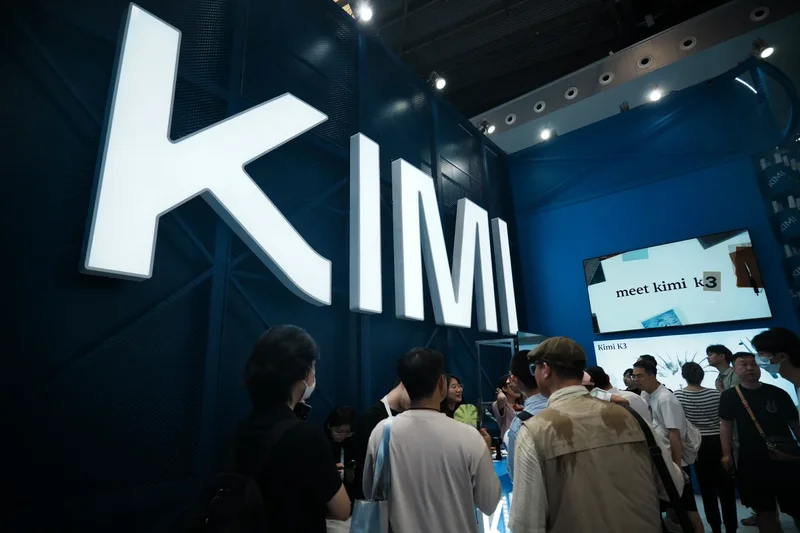
Just three days after the Chinese developer Moonshot AI unveiled Kimi K3 on July 17, it stopped accepting new subscriptions. Demand for the enormous artificial intelligence model had overwhelmed the company’s available computing capacity. Yet Moonshot says it plans to release K3’s full model weights by July 27, which would allow other organizations to host and modify the model themselves.
In a post on X, Dean W. Ball, OpenAI’s head of strategic futures, argued that a world dominated by open-weight models could lead to “full AI communism”—a future he described as “a dystopian hellscape.” But giving away the weights of a top-tier AI model may actually make practical sense. For Moonshot, doing so could spread K3 far beyond its own computing infrastructure and help it compete with leading U.S. systems whose developers keep their weights private. The company did not respond to a request for comment.
Before reaching for dystopian prophecies, Ball acknowledged in the same post that Kimi K3, a 2.8-trillion-parameter system, appears to be a very good model. In benchmarks published by Moonshot, Kimi K3 generally lands ahead of OpenAI’s GPT-5.5 and Anthropic’s Claude Opus 4.8 but behind Claude Fable 5 and, on some tests, GPT-5.6 Sol. Moonshot reports that its model performs especially well on Web searches and business workflows. These results place Kimi K3 among the strongest modern AI systems without showing that it has surpassed the leading American models. What most clearly sets Kimi K3 apart from GPT-5.6 Sol or Claude Fable 5 is Moonshot’s plan to release its weights openly.
On supporting science journalism
If you're enjoying this article, consider supporting our award-winning journalism by subscribing. By purchasing a subscription you are helping to ensure the future of impactful stories about the discoveries and ideas shaping our world today.
A large language model (LLM) such as Kimi, GPT or Claude is, at bottom, an enormous collection of numbers. During training, the model ingests vast amounts of text and other data while an algorithm adjusts billions or trillions of numerical dials—the weights—until the system can predict and eventually generate humanlike content. Much of what the model has learned is encoded in those numbers. American AI labs generally keep the weights of their most capable models on private servers. A user can talk to GPT or Claude through an app but never possess the model itself. An open-weight release inverts this arrangement: the developer posts the trained weights publicly, allowing anyone with sufficient hardware to run the model privately or customize it.
Chinese leaders have embraced that approach as part of a broader political message. At the 2026 World Artificial Intelligence Conference in Shanghai, Chinese president Xi Jinping called for “open source, collaboration and sharing” and the prevention of “new historical injustice in AI.” But that rhetoric blurs an important distinction.
“‘Open weight’ is not the same as ‘open source,’” says James Landay, a professor of computer science at Stanford University. There’s been a lot of mixing up between the two.”
An open-source AI model should provide more than its weights but also enough information and code for outsiders to study and modify the system—although researchers and standards groups continue to debate how much of the training process must be disclosed. An open-weight release can leave the model’s data and development history opaque. Landay says that uncertainty should make organizations cautious about adopting models whose provenance cannot be fully examined. “We might not know what’s in there; we might not know if they phone home in some ways with our data,” he warns. But such opacity does not erase the commercial logic of releasing the weights.
“They still make money in a number of ways,” says Kyle Chan, a fellow at the Brookings Institution, who studies China’s technology policy. Moonshot can continue selling access through its application-programming interface and subscription products even after other companies begin hosting Kimi K3.
Moonshot is younger and less richly resourced than the largest U.S. frontier-model developers. Chan argues that releasing a strong model’s weights gives such a company another way to compete: widespread adoption can expand its influence even when it lacks enough hardware to serve every user itself.
U.S. export controls introduced in 2022 have restricted Chinese laboratories’ access to advanced AI chips. “This constrained compute capacity for the Chinese AI labs,” Chan says, “they talk about it all the time.” The restrictions do not fully explain Chinese developers’ embrace of open weights, but Chan says limited compute makes the strategy more attractive.
Chan expects major hosting platforms such as Databricks to begin offering Kimi K3 after its weights are released. “By open-weighting it, you basically unlock all that extra compute capacity that other people have invested in and built up,” he says, effectively turning outside providers’ infrastructure into part of the model’s distribution system. “It’s like an amplifying effect.”
Meta helped popularize open-weight LLMs when it released Llama in 2023. DeepSeek brought new attention to China’s open-weight strategy with its R1 model in early 2025. OpenAI and Google now offer open-weight families of their own while reserving their most capable systems for controlled services. The U.S. start-up Thinking Machines Labs joined the field on July 15 with its first model, Inkling.
Chan believes the leading U.S. labs risk ceding ground if Chinese models become the systems that companies and developers around the world can most readily adopt. “I think it’s a mistake to give up on open weight,” he says. “The success of the Chinese models is showing its value.”
That doesn’t imply China will necessarily win the AI race, Landay says. “New open models may come from those big players and not from Alibaba or the Kimi people,” he says. “But if I could predict it, I’d be one of those rich guys driving an expensive car.”
Still, Landay expects competition from Chinese developers and smaller U.S. laboratories to put greater pressure on leading companies to release more capable open models. “I think the bigger lesson is that open ecosystems, in the long run, win,” he says.