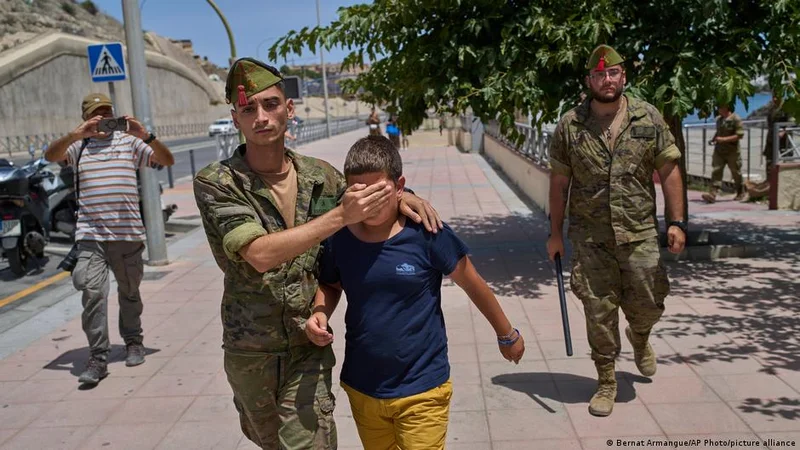
Spanish immigration and youth services officials have come up with a plan to transfer roughly 500 particularly vulnerable unaccompanied youths from the North African Spanish exclave of Ceuta to mainland Spain.
Spain's Ministry of Youth and Children says the plan has a mechanism that will allow "child protection organizations to take in and care for the most vulnerable individuals — including girls — in adapted facilities on the mainland, without the need to transfer custody to [regional authorities]."
What else do we know about the measure?
On Wednesday, Spain's Migration Minister Elma Saiz told public broadcaster RNE that Madrid is working with Ceuta and Spain's regional governments to organize the transfer and placement of the children, mainly girls, in foster homes as well as under government care.
Spain's EFE news agency quoted government officials saying that a royal decree would establish "the binding and solidarity-based reception of minors by all regions."
Migration Minister Saiz emphasized the fact that the "overriding welfare of the children" must be protected at all cost.
UNICEF Spain's Lara Contreras said the approach would see Ceuta retain legal guardianship of the girls until they were transferred to child protection organizations "willing to take them in" on the Spanish mainland.
Contreras said that 97 of the 500 girls selected — aged 9 to 17 — have already been moved to improved facilities and will be transferred as soon as possible.
Contreras says it is "urgent" that authorities properly identify unaccompanied children and denounced the fact that "hundreds of them are wandering the streets alone, in unsanitary conditions."
What is the situation in Ceuta?
The children are among the roughly 80,000 individuals who crossed into Ceuta from Morocco on July 30 in hopes of starting a better life in Europe.
Though most migrants have since returned to Morocco, Spanish Interior Minister Fernando Grande-Marlaska recently said that around 5,000 remain in Ceuta.
Spain's national police have reportedly identified 2,168 unaccompanied minors living on the streets since the border crossing and handed them over to local authorities on July 30.
Edited by: Saim Dušan Inayatullah
If you rely on our team for trusted reporting, please take a moment to select us as your Preferred Source on Google, so you'll always see our verified news first.