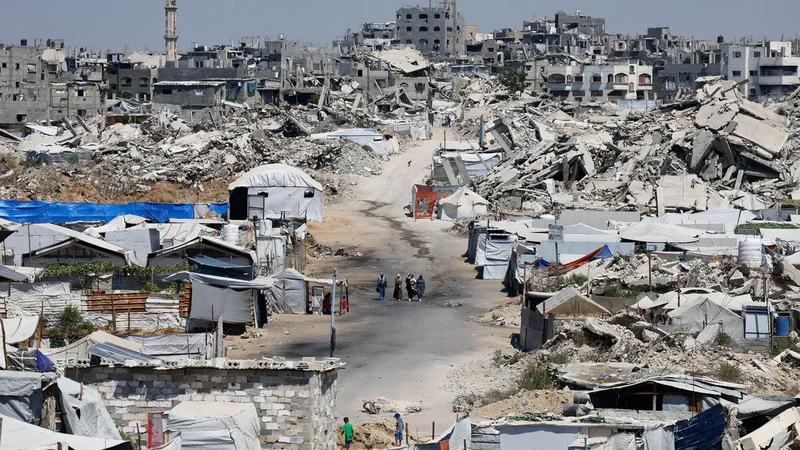
There is one, and only one solution to the decades long, volatile and bloody situation in West Asia: the creation or the establishment of a sovereign, independent, viable Palestinian state. In essence, it is no different from the oft-touted two-state solution. But the two-state formula speaks of the establishment of two states living side by side in good neighbourliness. However, one state already exists. What is needed is to establish or create a new, second state, namely Palestine. There will never be peace and stability in the region unless this is done. All the conflicts in the region — Israel’s war on Gaza, the Iran war, the Hezbollah-Israel war, the Houthi phenomenon — will not be resolved unless a viable Palestinian state comes into being. Israel’s relations with its Arab neighbours will remain strained until it accepts the reality of a Palestinian state, just as the Arabs have reconciled to the reality of Israel.
United States President Donald Trump seems to have recognised the importance of working towards the creation of a Palestinian state. Resolution 2803 setting up a Board of Peace (BoP), which was adopted by the United Nations Security Council in November 2025 has the following provision in its annex: “While Gaza re-development advances and when the PA [Palestinian Authority] reform program is faithfully carried out, the conditions may finally be in place for a credible pathway to Palestinian self-determination and statehood, which we recognize as the aspiration of the Palestinian people.”
On Iran and Israel
A major player in this conflict-infested region is Iran. Iran has not always been hostile to Israel. Indeed, under the Shah, Iran’s relations with Israel were cordial and there was a sizeable Jewish community in Iran. Since the Islamic revolution of 1979, most Jews left for Israel. But there are still about 15,000 Jews in Iran. Iran’s Constitution provides for a seat for the Jewish community in Parliament.
Historically, there has not been perpetual enmity between Islam and Judaism. The Koran mentions many prophets and patriarchs from the Hebrew bible, such as Moses, and Abraham. The Crusades were fought between Muslims and Christians; the Jews were not a party to them. Jews were persecuted in countries professing Christianity. The Arabs bore no responsibility for the Holocaust which was carried out by Nazi Germany and its collaborators. It would not be an exaggeration to say that but for the Holocaust, and the sense of guilt felt by the western countries, Israel might not have been born. It is well known that most western countries, including the U.S., barred the entry of Jews seeking refuge from Hitler’s Germany.
The transition from holy land to homeland started with the infamous Balfour Declaration of 1917 when the British expressed support for a homeland for the Jews, expressly limiting the indigenous Arab population only to civil and religious rights.
The roots of regional hostility
The hostility of Iran and the Arab countries towards Israel is based on the fact that Israel was created and imposed on the region at the expense of the indigenous Arab population. It is argued that the Palestinians were offered a state in the UN resolution of 1947 and a few times subsequently, but they rejected all offers. An Israeli Foreign Minister, Abba Eban, famously said that the Arabs never miss an opportunity to miss an opportunity. But one can hardly blame a landlord if he rejects an offer of a few rooms from an intruder who has occupied the whole house. Indeed, the slogan of the Zionists was: land without people for a people without land
It is noteworthy that Hezbollah, a Shia movement, and Iran, a Shia-majority country, support Hamas, a Sunni movement. This is easily explained by their commitment to the right of self-determination for the Palestinian people. Israel naturally comes in for hostility as the only power that stands in the way of the emergence of an independent Palestine.
Hezbollah began launching rockets and missiles against Israel just after Israel started its war on Gaza after October 7, 2023. It follows that if Israel accepts the reality of a Palestinian state at some time, Hezbollah will have no reason to make the life of people in northern Israel difficult.
In that case, Iran too will stop supplying weapons to Hezbollah. This is not to suggest that if the Palestinians are able to exercise their right of self-determination, Iran and Israel will become friends. But without that, their mutual enmity will never abate. If an irreversible road map to a Palestinian state emerges and is accepted by all the parties, secondary issues such as the Strait of Hormuz will be much easier to resolve.
Since Hamas’ terrorist attack on Israeli civilians in October 2023, whatever little support some in Israel had for the concept of a Palestinian state has evaporated. Israel’s disproportionate and ruthless strikes on Gaza, post October 7, might have almost isolated Israel, but in the process, the Gaza strip has been devastated and the possibility of the emergence of Palestine has receded by many years, perhaps decades. Consequently, peace and stability in the region have become an illusion.
Mediation is the key
The only way to have a realistic possibility of resolving the conflict is through external mediation. And the only external power that has the required influence and even goodwill with both sides is the United States. It is true that there is no such thing as an honest broker. But brokers, even non-honest ones, do manage to sell the transaction to the satisfaction, or equal non-satisfaction, of both parties.
Israel has insisted on bilateral talks, adding at the same time that there is no one on the other side to negotiate with. Usually, the stronger side insists on a bilateral approach, and the weaker side prefers an outside agency to help. The only time progress was achieved was when the Oslo Accord was concluded in 1993. Oslo was negotiated with the mediation or good offices of Norway.
Under Oslo, the Palestine Liberation Organization formally recognised Israel and the PA was created; it is this PA, albeit a reformed one, that is often mentioned as a possible caretaker government of Palestine. The Oslo Accords paved the way for Jordan’s recognition of Israel and eventually the Abraham Accords.
The other viable broker is the UN. Israel at the moment is dead set against the UN and has even declared the UN Secretary-General persona non grata. But Israel owes its existence to the UN. There is nothing permanent in international relations. Positions evolve with evolving situations.
Israeli Prime Minister Benjamin Netanyahu has his own personal reasons for opposing the idea of an independent Palestine. He had voted against the Oslo Accords and is implacably opposed to the idea of a Palestine state.
Let us hope that in due course, enlightened leadership will emerge in West Asia on all sides. If the leaders do not have the wisdom and the courage to make the necessary decisions, however difficult, the people of the region will remain doomed to suffer and be denied the peace and stability they need. Without these, they will never be able to realise the full potential for development that new technologies have to offer.
C.R. Gharekhan is former United Nations Coordinator for Occupied Territories and Special Envoy of India for West Asia
Published - August 20, 2026 12:16 am IST