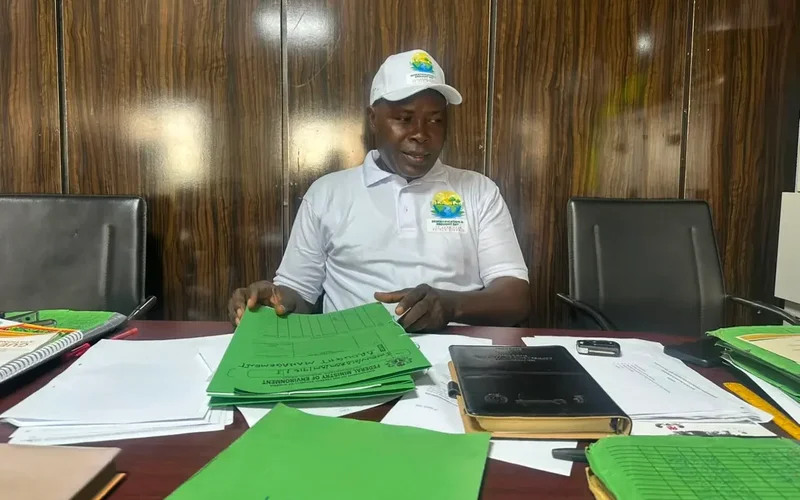
In this interview, Etim William, Director of the Desertification, Land Degradation and Drought Management Department of the Federal Ministry of Environment, the factors contributing to the degradation of Nigeria’s rangelands and how desertification, land degradation and drought are worsening farmer-herder conflicts and threatening food security across major agricultural hubs in the country.
Excerpt:
PT: What does your department do?
Mr William: Going by the name of the department — Desertification, Land Degradation and Drought Management — our mandate is to combat desertification, address land degradation by restoring degraded lands, and manage drought. Those are the mandates of the department.
PT: In commemoration of World Desertification and Drought Day, what does the ministry hope to achieve? What is the aim and objective of the event?
| | |
|---|
Mr William: Desertification, drought and land degradation are global menaces. There is hardly any country in the world that does not face land degradation. Desertification and drought also affect many countries. That is why the United Nations Convention to Combat Desertification (UNCCD), one of the Rio Conventions, was established to address desertification, land degradation, and drought.
Every year, the convention commemorates the fight against desertification and drought on June 17. The event seeks to raise public awareness of the impact of drought, land degradation, and desertification on humans, animals, and the environment. Life on land depends on the health of the land. From the land, we get food and natural resources. We have forests, vegetation, animals and genetic resources. So, if the land is degraded, you lose biodiversity and species, both flora and fauna. You lose ecosystems and genetic resources. Agricultural production will also decline because we do not farm in the air; we farm on land. That will inadvertently lead to food insecurity, hunger and poverty. It can also lead to migration because when land is degraded, people tend to leave their original communities in search of greener pastures. This creates competition for land resources, which can also result in conflicts, including farmer-herder conflicts.
This is because rangelands are no longer available in sufficient quantity; many have been degraded. Nobody seems to pay adequate attention to rangelands and their sustainable management. If the rangelands were available and sustainably managed, pastoralists would have less reason to take their herds through people’s farms.
PT: Do we have rangelands in Nigeria?
Mr William: Yes, we have rangelands.
PT: How many rangelands are there in Nigeria?
Mr William: I may not know the exact number. The Ministry of Livestock Development may have conducted an assessment of our rangelands, but I cannot tell you the exact number.
PT: What are rangelands?
Mr William: They are basically grasslands and shrublands. We have grasslands throughout the savanna, including the Guinea and Sudan Savannas.
PT: When you say some of these rangelands are degraded, what do you mean?
Mr William: They are overexploited. Sometimes people set them on fire. Most of them are being converted to croplands, and in the process of clearing the land, fire is used, which contributes to land degradation. Some are also converted to urban infrastructure and other uses.
PT: Are there gazetted rangelands in Nigeria?
Mr William: I think we have a few gazetted ones, but I am not in a position to provide details, as we do not have a direct mandate to manage rangelands. That should be the responsibility of the Ministry of Livestock Development. Our interest is that they are degraded landscapes and degraded ecosystems under the purview of the United Nations Convention to Combat Desertification, and Nigeria is a party to that convention.
PT: What is Nigeria’s commitment to the UNCCD as a signatory?
Mr William: Land degradation neutrality is one of our commitments. The convention focuses on restoring degraded lands, combating desertification and managing drought. All these issues — desertification, land degradation and drought — are closely connected to land. The UNCCD is the only convention that takes land as a critical factor in socioeconomic development. That is why degraded land needs to be restored.
PT: Under the convention, do we have specific targets that Nigeria wants to achieve?
Mr William: Yes. We have a land degradation neutrality target.
Land degradation neutrality is a programme designed by the UNCCD to address land degradation and achieve neutrality, as enshrined in Sustainable Development Goal 15.3.1. The target is to achieve land degradation neutrality.
PT: What does land degradation neutrality mean?
Mr William: Land degradation neutrality is a state or condition where there is no net degradation of land. It is essentially about achieving zero net land degradation. This means maintaining land cover, land productivity and soil organic matter in a productive condition. There should be no net loss in the fertility, productivity, amount or quality of land.
PT: You mentioned that some of our rangelands are degraded. I also understand that Nigeria used to have what were known as grazing routes. How is your department helping to address degradation along these corridors? Are there any breakthroughs you would like to share?
Mr William: Most of these rangelands are located in arid and semi-arid regions. These are areas where our activities are concentrated, particularly areas affected by desertification and drought. Most rangelands are affected by desertification, drought, and climate change. Our mandate to restore degraded lands, combat desertification and manage drought covers these areas. So, when we restore degraded lands, degraded rangelands are also restored. That is how we come in.
PT: How do you go about restoring these lands? Are there specific techniques or interventions?
Mr William: Of course. First, we carry out an assessment. We work with the states where the rangelands and desertification-affected areas are located. We have what is called the desertification frontline states. These are states heavily affected by desertification. There are 11 frontline states where desertification is more pronounced, and its impacts are more severe. They include Sokoto, Kebbi, Zamfara, Kano, Katsina, Jigawa, Adamawa and Taraba, among others.
PT: What are your activities across these states?
Mr William: Restoration. When we talk about restoration, we mean planting trees, sustainable management of the land and providing water facilities in areas affected by drought. We have a technique involving underground water storage systems. We install systems that collect rainwater during the rainy season and channel it into underground storage systems for use when the rains cease during the dry season. We also establish tree plantations using local varieties that can withstand drought and survive with insufficient rainfall. These are some of the things we do. We restore degraded and desertified landscapes and provide sources of water, including underground water systems. We also drill boreholes, including solar-powered boreholes. These interventions help to mitigate the impacts of desertification and drought while restoring degraded landscapes.
PT: In the course of doing this work, what are some of the challenges you face?
Mr William: The challenges in our case are enormous. One of the greatest is insecurity. These areas are affected by banditry, terrorism and kidnapping, so some areas are not accessible because they are high-risk areas in terms of security. Sometimes we cannot go to those areas. In areas we can reach, we sometimes find people vandalising the projects after we have established plantations. They steal solar pumps and solar panels and break the fences. We normally protect our plantations with wire fencing, but some people take cattle into the project sites, where they eat the seedlings. These are some of the challenges we are facing.
Another challenge is funding. The government has many things to address, and many sectors require subsidies and appropriations. What comes to us is just a pittance, so we have to make do with the limited funds available to us.
PT: How has collaboration with international partners such as the UNCCD and GIZ contributed to your work?
Mr William: Partnership has really enhanced our activities. At times, the UNCCD provides us with funding to implement specific projects. For example, before you can assess the extent of desertification and land degradation, you need data. The UNCCD helps us gather reliable data. The UNCCD has also supported our target-setting programme. The first phase of the target-setting process was supported by the UNCCD, during which we set a target of restoring about 10 million hectares of degraded land. There was a second phase of the target-setting process, which helped us to raise the target from 10 million hectares to about 19 million hectares.
The UNCCD has supported all these efforts. We also have other partners, including the World Bank-supported Agro-Climatic Resilience in Semi-Arid Landscapes (ACReSAL) project. The project seeks to address degraded landscapes in the semi-arid region, build resilience against climate change and support climate-smart agriculture. We also have the Food and Agriculture Organisation (FAO), which supported us through a project titled Action Against Desertification in the northern part of the country. Through that project, about 5,000 hectares of degraded land were restored. These forms of support have really helped us achieve some of our mandates.
Even today’s programme, which commemorates World Desertification and Drought Day, was supported by partners such as GIZ. We also received support from the Nigerian Bottling Company. These are some of the partnerships and support the ministry has enjoyed, which have enhanced our delivery.
PT: Looking ahead to the Conference of the Parties (COP), what is Nigeria pushing for? Is there an agenda the country is trying to achieve?
Mr Williams: One of the areas Nigeria will push during the COP is drought management.
Nigeria, alongside other African countries, seeks to advance a legally binding instrument on drought management. This is an African position, and Nigeria supports that position.
We are pushing to establish a legally binding instrument for drought management, essentially a drought protocol. That is one of the areas Nigeria will push for at the COP. Other areas include finance. We need to push for more financial support to meet our national needs and fund our National Adaptation Plan. Regarding land degradation, we need support and partners to help us achieve land degradation neutrality.
These are some of the issues we will push for.
PT: You mentioned finance. How much funding is Nigeria looking at, perhaps over the next five or 10 years, to boost efforts to address land degradation and desertification?
Mr Williams: The figure cannot be fixed or considered sacrosanct because things keep changing from time to time. We have inflation. Something you can do with ₦10 today may cost ₦20 tomorrow.
The fact remains that restoration requires a huge investment that no nation can undertake alone. We need support. We need to collaborate and partner with international organisations. We need their support.
PT: At the COP, how is Nigeria going to negotiate? Will Nigeria negotiate as part of the African bloc?
Mr William: Yes. We have the African Group of Negotiators. Whatever the African position is, Nigeria equally supports that position. We are not going to negotiate anything outside the position of the African group.
PT: You mentioned that about 50 per cent of our rangelands are degraded. How bad is the situation?
Mr William: It is very bad. If you listened to the Honourable Minister’s keynote address and the welcome address, it was reported that about 50 per cent of our rangelands are degraded.
PT: What do you think is causing the degradation of rangelands in Nigeria?
Mr William: There are numerous drivers. Climate change is one. Others include unsustainable use, overgrazing, deforestation, bush burning, competition for land resources and overpopulation. Poverty is also a factor. Land-use change is another. For example, converting rangelands to croplands or using them for infrastructure development contributes to degradation. Mining, including illegal mining, is another factor. There are numerous drivers.
PT: What would you like to see change, especially going into the COP, across some of these badly affected rangeland corridors?
Mr William: Just like the theme of this year’s World Desertification and Drought Day says, “Rangelands: Recognise, Respect, Restore,” we want more action. We want people to stop activities that degrade rangelands. We want people to understand the value of rangelands because, in fact, the issue of rangelands has not attracted sufficient attention.
Through today’s event, we are trying to create awareness about the value and importance of conserving our rangelands. It is not just about talking; we want action. We want attitudinal change. The government alone cannot do it. We want everyone to be involved, including pastoralists, communities, NGOs, private organisations, international communities and donor organisations. We want all of them to partner with the government to address the degradation of rangelands. By the time we achieve that goal, our food security will be strengthened, farmer-herder conflicts will be reduced, biodiversity will be replenished, and we will be able to mitigate the adverse effects of climate change.
Let me give you one example. The Northeast Trade Winds that blow from the Sahara Desert carry dust. We experience this phenomenon, which is often associated with the harmattan. It is also connected to degraded landscapes, rangelands, and forests. If our landscapes were well protected with vegetation and trees, the effects of climate events such as the harmattan would be reduced. If we had sufficient resilience, the impacts of climate change would be minimised. Those are the issues.