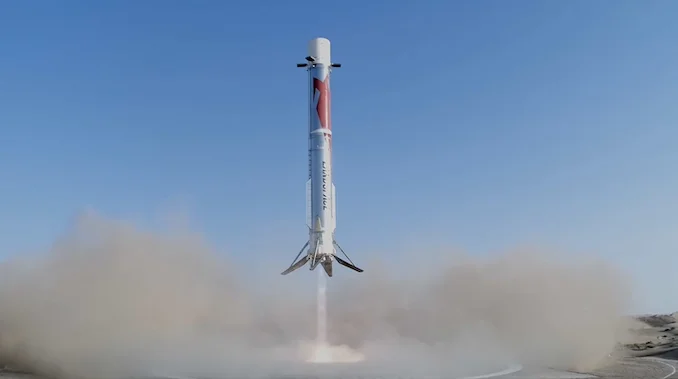
Chinese commercial launch company, LandSpace cemented its place in the race to rocket reusability as it landed the first stage booster of its ZhuQue-3 (ZQ-3) rocket on Wednesday morning local time.
The rocket lifted off from Dongfeng Commercial Space Innovation Pilot Zone in the northwestern part of the country at 7:35 a.m. CST on Aug. 19 (7:35 p.m. EDT / 2335 UTC on Aug. 18) to begin the second flight in this rocket’s development.
Following stage separation more than two minutes after liftoff, the booster began to target its designated landing zone in Minqin County, Gansu Province. It stuck the landing nearly eight minutes after liftoff. However, video clips shared on social media showed a post-landing fire breaking out in the aft section of the vehicle.
“This mission marks China’s first-ever successful recovery attempt of the first stage of an orbital-class launch vehicle using landing legs, and China’s first successful booster recovery on land,” LandSpace wrote after the mission. “It is a pivotal flight test for ZhuQue-3 as it transitions from the technological demonstration and verification phase toward the engineering application phase of reusability.”
ZhuQue-3 Y2 Launch Mission Recap
– The Return of ZhuQue | 朱雀归来 pic.twitter.com/MYAJBo6hQj
— LandSpace (@LandSpace_Tech) August 19, 2026
The ZQ-3 rocket stands at 76.6 meters (251.3 ft) in height, taller than SpaceX’s Falcon 9 rocket, which is 70 meters tall (229.6 ft). The rocket is an amalgamation of features from the Falcon 9 and Starship, given that it has a stainless steel exterior, chines and is fueled by liquid methane.
It uses nine Tianzhi-series engines on its first stage and a vacuum variant for its second stage. This was the second launch and second landing attempt for the ZQ-3, the first flight ending in a crash landing.
According to the company’s website, LandSpace was established in 2015 and completed its first vertical takeoff and vertical landing test in January 2024. The plan at that point was to launch the first ZQ-3 rocket in 2025, which it achieved in December of that year.
During its inaugural launch, LandSpace was able to deploy its payload to orbit, but the booster encountered an “abnormal combustion” during the recovery effort, according to the Xinhua News Agency.
“Building on flight data and engineering experience from the ZQ-3 Y1 flight test, ZQ-3 Y2 incorporates multiple targeted optimizations across key phases of recovery flight,” LandSpace wrote. “The landing propulsion scheme reduces the number of engines used in the landing burn, further simplifying system design and improving reliability. The onboard safety and automatic Flight Termination System (FTS) introduces a predicted-impact-point safety function and an optimized return control strategy, further enhancing the safety and autonomous control capability of the recovery flight.
“To address the complex mechanical and thermal environment during the first-stage return and re-entry phase, thermal protection systems were redesigned and enhanced to cope with intense re-entry loads and heat, further improving the vehicle’s environmental adaptability and reliability in the return and re-entry phase.”
After stage separation, the first stage completed a series of critical maneuvers during a planned coast phase: high-altitude attitude reorientation, powered deceleration via re-entry burn, aerodynamic gliding, landing burn, and landing leg deployment with touchdown attenuation —… pic.twitter.com/N8y5PPSXem
— LandSpace (@LandSpace_Tech) August 19, 2026
LandSpace said Wednesday’s mission also validated its Hold-Down and Release Mechanism for deploying payloads. It argued that the flight was a proving ground for “future large-scale constellation deployment, rapid batch deployment, and improved operation efficiency.”
LandSpace also operates a single-use rocket, ZhuQue-2E, which has flown six times since its debut in November 2024.
Expanding the reusability landscape
The successful recovery of its booster puts LandSpace in a very small club of launch providers that have achieved the goal of propulsively landing a booster with the goal of reusing it.
Last month, the China Aerospace Science and Technology Corporation (CASC) flew the inaugural flight of its partially reusable Long March 10B (Chángzhēng 10B). Unlike the landing legs used on ZQ-3, the Long March 10B used an off-shore barge and a series of strong wires to catch the booster on July 10.
SpaceX continues to lead the field in rocket reusability. It launched its 614th reflown booster to date on a flight for its Starlink constellation on Tuesday night.
The company currently has 26 first-stage boosters across its current fleet of Falcon 9 and Falcon Heavy rockets. Among those, four of the boosters in use have achieved at least 30 flights and another will be added to that list on Thursday.
Blue Origin entered the orbital rocket reusability field in January 2025 with the inaugural flight of its New Glenn rocket. It went on to recover its first booster on its second flight in November.
That rocket is grounded for now following an anomaly with an oxygen valve on its BE-4 engine that caused an explosion during a static fire test on May 28.
Other United States launches providers hoping to prove out their reusable, medium lift rockets include Firefly Aerospace with Eclipse, Relativity Space with Terran-R, Rocket Lab with Neutron, and Stoke Space with Nova. Those companies aim to launch inaugural flights within the next year.