Writing novels is an antidote to the intense investigative reporting of Louise Milligan’s day job. “It’s such an amazing, electrifying feeling; it’s one of the best things that has ever happened to me, writing fiction. There’s no therapy I could ever have that would give me anything like what I get from [it].”
The 41-year-old is speaking about her latest book, Shellybanks, set in Ireland, her country of birth. A crime/mystery, it explores families and secrets, power and faith, poverty and rebellion. Revolving around the harbour of the title, one thread explores the Magdalene laundries-style horrors imposed on young women in Ireland throughout the 20th century.
“Fiction has got to have a kernel of truth and everything that happens in that book could have happened, and did happen, to so many women, and it’s so wrong,” Milligan says.
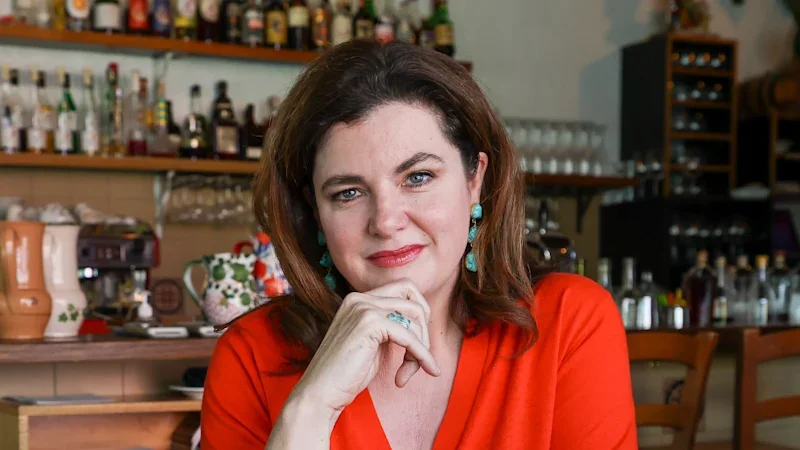
We’re dining at Bar Idda in Brunswick East, a Sicilian restaurant of 17 years’ standing, quite the achievement in a town with an ever-changing landscape of food offerings. Sharing is de rigueur, so we opt for the crumbed swordfish, the beef-and-almond meatballs, and a chicory salad, plus a glass of white wine each.
The venue is a recent favourite for family events, so for Milligan it holds a special place. Warm and welcoming, the food is excellent and the setting cosy. (When photographer Joe Armao arrives – himself Sicilian – he confirms the steak is rave-worthy.)
While Shellybanks explores “a creepy, intense reality”, it also has a lightness and humour, which Milligan says reflects her Irish/Australian culture: “It’s a novel that has a lot of heart.”
Both it and her first nonfiction offering Pheasant’s Nest have been optioned for the screen by Ambience Entertainment, known for Storm Boy and Muster Dogs.
Holding power to account is stock-in-trade for Milligan. Working as a journalist on the ABC’s Four Corners, her work was key to change in NSW consent laws (after 2018 story I Am That Girl) and her exposé of the toxic culture at Sydney’s Cranbrook School in 2024 led to a government inquiry and the resignation of the school’s principal.
(Four Corners has been in the news lately with the appointment of a new executive producer, and three episodes of the show by another journalist being investigated by the ABC Ombudsman. This interview was conducted before those developments.)
Being a journalist means you have the discipline of research, she says, a skill which carries over into fiction. “So that’s really helpful, I don’t find that a chore, I find it a joy. But then once you’ve done that, you can just let yourself go,” Milligan says. “[Fiction is] much more freeing, obviously, because you can just make things up.”
In 2017, she won the Walkley Book Award for Cardinal: The Rise and Fall of George Pell, which began as a story she’d covered at the ABC. Her 7.30 George Pell investigation won the Gold Quill that year.
(The late Cardinal Pell spent 404 days in prison after being convicted of child sex abuse charges. The charges were quashed on appeal by the High Court. Last year the federal government’s National Redress Scheme granted two men compensation for abuse, despite Pell being acquitted of separate criminal charges.)
In 2021, she wrote a searing critique of the Australian legal system, Witness, about the treatment of victims of sexual assault, which should be mandatory reading for all lawyers, law students and judiciary. Winner of the Victorian Premier’s Literary Awards People’s Choice prize, it was also shortlisted for the Stella Prize.
“Writing non-fiction books is very rewarding in lots of ways, but it’s so tough, especially because I was doing very high-stakes stuff. It was exhausting and terrifying, like Four Corners on steroids, whereas this is just joyful,” she says.
Much of Milligan’s journalism has been about “giving voice to people that were previously unheard, and also spending time sitting with people who are desperate for some sort of justice and accountability because of what happened to them, either as children or as vulnerable people”, she says.
That experience prompted her approach to Shellybanks. “In Dolores, I really wanted to explore a character going through that – in the same way with Kate [Delaney in Pheasant’s Nest] as well – to give them both the vulnerability but also the strength. That’s where the whole idea of Shellybanks comes back: how do you not get caught in the undertow? How do you make it to the limestone wall?”
While there’s a through line that reflects Milligan’s detailed knowledge of institutional abuse and its ongoing ramifications, her preoccupations centre on women and injustice more broadly.
“I’m really interested in the experience of women in Ireland and the impact of both colonialism and the church because the church was so important in the culture, the politics. The fact that you couldn’t get a condom till 1985, you couldn’t get divorced until 1997, you couldn’t get an abortion ...[until] 2018.”
That had really profound consequences for every woman, Milligan says, particularly those of her nana’s generation. “My Nana had 11 children ... Everyone she knew was similar. Her sisters all had multiple children; the one with the most had 13. And the husbands, some of them were OK and some of them were pretty useless. They were really intelligent, lively, amazing, strong women – and I don’t know how they did it.”
One of the joyous things about writing a novel set in her mother country was discovering more of Ireland; her family moved to Australia when she was six. While working on the book, she visited three times, twice with her mum and again with her 16-year-old daughter, who also helped with the research.
“We come from this massive family – Mum’s got 10 brothers and sisters. So a lot of the time when we would go back, we would just spend the whole time catching up with people – you don’t actually see that much of the country. So I made a really concerted last time to see a lot more and to get out of Dublin.”
The change in demographics over time is palpable – where traditionally Ireland was monocultural, now it’s a melting pot. One of her maternal aunts married a Nigerian, “a great scandal in the family at the time”.
Ireland has been very welcoming of refugees, she says, much more so than Australia in recent years, which is part of her wanting that sense of another culture in the book.
There’s also a sense of everything that came before; the Irish are obsessed with death, Milligan says. In her latest book, there’s a funeral scene one character has to leave because it’s so triggering, involving the viewing of the deceased.
People there really love talking about death, she says. “My Nana, nothing gave her more weird joy than talking about who had died or who was dying, or who had cancer ... I think they come to terms with death a lot better because of that. And there’s a sense that the dead still live among us, not in a ghostly sense, but just in a sense that they’re still remembered. They have masses every year for them ... They do look it in the eye.”
Shellybanks is based on a recurring dream she had involving her and her Nana at the beach of the same name in Dublin Bay, a big, U-shaped bay where the tide goes out for miles, she says. “There’s this squelchy, grey sand and there are cockleshells everywhere and kids would go out and play on it.
“My uncles, when they were kids, would go and play in the cockle lake, which formed in the middle of the bay out from Shellybanks, but the water would come whooshing back in,” she says. “And I had this dream – I don’t know whether it happened or not because where would I get this dream from – but of the water coming back and getting caught.”
On a recent research trip, she found out one of her cousins had that exact experience and nearly drowned. “My Nana would always talk about kids drowning because back in the day most of them didn’t know how to swim ... I had this idea that Shellybanks could be this metaphor for trauma and not getting caught in the undertow.”
Swimming in the ocean is one of the investigative journalist’s passions. On holidays, she makes a beeline for anywhere she can swim every day, describing it as “incredibly calming”.
Her family are also very close: several of the characters in her fiction are loosely based on aunts and uncles. We talk about the shared joy of growing up in Irish families and having gatherings at which people sang or read poetry. At one point, she easily recalls a poem learnt as a teenager, Aunt Jennifer’s Tigers by Adrienne Rich.
In recent years, writing novels has become something of an obsession: Milligan is 11 chapters into her next book.
“In Ireland, I really did feel like I was this human divining rod. I just walked around and picked things up and had ideas. Maybe I might do this, maybe I might do that ... I’d research this and I’d research that and I’d talk to this person and that person and then it would just all come to me.”
Shellybanks is published by Allen & Unwin.
The Booklist is a weekly newsletter for book lovers from Jason Steger. Get it delivered every Friday.