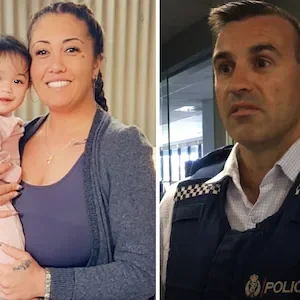
She said detectives arranging the interview, and those who met her for a preliminary discussion on Monday and interview on Tuesday, repeatedly said their interest in speaking to her related to Verry.
They introduced themselves as members of the police internal integrity unit, she said. The Herald has posed a series of questions to the police about the interview but has received no response.
Bennett said she was expected to return today and possibly tomorrow for more questions.
Ebony Bennett with her granddaughter, Kween Thompson, who died the day after this photograph was taken, aged 10 months.
She and her daughter, the baby’s mother Kalani Taitumu, were the only two people at home when Kween was found unresponsive.
Verry is at the centre of an employment investigation after police identified 54 child protection, adult sexual assault and other cases requiring reinvestigation among almost 1000 files under his oversight. The investigation is named Operation Hark. Almost all the cases relate to Verry’s time with the police in Northland.
Bennett claims similar questions are also being asked about the investigation into Kween’s sudden death in July 2023.
Police will not officially comment but Verry has been publicly linked to the case – he made an appeal to the public for information just days after her death.
Verry was at the time a Detective Senior Sergeant with Northland’s Child Protection Team, based in Whangārei, and described as the lead detective on the case.
He said at the time that Kween died of asphyxia but that police had been told of a non-accidental injury which was the focus of a child protection investigation.
He told the Herald at the time: “As part of that investigation, we are looking into the circumstances of the death, which at this stage is being treated as unexplained. It appears the non-accidental injury does not relate to the death.”
‘Varying co-operation’
Bennett’s position then and now was that Kween’s death was a sudden and tragic loss. Kween’s mother Kalani Taitumu told The Hui in 2024 of finding her daughter not moving, with blue lips, in a partially collapsed portacot.
A preliminary coroner’s report shows the cause of death as asphyxia – a lack of oxygen – but the coroner’s office says a final determination has not been reached and the file remains open. Any inquest would ordinarily await the completion of the police investigation.
Since then, Bennett said she had not heard from police, despite repeated efforts to make contact. That included visiting the police station in Dargaville, phone calls to Verry and dozens of complaints to the Independent Police Conduct Authority (IPCA). The police have also not responded to questions on Bennett’s claims of attempting to make contact.
The police have been approached for comment on this.
In The Hui interview in 2024, Bennett and Taitumu publicly offered themselves to the police for interview.
Bennett’s frustration is all the greater because, she says, of public comments from Verry that the police had “varying degrees” of co-operation from family members.
“No one f***ing listens because of Kevan Verry,” she told the Herald. “For three years, I’ve just sounded like a crazy woman.”
Detective Senior Sergeant Kevan Verry.
She said the phone call last Friday from a detective asking her to meet with him and a team of others to discuss Kween and Verry brought relief.
Bennett claims the last conversation she had with Verry ended with him telling her to leave him alone and then disconnecting the call.
The interview, she said, felt like she was being heard after three years of asking police to listen.
While Verry is under employment investigation, the police have brought on a “surge” force of 16 investigators to review and reinvestigate files that were under his oversight.
The focus on Verry came after concerns in May about the handling of a historical sexual abuse complaint. That case had reportedly sat for years without meaningful investigative action.
An initial check then found 13 further cases of concern, which led to a police review of nearly 1000 files. The review found 40 more cases requiring fresh investigation, bringing the total to 54 cases.
Those are made up of 40 child protection cases, 12 adult sexual assault cases and two involving alleged offending that police have not specified.
Fewer cops on child inquiries
The files cover a period in which staffing allocated to Northland’s Child Protection Team had fallen sharply. Police figures released under the Official Information Act show the team went from about 32 fulltime-equivalent (FTE) staff in 2022 to 25 in 2023 and fewer than 23 in 2024. It recovered to 27 FTEs in 2025.
The police have not detailed alleged failings in the cases or said that all 54 were mishandled in the same way. Along with the “surge” force, the police have brought in an external advisory group and a joint police-Oranga Tamariki assurance panel to oversee the work.
Criminal defence lawyer Sumudu Thode – whose work includes cases in Northland – said the police should provide more information to assure the public there was not a systemic issue, either within Northland or in other districts.
She said the files in this case could pose issues that lawyers would see in courts years down the track. Potential victims who disappeared in the system could lose faith in the support structures intended to protect them and hold offenders to account.
In that sense, Thode said it could result in the adverse outcomes seen in cases of state abuse.
“All the negative impacts that can have on people that result in them being defendants in criminal court in five, 10, 15 years.”
Thode said cases that weren’t progressed to closure could easily slip under the radar. She said if charges were not laid and someone had not retained a lawyer, then parts of the defence system would not usually have visibility of complaints made about people or their engagement – or lack of – with police.
Thode, who is also the vice-president of the Criminal Bar Association, said Northland posed particular challenges for police as it had a large geographical area and people often in situations of disadvantage and vulnerability. People were less likely to have contact with professional services – such as a GP – and often moved and changed contact numbers.
“It takes time and it takes resources. It takes that much more – which makes it easier to pick up a burglary file instead.”
At the 2023 Census, Northland had 194,007 residents, of which 37.4% were Māori – more than twice the national share of 17.8%.
The median personal income for Northland adults was $33,100, compared with $41,500 nationally. Northlanders were almost twice as likely to live in areas ranked in the country’s two most deprived deciles, at 40% compared with 20% nationally.
Martin Kaipo, the chief executive of Northland health and social-services provider the Ōtangarei Trust, also spoke of the difficulties police faced investigating complex cases across the region.
Long travel distances, isolated communities with little engagement with Government agencies and entrenched social problems combined to make investigations difficult, he said. Māori liaison officers helped, “but there’s still the chain of command”.
“Is it culture or is it time?” he asked, questioning whether the problem lay within police culture or the time structurally available to investigate complex cases.
Lawyer Sumudu Thode. Photo / RAW
He said his agency had built strong working relationships with Oranga Tamariki and police in recent years.
For a period before that, Kaipa said it was his view that complex cases involving vulnerable children “didn’t seem like a priority”.
Police history of bungling cases
Assistant Commissioner Tusha Penny, who is overseeing the reinvestigation of the files in Operation Hark, said wider checks had been carried out and found localised problems but no national systemic failure.
Penny has confronted a similar issue before.
In June 2006, Masterton Detective Sue Mackle wrote to Deputy Commissioner Rob Pope and other senior staff, saying she was unable to cope with the number of child abuse cases in the district.
In her email, she wrote that “obviously, child abuse is not an area of importance for the police, as opposed to areas such as traffic”.
By Mackle’s estimate, about 140 cases had not been investigated. Files were on average 5 years old and some children remained living with those alleged to have abused them.
Penny – then a Detective Sergeant - was sent to Masterton to assess the complaint. She found one part-time detective carrying about 121 files, some dating back to 2002, no effective file-management system and basic investigative work still outstanding.
Penny recommended immediate steps to clear the backlog. While action was directed to be taken, senior police later accepted local assurances the problem had been brought under control.
But they didn’t check and a 2008 audit showed little had changed – more than 100 outstanding cases remained, while dozens had previously been incorrectly filed or inappropriately resolved.
The discovery led to nationwide IPCA inquiries published in 2010 and 2011.
Ōtangarei Trust chief executive Martin Kaipo. Photo / Tania Whyte
Those inquiry reports show the Wairarapa child-abuse backlog was repeated across the country, exposing wider failures in police supervision, file management, resourcing and oversight.
The police launched “Operation Hope” and reviewed hundreds of files, finding dozens needing more work. The IPCA said the problems showed how child-abuse investigations could be neglected when specialist staff were diverted to other serious crime.
The inquiry also found improper file closures, weak quality assurance and inadequate district and national oversight.
In Northland, where Verry was later based, the 2010/2011 IPCA inquiry found child-abuse investigations were “under-resourced, poorly recorded and not consistently supervised”.
At the time, Northland had one dedicated child-abuse team in Whangārei, while cases in Dargaville, Kaitāia, Kerikeri and Kaikohe were handled through satellite stations. Police could not reliably establish how many files officers held, and investigators were regularly diverted to other work.
At times, that included traffic duties.
IPCA designed safeguards
While urgent medical examinations, interviews and care-and-protection actions were generally timely, unacceptable delays occurred later as officers juggled non-urgent investigative work and competing demands.
The IPCA also highlighted the sprawling nature of the district, fragmented responsibility, limited specialist capacity and weak central oversight. These factors, it said, created conditions in which files could drift.
It specifically recommended a district-wide oversight role for Northland, urgent improvements to case management and a national minimum standard for investigation files.
The numbers are not directly comparable with Operation Hark but provide a historical point of reference.
Police staff reviewed 127 Northland child-abuse files and found four had suffered delays. Two historical sexual-abuse cases resulted in informal follow-up with the officers responsible but no formal disciplinary action.
Assistant Commissioner District Support Tusha Penny. Photo / RNZ
A separate computer check identified another 64 files that lacked enough information to show they had been properly handled. Police staff subsequently checked those files and carried out any necessary follow-up.
The IPCA reports led to safeguards intended to prevent cases from being lost in the system. Those recommendations included a mandatory supervisory review before files were closed, regular random audits, better recording systems and clearer national responsibility for child-protection investigations.
Verry, in his senior Northland role, was part of the safety net intended to stop cases from drifting. But by the time the period now under investigation began, he had himself become the focus of serious internal concerns that the police were later found to have handled inadequately.
‘Upward bullying’
An Employment Relations Authority (ERA) decision released in December found Verry’s conduct formed part of a pattern of “upward bullying” directed at Detective Inspector Bridget Doell.
Police management had been specifically warned about his conduct after Doell’s performance review included references to senior detectives working to undermine her, and in a later email raised by the police HR (human resources) manager.
Verry was one of four detective senior sergeants reporting to Doell.
In August 2022, an email Verry sent to Doell accusing her of bullying and criticising her leadership led to the police HR manager assessing it as inappropriate, unprofessional and undermining, saying she was “appalled”.
It was raised with Northland District Commander Superintendent Tony Hill, who spoke to Verry. He was not investigated or sanctioned. The authority later found the police’s failure to deal adequately with the email “probably emboldened” Verry.
Six months later, while Doell was temporarily acting as Northland crime manager, Verry sent another email about her to four members of her own team. Doell later described it as a concerted and demeaning attack – when she eventually saw it.
The email was sent up the chain of command – but police managers decided no disciplinary sanction was required. Verry was asked to apologise. Doell was asked to accept the apology without first being shown what he had written, the ERA decision said.
She learned of the email in April 2023 but did not receive a copy for six months. After reading it, according to the ERA decision, she said she felt manipulated, humiliated and misled by senior police.
The wider picture emerged through messages recovered from Verry’s police phone, revealing the four Detective Senior Sergeants had a private chat called “The group we don’t talk about”, which appeared to be used to co-ordinate opposition to one of Doell’s proposed roster changes.
Verry had saved Doell in his contacts using an “Ice Queen” emoji, while messages between him and officers he managed contained repeated disparaging and undermining commentary about her.
Those exchanges continued until June 2023 – including messages Verry sent while already under investigation over the February email.
Verry denied trying to undermine Doell, saying he was raising genuine concerns and that the private messages were due to extreme pressure and frustration.
The authority found the police had unjustifiably disadvantaged Doell by failing to investigate the February email adequately, take remedial action or provide her with proper support.
Doell was awarded $15,000 for the unjustified disadvantage she suffered. Verry was promoted to Detective Inspector – before the ERA decision came out – and was publicly identified with the Counties Manukau CIB in March 2025.
By the time the ERA decision was made public in December, he was working in Wellington with the National Gang Unit, created under the current Government as part of Minister of Police Mark Mitchell’s tough-on-gangs approach.
The Police Association – the police union – said it was representing Verry in the employment inquiry and no further comment would be made. It would not comment whether it was representing other officers linked to the claims against Verry.
David Fisher is based in Northland and has worked as a journalist for more than 30 years, winning multiple journalism awards including being twice named Reporter of the Year and being selected as one of a small number of Wolfson Press Fellows to Wolfson College, Cambridge. He first joined the Herald in 2004.
Sign up to The Daily H, a free newsletter curated by our editors and delivered straight to your inbox every weekday.