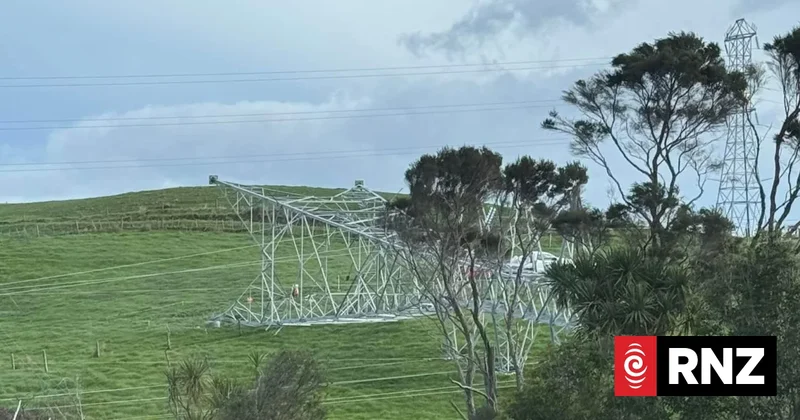
Transpower pylon collapse: High Court hears call for class action after Northland power outage
Northland businesses affected by a power outage following a fallen pylon in 2024 are urging a court to allow them to take a class action to recoup their losses.
On Thursday, the High Court at Wellington heard that an estimated 24,000 businesses were operating in Northland when the Transpower pylon at Glorit, near Wellsford, collapsed in June, after an unsupervised Omexom contractor removed all the nuts from three of its four legs during routine maintenance.
Mike Colson, KC, representing Skibo Ltd, a Northland paint and protective coating business, asked Justice Victoria Heine to grant representative orders under Rule 4.24 of the High Court rules, which allows a claim to be brought "on behalf of, or for the benefit of, all persons with the same interest in the subject matter of the proceeding".
The action is against Transpower and its maintenance contractor Omexom over the regional power outage caused by the collapsed pylon.
It seeks to recover the losses Northland businesses incurred, with estimates of that economic loss arising from the outage ranging from $37.5 million to $80m.
Colson told the court Transpower could have avoided the issue it's now facing if it had effectively issued proper instructions or supervised its contractors.
He argued that Transpower had a duty of care to Northland businesses to avoid obvious interruptions to the power supply, and the fallen pylon showed it breached that duty of care.
There is one power line into Northland and Transpower knew or should have known the risks associated with that when undertaking maintenance.
Northland businesses were in no position to mitigate that risk, he said.
Colson said many of these businesses were also small and it wasn't reasonable to expect them to have business interruption insurance.
That was a point Jack Hodder, KC, representing Transpower, picked up on.
He told the court Colson had tried to characterise the issue as this being a case of large defendants turning up and trying to suppress access to justice for small-consumer types.
He told the court that wasn't the case and the court didn't have to grant Rule 4.24.
He referred to the evidence of Chris Birkenshaw, Transpower's general counsel, suggesting a handful of affected people had large claims, around $900,000, through to many much smaller ones of several thousand dollars.
Birkenshaw's evidence was that there was a relatively modest number of claims; although there was no evidence how many people wanted to take part in the class action.
The larger players were capable of looking after themselves and for smaller claimants, there was access to justice through the Disputes Tribunal, Hodder said.
Daniel Kalderimis, KC, representing Omexom, told the court the plaintiffs had oversimplified their case, and in doing so had proposed an oversimplified trial process.
There were serious concerns about how a trial would work.
"We could hold a trial and then find out that we are missing vital bits of information," he said.
There had been other court cases involving electricity outages, but none were comparable with this one, he said, because there were no other New Zealand cases that involved a single utility failure that led to a mass tort claim.
He flagged that it would raise some novel and significant issues and said an opt-out procedure wasn't a coherent way to proceed.
"The kind of loss that is suffered may well be determinative of whether a duty is owed," he said.
Opt-in versus opt-out
If a representative order is made, Justice Heine can decide if there was an opt-in or opt-out clause for those businesses that want to be involved.
The action is being funded by litigation funder Omni Bridgeway, which the court heard had been funding litigation claims for 40 years.
Its affadavit suggested if the case was to proceed as an opt-in, it may no longer be viable to fund the case.
But Hodder challenged this, saying the Supreme Court had addressed that factor and ruled it shouldn't be treated as a "trump card" and instead was just another factor that needed to be weighed.
Colson also referred to the affidavits of two prominent iwi leaders, Harry Burkhardt and Dame Naida Glavish, who gave a tikanga view on whether to opt in or opt out.
Both referred to the large number of Māori businesses in Northland, which acted as a community and did things together.
The court heard they believed opting out would be consistent with a tikanga approach.
But Hodder said if the order wasn't granted by the court, it could wait and see how many claimants came forward.
If multiple claimants came forward, another claim could be brought and managed under case management, he said.
Electricity Authority involvement
Following investigations, Transpower accepted that the collapse was "entirely avoidable" but did not admit legal fault or a breach of the Electricity Participation Code.
While the Electricity Authority initially moved to prosecute Transpower, it dropped its complaint in May this year, after an international expert concluded the company's systems met good industry practice.
Colson submitted to the judge that this wasn't a case where the authority had withdrawn its complaint, and therefore this action had no merit.
"This is not a mini-trial; you just have to be sure it's not a meritless claim," Colson said.
Justice Heine reserved her decision.